Russian Government Attempts to Block WhatsApp and Restrict Telegram

Government Censorship Network Blocking DNS Manipulation
Overview
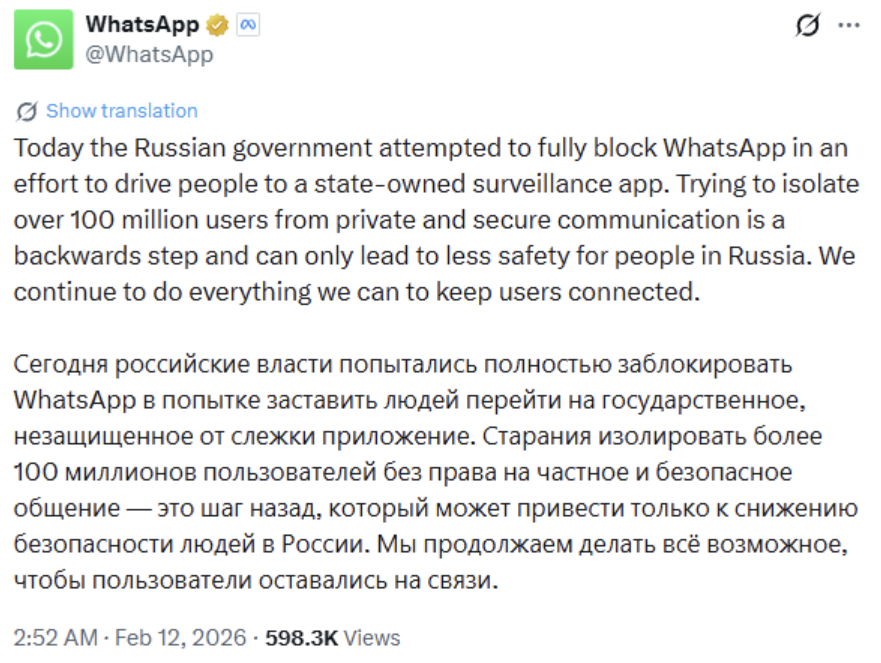
The Russian telecommunications regulator Roskomnadzor has escalated measures to block access to the WhatsApp messaging service nationwide and impose restrictions on Telegram. Authorities removed key WhatsApp domains from Russia's national DNS, effectively cutting off access unless users employ DNS workarounds or VPNs. The government justifies these moves as enforcing local laws and combating crime, while critics view them as censorship and efforts to promote a state-backed alternative messaging app named MAX. This represents a significant disruption to communications for up to 100 million Russian users.
Technical Specifications
| Attribute | Details |
|---|---|
| Incident Type | Government-mandated network censorship |
| Affected Services | WhatsApp, Telegram |
| Primary Mechanism | DNS manipulation, traffic filtering, service throttling |
| Technologies Used | Deep Packet Inspection (DPI), domain blocking, DNS exclusion |
| Impact Scope | National-level (all Russia) |
| Users Affected | Approximately 100 million Russians |
| Alternative Promoted | MAX (state-backed messaging app) |
Affected Products
- WhatsApp (all versions accessing whatsapp.com, web.whatsapp.com)
- Telegram (service throttling and degradation)
- Any device or VPN trying to access these services from Russia
- Status: Active blocking/restrictions as of February 2026
Technical Details
DNS Manipulation
- WhatsApp domains (whatsapp.com, web.whatsapp.com) were removed from Russia's internal DNS system
- Standard DNS resolution renders these domains unreachable from within Russia
- Users cannot access services without manual DNS override or VPN circumvention
- ISPs and regional DNS providers instructed to exclude WhatsApp domains from resolution
Traffic Filtering
- Deep Packet Inspection (DPI) technologies deployed to inspect encrypted traffic
- Additional filtering mechanisms block or degrade access to encrypted messaging services
- Throttling applied to known Telegram IP ranges and infrastructure
- Port-level blocking and protocol-level inspection limiting service functionality
Service Throttling
- Telegram experiences performance degradation and intermittent availability
- Connection timeouts and packet loss on Telegram traffic
- Mobile and web clients show reduced connectivity and slower message delivery
- Full blocking of Telegram less successful than WhatsApp due to distributed infrastructure
Attack Scenario
This is not a typical cyberattack by malicious actors, but a state-driven network censorship action executed through regulatory and technical means:
- Regulatory Action: Roskomnadzor issues directive to block WhatsApp and restrict Telegram based on claimed non-compliance with domestic regulations
- DNS Exclusion: National DNS infrastructure is updated to remove WhatsApp domain records, making the service unresolvable
- ISP Mandate: Internet Service Providers receive instructions to filter or block specified domains and IP ranges
- DPI Deployment: Traffic inspection systems are activated to identify and throttle encrypted messaging protocols
- User Impact: Citizens lose reliable access to primary communication channels
- Forced Migration: Users pressured to adopt state-approved alternatives like MAX for compliant communications
Impact Assessment
- Up to 100 million Russian users lose reliable WhatsApp access
- Telegram experiences severe throttling and degraded performance
- Personal communications between family and friends interrupted
- Business communications disrupted across enterprises operating in Russia
- Emergency communications channels compromised for crisis situations
- Users forced to migrate to government-approved alternatives lacking strong encryption
- Potential increased surveillance through state-controlled messaging platforms
- Loss of end-to-end encryption protections previously offered by WhatsApp/Telegram
- Increased vulnerability to monitoring and data extraction by authorities
- Chilling effect on free speech and political expression in private communications
- International businesses with Russian operations lose secure communication channels
- Remote workers unable to coordinate with distributed teams
- Compliance burden on companies to implement alternative communication solutions
- Performance degradation affecting business continuity and productivity
- Economic impact from service disruption and forced migration to alternatives
Mitigation Strategies
Alternative Communication Platforms
- Migrate to Signal, which uses different infrastructure and routing patterns
- Consider peer-to-peer or federated messaging platforms with distributed architecture
- Evaluate locally-compliant or hosted messaging solutions for business continuity
- Implement encrypted messaging through applications less subject to government restrictions
Business Contingency
- Establish backup communication channels for teams with Russian operations
- Document alternative contact methods and protocols for enterprise communications
- Implement redundant communication infrastructure across jurisdictions
- Train staff on circumvention techniques and secure alternative platforms
- Develop communication plans that don't rely on blocked services
Resources and References
News Coverage
- Russia tries to block WhatsApp, Telegram in communication blockade
- Russia fully blocks WhatsApp, talks up state-backed alternative - Reuters
- Russia fully blocks WhatsApp - Cybernews
- Russia moves to block WhatsApp as crackdown on messengers continues
- Russia is using DNS and DPI to block YouTube, Telegram and WhatsApp while pushing state-controlled MAX as alternative | TechRadar
- Russia Blocks WhatsApp Nationwide Impacting 100 Million Users - Dataconomy
- Russia blocks Meta’s WhatsApp, pushing its 100 million+ users to state backed service - BusinessToday
Last Updated: February 15, 2026