UAT-10027 Targets U.S. Education and Healthcare with Dohdoor Backdoor
Dohdoor Backdoor UAT-10027 DoH C2 Healthcare/Education
Overview
UAT-10027 is an ongoing malicious cyber campaign delivering a previously undocumented backdoor known as Dohdoor into Windows environments. Activity has been observed since at least December 2025 and is focused on U.S. education and healthcare organizations.
The campaign uses a multi-stage execution chain, trusted Windows binaries for DLL sideloading, and DNS-over-HTTPS (DoH) command-and-control over port 443 to blend malicious traffic with legitimate encrypted web traffic. Reporting indicates robust evasion methods and post-compromise delivery of in-memory payloads associated with Cobalt Strike behavior.
Technical Specifications
| Attribute | Details |
|---|---|
| Threat Cluster | UAT-10027 |
| Malware Family | Dohdoor (backdoor, previously undocumented) |
| Target Sectors | U.S. education and healthcare |
| Campaign Activity | Ongoing since at least December 2025 |
| Initial Delivery | Suspected phishing-linked PowerShell execution |
| C2 Channel | DNS-over-HTTPS (DoH) over TCP 443 |
| Evasion Techniques | DLL sideloading, in-memory payload staging, ntdll.dll syscall-monitoring unhooking |
| Likely Follow-on Payload | In-memory Cobalt Strike Beacon-like activity |
Affected Products
- Microsoft Windows endpoint environments
- Organizations running endpoints where PowerShell execution is insufficiently restricted
- Networks with limited visibility into encrypted DoH traffic
- Sectors observed: U.S. education and healthcare
- Status: Active campaign, ongoing operational risk
Technical Details
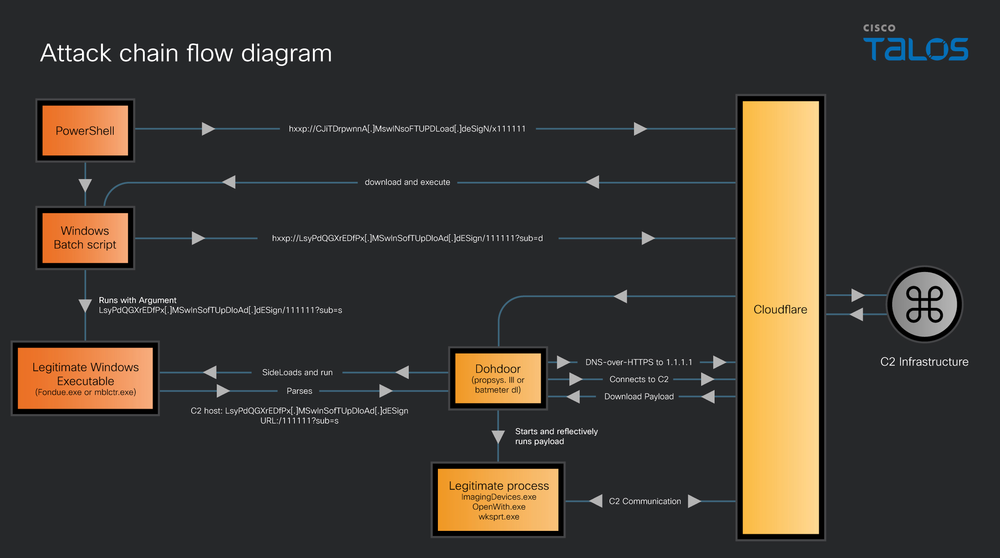
Initial Access and Staging
- Initial access is likely phishing-driven, resulting in malicious PowerShell execution.
- PowerShell downloads a batch-script loader from remote infrastructure.
- The loader creates hidden directories and stages malicious components.
DLL Sideloading Chain
- Staged DLL names include
propsys.dllandbatmeter.dllin observed reporting. - Attackers sideload via trusted Windows binaries such as
Fondue.exe,mblctr.exe, andScreenClippingHost.exe. - This tactic helps execution blend into expected process behavior.
C2 and In-Memory Operations
- Dohdoor communicates with C2 over DoH on port 443, often routed through Cloudflare infrastructure.
- Additional payloads are reflectively loaded into trusted processes.
- Follow-on in-memory activity appears consistent with Cobalt Strike Beacon deployment.
Evasion Behavior
- Malware reportedly interferes with syscall-monitoring visibility in
ntdll.dll. - Irregular domain naming and encrypted DNS transport complicate network-based detection.
- Reduced on-disk artifacts and memory-centric execution hinder traditional forensic workflows.
Attack Scenario
-
Initial Access:
- Victim receives phishing content and executes malicious PowerShell.
-
Downloader Stage:
- PowerShell retrieves a remote batch loader script.
-
Installation Stage:
- Batch loader creates hidden directories and writes malicious DLL payloads.
-
Execution and Persistence:
- Trusted Windows binaries sideload malicious DLLs and establish Dohdoor access.
-
Post-Compromise Expansion:
- Dohdoor connects via DoH C2, retrieves in-memory tooling, and enables deeper operations (e.g., beaconing, lateral movement).
Impact Assessment
- Persistent unauthorized control over compromised Windows hosts
- Potential tampering with system and security configurations
- Increased risk of malicious policy/script deployment
- Elevated risk of credential theft and sensitive data access
- Covert C2 channels reduce defender visibility into attacker communications
- Post-compromise tooling may enable broad reconnaissance and data collection
- Ongoing attacker presence may degrade endpoint reliability and security tooling efficacy
- Potential for broader operational disruption if lateral movement succeeds
- High risk of escalation to additional disruptive payloads
Mitigation Strategies
Network & Detection Controls
- Monitor encrypted DNS (DoH) activity for unusual endpoints, long-lived sessions, and abnormal client patterns
- Enforce approved DoH resolvers only, or apply controls that inspect/block unauthorized DoH usage
- Alert on suspicious use of LOLBins associated with DLL sideloading patterns
Endpoint & System Hardening
- Maintain current EDR/AV with detections for in-memory execution and DLL sideloading behavior
- Restrict and monitor PowerShell usage through policy controls and script logging
- Harden process execution and application control policies for trusted binary abuse pathways
Threat Hunting Priorities
- Hunt for hidden staging directories and suspicious DLL placement near trusted binaries
- Investigate anomalous execution chains involving
Fondue.exe,mblctr.exe, andScreenClippingHost.exe - Correlate DoH beacon-like traffic with suspicious endpoint process trees
- Apply available signatures and behavioral rules for reported Dohdoor artifacts where validated
Resources and References
Open-Source Reporting
- New Dohdoor malware Attacking Schools and Health Care Sectors in U.S. via Multi-Stage Attack Chain
- UAT-10027 Targets U.S. Education and Healthcare with Dohdoor Backdoor
- New Dohdoor malware campaign targets education and health care
- Dohdoor Backdoor Hits U.S. Schools and Hospitals Through Stealthy DoH-Based Attacks
- Dohdoor Malware Targets U.S. Schools and Healthcare with Multi-Stage Attack
- UAT-10027 Targets U.S. Education and Healthcare with Dohdoor Backdoor | by SOCFortress | Feb, 2026 | Medium
Last Updated: March 1, 2026