Poland Energy Sector IT-to-OT Intrusion via Private APN

IT-to-OT Pivot Private APN Abuse Industrial Router Exposure Siemens PLC Manipulation Critical Infrastructure
Overview
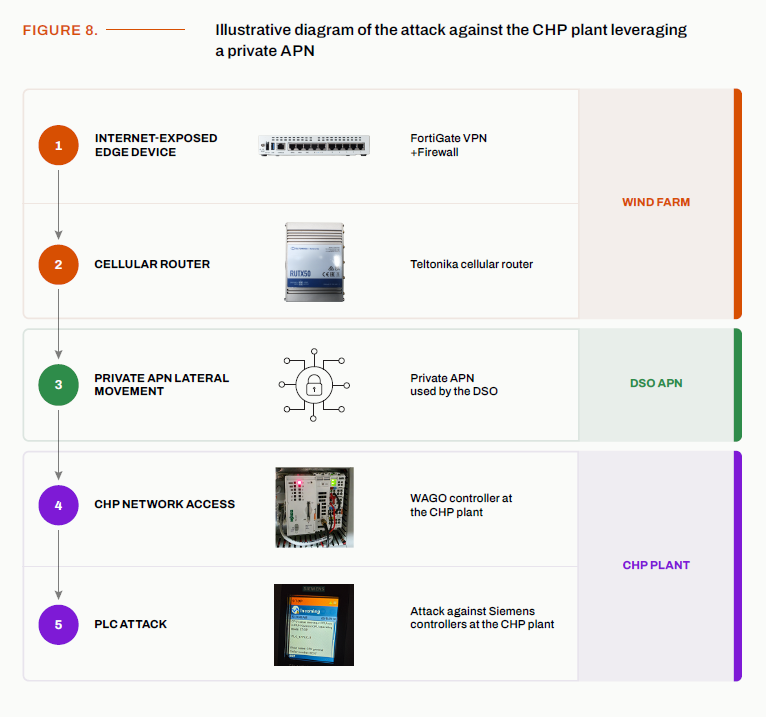
Attackers moved from an IT environment into an OT environment by abusing trusted connectivity through a private cellular APN. The intrusion demonstrates how a compromised IT system and inadequately protected industrial cellular router can provide a pathway into an isolated OT network.
Attackers ultimately reached industrial controllers and manipulated Siemens PLCs.
Technical Details
The attack chain involved compromised IT infrastructure, a Fortinet device, a Teltonika RUTX50 cellular router, and connectivity through a private APN.
Attackers used tunneling to reach OT-connected infrastructure, including a WAGO controller, and subsequently reached Siemens PLCs. The attackers performed reconnaissance and manipulated PLC operating states.
A WAGO controller was also damaged in a way that affected its ability to boot and complicated forensic analysis.
Technical Specifications
| Attribute | Details |
|---|---|
| Intrusion Type | Cross-domain IT-to-OT compromise |
| Initial Domain | Enterprise IT environment |
| Pivot Mechanism | Trusted private cellular APN path via industrial router |
| Key Infrastructure Referenced | Fortinet device, Teltonika RUTX50, WAGO controller, Siemens PLCs |
| Access Technique | Tunneling through connected infrastructure |
| OT Actions Observed | Reconnaissance and PLC state manipulation |
| Anti-Forensics/Disruption | Controller damage affecting boot and forensic visibility |
| Sector Context | Energy/industrial operations in Poland |
Affected Products
- Internet-facing or remotely accessible IT perimeter systems in the affected environment
- Teltonika RUTX50 industrial cellular router connected to private APN infrastructure
- OT-connected WAGO controller and associated automation components
- Siemens PLCs exposed through trusted cross-network connectivity
Attack Scenario
- Initial access: attackers compromise exposed or remote-access IT infrastructure.
- Discovery: an industrial cellular router is identified within reachable trust paths.
- Pivot: private APN connectivity is abused as a trusted route.
- IT-to-OT movement: attackers use this path to access OT-connected equipment.
- OT reconnaissance: industrial controllers and networked control devices are mapped.
- PLC manipulation: Siemens PLCs are moved into abnormal operating states and credentials/settings are changed.
- Anti-forensics: industrial equipment is damaged or manipulated to hinder investigation.
Impact Assessment
- Attackers gained capability to alter PLC states and operational settings
- Unauthorized credential and configuration changes can undermine control-system trust
- Manipulation of industrial devices can create unsafe or unstable process conditions
- Cross-domain access can expose sensitive IT and OT configuration data
- Reconnaissance of control environments reveals high-value operational intelligence
- Compromised routing infrastructure can leak information about segmented networks
- Communications and industrial operations were disrupted during the incident
- Damaged controller behavior reduced reliability and complicated recovery
- Although electricity generation and heat supply were not interrupted, operational risk escalated significantly
Mitigation Strategies
Network Architecture and Segmentation
- Segment IT and OT networks with strict policy enforcement.
- Do not treat private APNs as inherently trusted security boundaries.
- Place cellular gateways in controlled DMZ zones with explicit filtering.
Access Hardening
- Restrict industrial cellular-router management interfaces.
- Enforce MFA, strong credentials, and removal of default credentials.
- Restrict APN routing with firewall and ACL controls.
Monitoring and Detection
- Monitor industrial protocols and PLC state changes for unauthorized manipulation.
- Centrally collect and retain logs from IT, router, and OT control layers.
- Perform OT-specific threat hunting focused on cross-domain pivot indicators.
Resilience and Response
- Maintain offline backups of PLC configurations and critical control logic.
- Patch internet-facing VPN and firewall devices on a continuous priority basis.
- Conduct OT incident-response exercises that include IT-to-OT transition scenarios.
Resources and References
Public Reporting
Last Updated: August 12, 2026