Critical GitHub Vulnerability Exposed Millions of Repositories (CVE-2026-3854)
CVE-2026-3854 Remote Code Execution Command Injection Supply Chain Risk
Overview
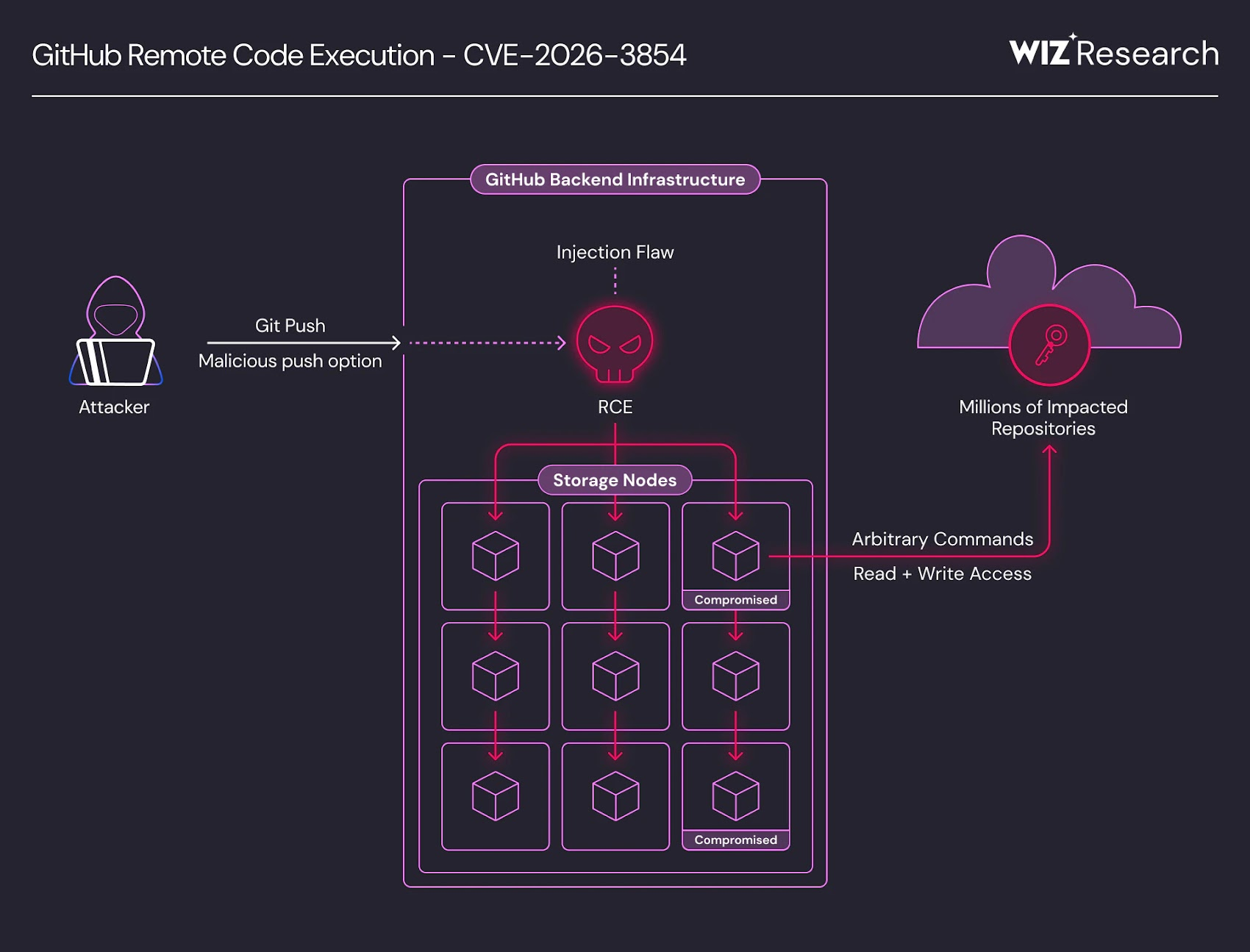
CVE-2026-3854 is a critical command injection vulnerability in GitHub's internal git push processing pipeline, carrying a CVSS score of 8.7. An attacker with ordinary push access to any repository can inject malicious push option values that bypass sanitization in inter-service headers, ultimately overriding environment variables and hook execution paths to achieve remote code execution on backend servers. On GitHub Enterprise Server (GHES), successful exploitation yields full instance compromise; on GitHub.com, Wiz Research confirmed RCE on multi-tenant shared storage nodes, exposing data from millions of repositories.
Discovered by Wiz Research in March 2026 and reported via GitHub's bug bounty program, GitHub validated and hot-patched GitHub.com in under two hours. No evidence of exploitation in the wild was found.
Technical Specifications
| Attribute | Details |
|---|---|
| CVE | CVE-2026-3854 |
| CVSS Score | 8.7 (Critical) |
| Vulnerability Type | Command Injection / Improper Neutralization of Input in Internal Service Headers |
| Affected Products | GitHub Enterprise Server (GHES) all versions before fix; GitHub.com (patched) |
| Fixed GHES Versions | 3.14.25, 3.15.20, 3.16.16, 3.17.13, 3.18.7, 3.19.4 (or later) |
| Attack Prerequisite | Authenticated push access to any repository on the target |
| Root Cause | User-supplied git push options embedded in internal service headers without sanitization |
| Wild Exploitation | None confirmed |
| Discovered By | Wiz Research (reported March 4, 2026) |
Affected Products
- GitHub Enterprise Server (GHES) — all versions prior to the fixed releases listed above
- GitHub.com / Enterprise Cloud — patched by GitHub within two hours of report; no customer action required
Attack Scenario
- Attacker authenticates to a GitHub instance with developer-level push access to any repository — no elevated privileges required
- A
git pushis crafted with malicious push options (e.g.,git push -o key=value) containing a delimiter character that splits the value into multiple injected header fields - GitHub's backend embeds the user-supplied options into an internal service header without adequate escaping, causing the injected fields to be parsed as legitimate metadata by downstream microservices
- Downstream services consume the spoofed header fields, enabling the attacker to: toggle feature flags (e.g., enable custom hook execution on GitHub.com), override environment variables (e.g., sandbox restrictions), and redirect the hook directory via path traversal to an attacker-controlled location
- When the push is processed, the backend executes hooks or scripts from the attacker-controlled path as the git service account — achieving RCE on the storage or application node
- On GHES: attacker gains full control of the instance — all repositories, secrets, configuration, and CI/CD pipelines
- On GitHub.com: attacker achieves RCE on shared multi-tenant storage nodes, with visibility into repositories hosted across that node
Impact
- Full remote code execution on GHES backend servers with developer-level push access only
- On GitHub.com: confirmed RCE on shared storage nodes despite custom hooks normally being disabled
- Access to all repositories, secrets, tokens, and CI/CD configuration on compromised instances
- Ability to tamper with pipelines, inject backdoors into codebases, and poison release artifacts
- GHES customers face complete instance compromise — source code, credentials, and build infrastructure at risk
- GitHub.com multi-tenancy means a single exploit attempt could expose data from millions of repositories
- Incident response burden for organizations auditing push logs and hook behavior around the disclosure window
- GitHub is foundational to global software supply chains; platform-level RCE translates to downstream risk for thousands of vendors and open-source projects
- Highlights internal microservice protocols as a critical attack surface when carrying user-controlled input
- Demonstrates that low-privilege access (push rights) can have catastrophic blast radius in complex platforms
Mitigations
For GitHub Enterprise Server Admins
- Patch immediately — upgrade to fixed GHES versions:
3.14.25,3.15.20,3.16.16,3.17.13,3.18.7,3.19.4, or later - Audit who holds push access to repositories on internet-facing GHES instances; apply least-privilege principles
- Review
git pushoperation logs for malformed or unusual push options, particularly between March–April 2026 - Investigate for anomalous hook behavior or unexpected processes running as the git service account
- Confine hook execution to tightly sandboxed environments (containers, seccomp, AppArmor) even after patching
For GitHub.com / Enterprise Cloud Users
- No software patch required — GitHub has already fixed and redeployed the fix
- Enforce least-privilege access controls on sensitive repositories, especially release and protected branches
- Monitor critical repositories for unexpected commits, configuration changes, or CI/CD modifications
Engineering Lessons
- Internal service protocols carrying user-controlled data must be treated as untrusted; centralize sanitization and enforce strict delimiter and encoding rules
- Apply defense-in-depth around hook execution — even if header metadata is compromised, hooks should run in tightly constrained, isolated environments
Resources
Open-Source Reporting
- CVE-2026-3854: GitHub Flaw Enables Remote Code Execution — SecurityAffairs
- Securing the Git Push Pipeline: Responding to a Critical RCE Vulnerability — GitHub Blog
- GitHub RCE Vulnerability CVE-2026-3854 — Wiz Research
- Discussion — Hacker News
- Researchers Discover Critical GitHub Vulnerability — The Hacker News
Last Updated: April 29, 2026