DirtyClone Linux Kernel Privilege Escalation Vulnerability
CVE-2026-43503
Linux Kernel Privilege Escalation
Page Cache Memory Corruption
Overview
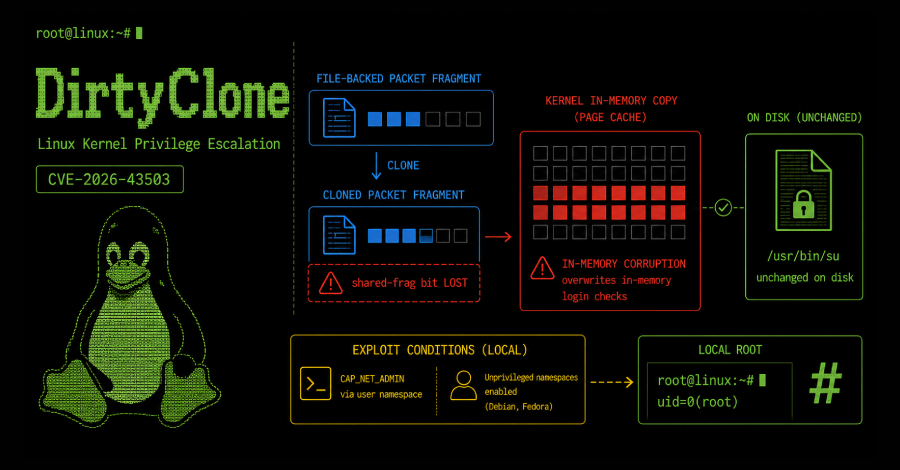
DirtyClone (CVE-2026-43503) is a newly disclosed Linux kernel vulnerability that enables local low-privileged attackers to gain root privileges by corrupting page-cache memory during packet-cloning operations. The flaw affects multiple Linux distributions and server environments, including cloud and containerized deployments.
DirtyClone abuses the kernel’s packet-cloning helpers so that memory pages backing privileged executables in the page cache become writable in practice. Attackers can thereby alter the in-memory representation of binaries like /usr/bin/sudo or /usr/bin/su without touching the filesystem, making the privilege escalation stealthy and difficult for traditional file-integrity tooling to detect.
Technical Specifications
| Attribute | Details |
|---|---|
| CVE ID | CVE-2026-43503 |
| Vulnerability Type | Local privilege escalation via page-cache corruption during packet cloning |
| CVSS Score | High/Critical (local root) |
| Attack Vector | Local |
| Authentication | Requires initial low-privileged access |
| Complexity | Medium (requires exploit code and kernel behavior understanding) |
| User Interaction | Not required once attacker has a shell |
| Affected Versions | Linux kernels with vulnerable packet-cloning helper implementations across multiple distributions and server environments |
Affected Products
- Linux server distributions running kernels that include the vulnerable packet-cloning helper code
- Cloud servers and VPS instances hosting multi-tenant workloads on affected kernels
- Container hosts where local access or container escape can lead to kernel-level exploitation
- Shared multi-user systems that provide shell access to untrusted or semi-trusted users
Attack Scenario
- An attacker gains local access to a Linux system (e.g., via SSH, compromised credentials, a web shell, or container escape).
- The attacker runs a DirtyClone exploit that targets the kernel packet-cloning helper functions.
- Exploit logic manipulates packet-cloning operations in a way that improperly clears a shared-memory protection flag, causing file-backed page-cache memory to be treated as writable.
- The exploit corrupts cached memory pages associated with privileged executables such as
/usr/bin/sudoor/usr/bin/su, without modifying the actual files on disk. - The attacker executes the temporarily modified binary and obtains a root shell.
- With root privileges, the attacker fully compromises the system and may establish persistence or move laterally.
Impact Assessment
Integrity
- Attackers can alter privileged binaries in memory, undermining assumptions about binary integrity while leaving disk content unchanged.
- Kernel-level manipulation of the page cache enables stealthy modification of execution paths for critical utilities such as
sudoandsu. - Security controls that rely solely on filesystem verification, package integrity, or immutable flags may fail to detect the compromise.
Confidentiality
- Root access permits reading any data accessible to the system administrator, including credentials, secrets, configuration files, and application data.
- Compromise of cloud or container hosts may expose other tenants’ workloads and sensitive multi-tenant information.
- Attackers can dump process memory, intercept inter-process communications, and extract secrets from privileged services.
Availability
- With root privileges, attackers can disable security tools, alter system configuration, or deploy destructive payloads such as ransomware.
- Critical services may be stopped or tampered with, leading to outages and degraded performance.
- Recovery may require patching, reboots, and comprehensive investigation of potentially impacted hosts across an enterprise fleet.
Mitigation Strategies
Immediate Actions
- Apply the latest Linux kernel security patches that address CVE-2026-43503 as soon as they are available from your distribution.
- Reboot systems after patching to ensure that vulnerable kernel code is no longer in use.
- Restrict unnecessary local user access, especially on shared or internet-facing systems.
Short-term Measures
- Harden container environments by limiting container-to-host interactions and enforcing strict isolation boundaries.
- Enable and correctly configure SELinux or AppArmor to add additional enforcement layers, limiting what even a compromised binary can do.
- Monitor for suspicious privilege escalation patterns, including unusual invocation of
sudo,su, or other privileged utilities.
Monitoring & Detection
- Use security tooling capable of detecting anomalous in-memory behavior, kernel exploitation artifacts, or unexpected transitions of unprivileged processes to root.
- Review logs and telemetry for indicators of local exploit execution, including atypical system calls or kernel messages associated with packet cloning.
- Limit exposure of shared multi-user systems and apply stricter access control, logging, and segmentation for high-risk hosts.
Resources and References
Official Documentation
Last Updated: June 28, 2026