Fake Microsoft Entra Passkey Enrollment Vishing Campaign
Vishing Microsoft Entra Passkey Abuse FIDO2/WebAuthn Account Persistence
Overview
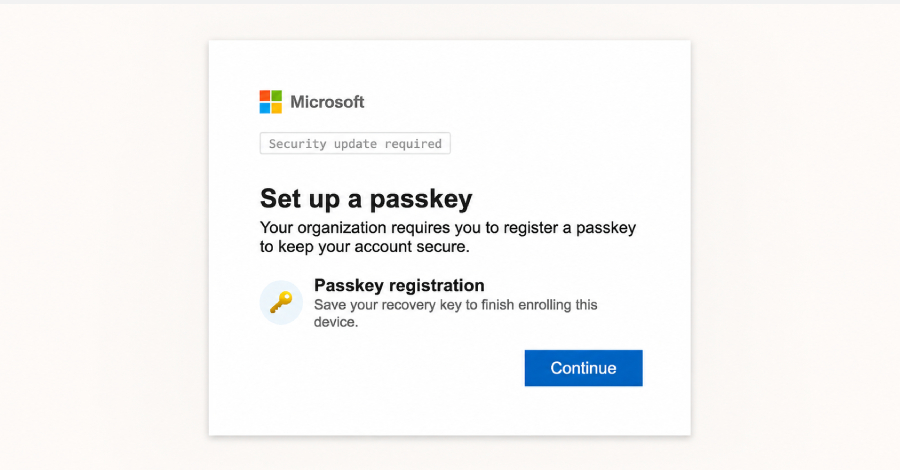
Researchers identified a sophisticated social engineering campaign in which attackers impersonate Microsoft or corporate IT support over the phone to convince victims to complete a fake Microsoft Entra passkey enrollment process. Instead of exploiting software vulnerabilities, attackers abuse legitimate Microsoft Entra authentication features to register attacker-controlled FIDO2/WebAuthn passkeys on victim accounts, enabling persistent unauthorized access.
Technical Specifications
| Attribute | Details |
|---|---|
| Threat Actor | O-UNC-066 |
| Primary Technique | Voice phishing (vishing) and real-time session relay |
| Abused Platform | Microsoft Entra / Microsoft 365 identity workflow |
| Abused Feature | Legitimate FIDO2/WebAuthn passkey enrollment |
| Initial Lure | Phone call impersonating Microsoft or internal IT support |
| Credential Capture | Fake Microsoft Entra enrollment portal phishing page |
| Persistence Method | Registration of rogue attacker-controlled passkey |
| Malware Requirement | None (identity feature abuse and social engineering) |
| Post-Reset Risk | Access can persist after password change if rogue passkey remains |
Affected Products
- Microsoft 365 tenant accounts susceptible to social engineering
- Microsoft Entra identities without strict authentication-method governance
- Organizations lacking monitoring on passkey/FIDO2 method registrations
- Privileged cloud/admin accounts where compromised authentication methods are high-impact
Attack Scenario
- An attacker calls the victim while impersonating Microsoft or corporate IT support.
- The victim is told security verification or passkey enrollment is required.
- The victim visits a fake Microsoft Entra enrollment page.
- The victim enters credentials and approves MFA prompts.
- The attacker relays the authenticated session to Microsoft in real time.
- The attacker registers an attacker-controlled FIDO2/WebAuthn passkey on the victim account.
- The attacker uses the newly registered passkey for persistent access to Microsoft 365 resources.
Impact Assessment
- Attackers can manipulate mailbox rules, files, and collaboration settings from compromised accounts
- Business processes may be altered via unauthorized account actions
- Privileged account compromise can affect tenant-wide security posture
- Unauthorized access to Outlook, Teams, SharePoint, and OneDrive data
- Theft of confidential emails, documents, and internal communications
- Increased risk of BEC and downstream fraud using trusted identities
- Account recovery and incident response can disrupt user productivity
- Defensive containment may require temporary access restrictions and auth-method resets
- Tenant operations can be degraded during broad identity remediation
Mitigation Strategies
Immediate Actions
- Train users to recognize vishing and fake IT support calls
- Communicate that Microsoft will not request passkey enrollment via unsolicited phone calls
- Review and remove unauthorized authentication methods immediately
Short-term Measures
- Implement Conditional Access and Microsoft Entra Identity Protection policies
- Require enhanced approvals or strong controls for new authentication method registration where possible
- Conduct immediate authentication-method audits for privileged and high-risk accounts
Monitoring & Detection
- Monitor Microsoft Entra audit logs for new FIDO2/passkey registrations
- Alert on unusual enrollments, new devices, and anomalous login behavior
- Correlate phone-based social engineering reports with authentication changes and session anomalies
Long-term Solutions
- Establish recurring governance reviews of registered authentication methods tenant-wide
- Harden identity lifecycle controls for admin and executive accounts
- Integrate identity-threat detections into SOC playbooks focused on account persistence abuse
Resources and References
Last Updated: July 12, 2026