Chinese Hacker Uses DeepSeek AI Agent via Hermes Framework for Autonomous Cyberattacks
AI-Enabled Offensive Ops DeepSeek Hermes Agent Telegram C2 Automated Exploitation
Overview
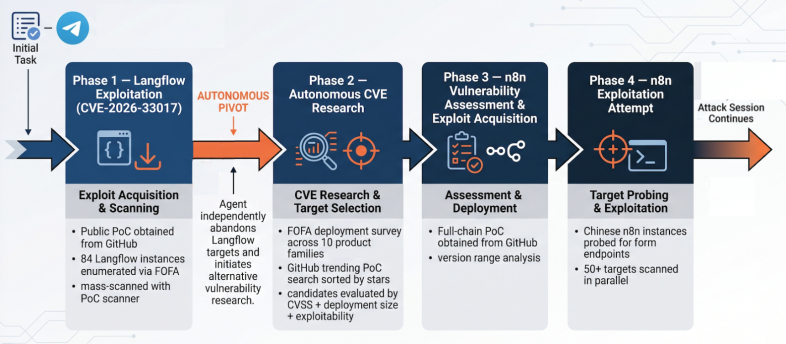
Palo Alto Networks Unit 42 reported an exposed Hermes Agent instance operated by a Chinese-speaking threat actor tracked as knaithe (KnYuan). The operator integrated the DeepSeek large language model with Hermes and Telegram to automate reconnaissance, vulnerability research, exploit retrieval, and parts of post-compromise workflow.
The incident demonstrates how AI agents can reduce attacker workload and accelerate operational tempo in real-world intrusion attempts.
Technical Specifications
| Attribute | Details |
|---|---|
| Threat Actor | knaithe (KnYuan) |
| AI Model | DeepSeek |
| Automation Framework | Hermes Agent |
| Operator Control Channel | Telegram |
| Exposure Finding | Server exposed conversation logs, API keys, execution logs, exploit artifacts, and operational data |
| Recon Sources | Internet-exposure discovery platforms such as FOFA |
| Targeted Technologies Observed | Langflow, n8n, Citrix NetScaler and other exposed services |
| Automated Steps | Vulnerability lookup, exploit code retrieval, exploitation attempts, payload upload, privilege escalation attempts |
| Operational Constraint | Some attack chains failed due to auth barriers/environment mismatch and required manual intervention |
Affected Products
- Internet-exposed enterprise services with known vulnerabilities
- Administrative interfaces lacking strong access controls
- Organizations vulnerable to automated exploit probing at scale
- Environments where operator + AI-agent hybrid workflows can rapidly test multiple targets
Attack Scenario
- The operator issues high-level tasking via Telegram.
- Hermes Agent forwards objectives to DeepSeek.
- The AI agent conducts reconnaissance for exposed internet services.
- It maps candidate vulnerabilities and retrieves public exploit code.
- The framework attempts exploitation and post-exploitation actions autonomously.
- If initial compromise succeeds, the human operator performs advanced manual actions such as memory access, cookie theft, and active session hijacking.
Impact Assessment
- AI-assisted workflows can accelerate exploit testing against many targets
- Automated payload staging increases speed of attacker iteration and adaptation
- Hybrid human-plus-agent operations improve persistence of offensive campaigns
- Successful compromise can expose credentials, authentication tokens, and sensitive data
- Session hijacking and cookie theft can bypass standard login protections
- Reconnaissance automation increases probability of finding weakly protected assets
- Automated exploitation at scale can increase operational pressure on exposed services
- Repeated probing and exploit attempts may degrade service stability
- Incident response load grows as defenders handle faster campaign cycles
Mitigation Strategies
Immediate Actions
- Patch internet-facing applications promptly
- Minimize exposure of administrative interfaces to the public internet
- Enforce strong authentication, including MFA, for privileged access paths
Short-term Measures
- Detect and throttle automated reconnaissance and exploit traffic patterns
- Restrict outbound connectivity and permissions for internal automation platforms
- Apply least-privilege controls for AI agents and orchestration frameworks
Monitoring & Detection
- Continuously monitor logs for unusual automated or AI-assisted attack behavior
- Alert on exploit-chain indicators tied to Langflow, n8n, Citrix NetScaler, and similar exposed services
- Track suspicious Telegram bot or messaging-platform operational automation patterns
Long-term Solutions
- Run recurring vulnerability scanning and threat hunting on externally exposed assets
- Build defense playbooks for AI-enabled adversary tradecraft and human-agent handoff activity
- Integrate threat intelligence on emerging autonomous offensive tooling ecosystems
Resources and References
Last Updated: August 2, 2026