Hackers Use Pixel-Large SVG Trick to Hide Credit Card Stealer

Web Skimming Magecart Payment Card Theft
Overview
A sophisticated web skimming campaign targets Magento-based e-commerce stores by injecting malicious JavaScript hidden inside a 1×1 pixel invisible SVG image embedded directly in the page HTML. The attack deploys a fake payment overlay during checkout to harvest customer credit card details in real time, encrypts the stolen data, and silently exfiltrates it to attacker-controlled servers. The pixel-sized SVG container and heavy obfuscation make the payload nearly invisible to visual inspection and difficult to detect with traditional security scanning tools, enabling persistent card theft across compromised storefronts.
Technical Specifications
| Attribute | Details |
|---|---|
| Attack Type | Web Skimming / Magecart-Style Card Theft |
| Target Platform | Magento-Based Online Stores |
| Initial Access | Magento PolyShell RCE Vulnerability (Suspected) |
| Payload Container | Inline <svg> Element (1×1 Pixel) |
| Execution Trigger | SVG onload Event Handler |
| Obfuscation | Base64 Encoding (atob()), setTimeout Delayed Execution |
| Overlay Attack | Fake Checkout Form Injected Over Legitimate Payment Page |
| Card Validation | Luhn Algorithm |
| Data Encryption | XOR + Base64 |
| Exfiltration Endpoint | Attacker-Controlled Server (e.g., /fb_metrics.php) |
| Persistence | Browser localStorage Key (_mgx_cv) |
Affected Products
- Magento (Adobe Commerce): Unpatched Magento installations vulnerable to PolyShell or similar RCE vulnerabilities used for initial code injection
- Magento Checkout Pages: The skimmer specifically targets checkout flows where payment card entry forms are rendered
- Customer Browsers: Any browser rendering the compromised checkout page executes the injected SVG payload and fake overlay
- End Users: Shoppers entering payment card details (card number, CVV, expiry, billing address) on compromised storefronts
Technical Details
- Initial Compromise: Attacker likely exploits a known Magento remote code execution vulnerability (e.g., PolyShell) to gain administrative or file-write access to the target storefront, enabling injection of malicious code into theme files or database-stored page templates
- SVG Steganography: Malicious JavaScript is embedded inside an inline
<svg width="1" height="1">HTML element rendered at 1×1 pixel — visually invisible to users and easily overlooked during manual code review - Execution via
onload: The SVG'sonloadevent attribute fires the obfuscated JavaScript automatically when the page loads, requiring no user interaction beyond visiting the checkout page - Obfuscation Layers: Payload uses
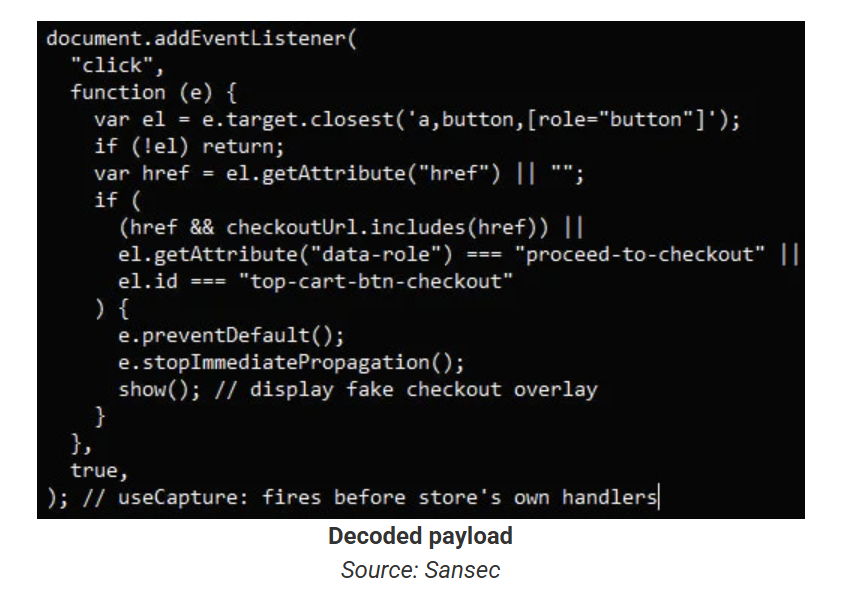
atob()Base64 decoding to reconstruct the malicious script at runtime;setTimeoutdelays execution to evade security tools that scan only at page-load time - Overlay Attack: Once executed, the script injects a convincing fake payment form overlay on top of the legitimate Magento checkout UI; the overlay is visually identical to a real payment form, capturing card details before they reach the actual payment processor
- Card Validation: Stolen card numbers are validated client-side using the Luhn algorithm before transmission, filtering out typos and ensuring only valid card data is exfiltrated
- Data Encryption: Captured card data is encrypted using XOR combined with Base64 encoding prior to transmission, obfuscating the payload in network traffic and defeating simple content-based detection
- Exfiltration: Encrypted data is sent via HTTP POST to an attacker-controlled endpoint (e.g.,
/fb_metrics.php) disguised as analytics traffic, blending with legitimate third-party tracking requests - Persistence via LocalStorage: The skimmer writes a key (
_mgx_cv) to the browser'slocalStorageto track previously compromised sessions, avoid duplicate submissions, and potentially maintain state across browsing sessions
Attack Scenario
- Initial Access: Attacker exploits a Magento RCE vulnerability (e.g., PolyShell) or brute-forces admin credentials to gain write access to the storefront's theme files, CMS blocks, or database content
- Payload Injection: Malicious inline
<svg>element containing Base64-obfuscated JavaScript is injected into the checkout page template or a globally loaded script file - Victim Visits Checkout: Shopper navigates to the checkout page to complete a purchase; the SVG element renders invisibly (1×1 pixel) while its
onloadhandler silently fires - Delayed Script Execution:
setTimeoutdelays execution of the decoded JavaScript payload, bypassing automated scanners that evaluate pages only at initial load time - Fake Overlay Deployment: The script injects a pixel-perfect fake payment form overlay over the legitimate checkout UI; the victim sees what appears to be a normal payment card entry form
- Card Data Capture: Victim enters credit card number, CVV, expiry date, and billing details into the fake overlay; the skimmer captures all input in real time
- Validation & Encryption: Captured card number is validated using the Luhn algorithm; all collected data is encrypted with XOR + Base64 encoding
- Silent Exfiltration: Encrypted card data is POST-ed to the attacker's server endpoint (disguised as analytics/metrics traffic);
localStoragekey is set to mark the session; victim is redirected to a normal order confirmation page, completely unaware of the theft
Impact Assessment
- Payment Card Theft: Credit card numbers, CVV codes, expiry dates, and billing addresses are silently stolen during checkout
- Financial Fraud: Stolen card data is used for unauthorized purchases, sold on dark web marketplaces, or used in carding operations
- Delayed Discovery: Victims typically discover the compromise only when unauthorized charges appear — often days or weeks after the skimming event
- Identity Risk: Billing address data combined with card details provides sufficient information for identity theft and account takeover attempts
- Reputational Damage: Customer-facing card theft incidents generate negative reviews, media coverage, and loss of consumer trust that persists long after remediation
- Chargebacks & Financial Loss: Fraudulent transactions result in payment processor chargebacks, fees, and potential loss of merchant processing accounts
- Regulatory & Legal Consequences: PCI DSS non-compliance resulting from a card data breach carries significant fines, mandatory forensic audits, and potential liability for consumer losses
- Prolonged Silent Infection: The pixel-SVG technique enables the skimmer to persist undetected across many transactions before discovery, maximizing stolen card volume
- Visual Invisibility: 1×1 pixel SVG is imperceptible to manual page inspection and overlooked in visual code reviews
- Obfuscation Resistance: Multi-layer Base64 + delayed execution evades automated scanners operating at page-load time
- Traffic Camouflage: Exfiltration disguised as analytics POST requests blends with legitimate third-party traffic in proxy and SIEM logs
- LocalStorage Persistence: Browser-side state tracking complicates forensic scope determination; victims may be tracked across multiple sessions
Mitigation Strategies
For Magento Store Operators
- Patch Magento Immediately: Apply all available Magento / Adobe Commerce security patches; specifically address PolyShell and any known RCE vulnerabilities; upgrade to the latest supported version
- Implement Content Security Policy (CSP): Deploy strict CSP headers to whitelist approved script sources; block inline
<script>and SVG event handlers viascript-srcanddefault-srcdirectives; useconnect-srcto restrict exfiltration to approved domains only - File Integrity Monitoring: Deploy file integrity monitoring on all Magento theme files, JavaScript includes, and CMS blocks; alert on any unauthorized modifications to checkout-related templates
- Web Application Firewall (WAF): Configure WAF rules to detect and block injection of SVG/script content into page responses; add rules for known skimmer exfiltration patterns (e.g.,
/fb_metrics.php) - Monitor for Suspicious HTML: Regularly audit page HTML for inline
<svg>elements with event handlers, unexpected Base64-encoded script blocks, and unauthorized third-party script inclusions - Block Malicious IPs/Domains: Subscribe to Magecart and web skimming threat intelligence feeds; block known attacker-controlled exfiltration domains and IPs at the WAF and DNS level
- Subresource Integrity (SRI): Apply SRI hashes to all externally loaded JavaScript files to detect unauthorized modifications by CDN or supply chain tampering
- Restrict Admin Access: Enable two-factor authentication on all Magento admin accounts; restrict admin panel access to known IP addresses; review and remove unused admin accounts
For End Users
- Use Virtual or Masked Cards: Pay with single-use virtual card numbers or digital wallets (Apple Pay, Google Pay) that do not expose real card details to the merchant
- Monitor Bank Transactions: Review card statements and banking alerts regularly; report unrecognized charges immediately to the card issuer
- Be Alert to Unusual Checkout Behavior: Treat unexpected redirects, double payment form prompts, or pages that load slowly during checkout as potential indicators of compromise; use a different payment method if in doubt
Resources
Open-Source Reporting
Last Updated: April 9, 2026