Cisco Unified CM Critical SSRF Vulnerability - CVE-2026-20230
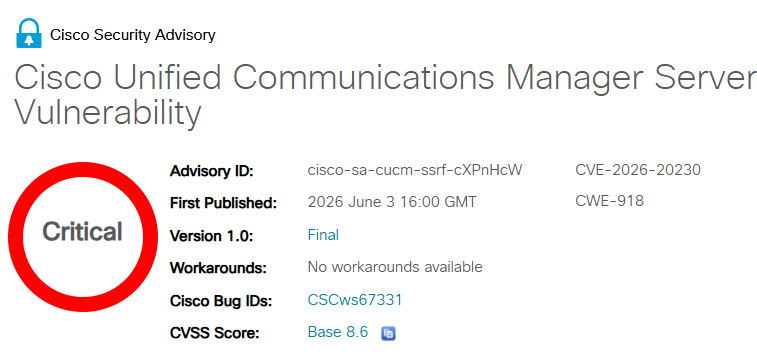
CVE-2026-20230 SSRF Cisco Unified CM Root Privilege Escalation
Overview
Cisco disclosed a critical Server-Side Request Forgery (SSRF) vulnerability affecting Cisco Unified Communications Manager (Unified CM) and Unified CM Session Management Edition (SME). Public proof-of-concept (PoC) exploit code is available, increasing the likelihood of exploitation attempts. Successful exploitation may allow attackers to gain root-level access to affected systems.
Technical Specifications
| Attribute | Details |
|---|---|
| CVE ID | CVE-2026-20230 |
| Vulnerability Type | Server-Side Request Forgery (SSRF) leading to arbitrary file write and privilege escalation |
| Affected Products | Cisco Unified Communications Manager (Unified CM), Unified CM Session Management Edition (SME) |
| Affected Component | WebDialer service |
| Root Cause | Improper validation of HTTP requests in WebDialer |
| Attack Prerequisite | WebDialer service must be enabled |
| Authentication Required | None (unauthenticated exploitation possible) |
| Exploitation Status | Public PoC exploit code available |
| Potential Outcome | Arbitrary file writes to OS and escalation to root-level access |
| Fixed Versions | Unified CM/SME 14SU6 or later |
Affected Products
- Cisco Unified Communications Manager (Unified CM) instances with WebDialer enabled
- Cisco Unified CM Session Management Edition (SME) instances with WebDialer enabled
- Enterprise voice infrastructure exposing Unified CM interfaces to untrusted networks
Attack Scenario
- The attacker discovers an exposed Cisco Unified CM server.
- The attacker confirms the WebDialer service is enabled.
- Crafted malicious HTTP requests are sent to the vulnerable service.
- The SSRF vulnerability is exploited to trigger unauthorized server-side actions.
- Malicious files are written to the underlying operating system.
- The attacker escalates privileges to obtain root access.
- The compromised server is used for persistence, lateral movement, or abuse of enterprise voice infrastructure.
Impact
- Full compromise of Unified CM server integrity through unauthorized file writes
- Root-level modification of operating system files and service configurations
- Potential tampering with enterprise communications routing and voice management functions
- Increased risk of exposure of sensitive communications infrastructure and metadata
- Potential unauthorized access to internal voice system configurations and connected services
- Expanded opportunities for espionage against enterprise communications environments
- Disruption of enterprise VoIP and communications services
- Risk of service degradation or outage from malicious system-level changes
- Potential lateral movement impact on broader network operations
Mitigations
Immediate Actions
- Apply Cisco security patches immediately
- Upgrade Unified CM/SME to versions containing fixes (14SU6 or later)
- Disable WebDialer service where not required
Short-term Measures
- Restrict external access to Unified CM management interfaces
- Enforce network access controls for voice management services
- Validate exposure of Unified CM instances and remove internet-facing access paths
Monitoring & Detection
- Monitor logs for suspicious HTTP requests targeting WebDialer
- Alert on unauthorized file creation or modification on Unified CM systems
- Conduct vulnerability scanning for exposed Unified CM instances
Resources
Official and Open-Source Reporting
- Cisco Warns of Available PoC for Critical Unified CM Vulnerability - SecurityWeek
- Cisco warns of critical Unified CM flaw with PoC exploit code
- Cisco Patches CVE-2026-20230 in Unified CM as Exploit Code Goes Public
- Cisco Unified Communications Manager Server-Side Request Forgery Vulnerability
- Cisco warns of critical Unified CM flaw with PoC exploit code - Live Threat Intelligence - Threat Radar | OffSeq.com
Last Updated: June 7, 2026