Russian Espionage Group Exploited Zimbra Zero-Day (CVE-2025-66376) to Steal Emails
CVE-2025-66376 Zimbra Zero-Day Stored XSS Email Theft State-Sponsored Espionage
Overview
A Russian state-sponsored espionage group tracked as Laundry Bear (also known as Void Blizzard by Microsoft) exploited a zero-day flaw in Zimbra Collaboration Suite Classic Web UI to steal sensitive communications and account recovery data.
The vulnerability allows malicious JavaScript to run when a victim opens a crafted HTML email in an authenticated Zimbra web session, enabling mailbox and directory intelligence collection without traditional credential phishing.
Technical Specifications
| Attribute | Details |
|---|---|
| Vulnerability | CVE-2025-66376 |
| Type | Stored Cross-Site Scripting (Stored XSS) |
| Affected Component | Zimbra Collaboration Suite Classic Web UI |
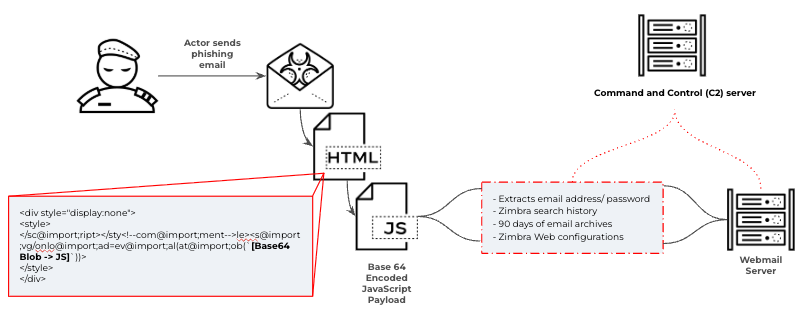
| Attack Vector | Crafted HTML email with CSS/JavaScript payload |
| Trigger Model | "Half-click" execution when victim opens email in Classic Web UI |
| Privilege Required (attacker) | None in victim environment before delivery |
| Execution Context | Victim's authenticated browser session |
| Observed Objective | Espionage-focused mailbox and identity data theft |
Observed Post-Execution Capabilities
- Access mailbox content through authenticated Zimbra APIs
- Collect approximately 90 days of email data (reported)
- Steal contacts and address books
- Extract browser-saved authentication artifacts/credentials
- Capture 2FA recovery codes
- Enumerate organizational directory data
- Exfiltrate collected data to attacker-controlled infrastructure
Affected Products
- Zimbra Collaboration Suite deployments using vulnerable Classic Web UI builds
- Organizations with users accessing untrusted HTML email content in Classic UI context
- High-value sectors handling diplomatic, government, or strategic communications via Zimbra
Attack Scenario
- Attacker crafts and delivers a malicious HTML email containing stored XSS payload elements.
- Target user opens the message in Zimbra Classic Web UI.
- Injected JavaScript executes inside the victim's active authenticated session.
- Script abuses legitimate Zimbra APIs to pull mailbox, contact, and identity-recovery data.
- Data is silently exfiltrated to attacker-controlled endpoints for ongoing intelligence collection.
Impact Assessment
- Session-context script execution can abuse trusted application behavior
- Mailbox and account settings may be altered depending on available session permissions
- Compromised accounts can become persistence points for further espionage operations
- Unauthorized access to confidential email communications and contact networks
- Exposure of authentication and account recovery material (including 2FA recovery codes)
- Strategic intelligence leakage risk for government, diplomatic, and enterprise targets
- Incident containment may require session invalidation, credential resets, and temporary service controls
- Large-scale mailbox review and forensic response can impact normal communication workflows
- Follow-on compromise risk can disrupt operations if remediation is delayed
Mitigation Strategies
Immediate Actions
- Apply Zimbra security updates addressing CVE-2025-66376 immediately
- Upgrade to supported Zimbra versions and reduce dependence on Classic Web UI where feasible
- Rotate credentials and regenerate recovery codes for potentially exposed users
Short-term Measures
- Restrict or sanitize active HTML content in inbound email where operationally possible
- Invalidate active sessions and review suspicious mailbox/API activity post-patch
- Enforce MFA and verify account recovery workflows are tightly controlled
Monitoring & Detection
- Monitor Zimbra API usage for abnormal bulk mailbox/contact access patterns
- Review authentication/session logs for unusual browser sessions and geographic anomalies
- Alert on suspicious outbound exfiltration patterns from mail access workflows
Long-term Solutions
- Implement stronger content sanitization and script-execution controls in webmail interfaces
- Segment and harden high-value communication systems handling sensitive data
- Exercise incident response playbooks for webmail session abuse and account recovery compromise
Resources and References
Public Reporting
Last Updated: July 26, 2026