PhantomEnigma Malware Campaign Leveraging Hijacked Brazilian Government Websites
Supply-Chain Style Delivery Government Site Hijack Node.js Backdoor Trojanized Installers C2-Controlled Modules
Overview
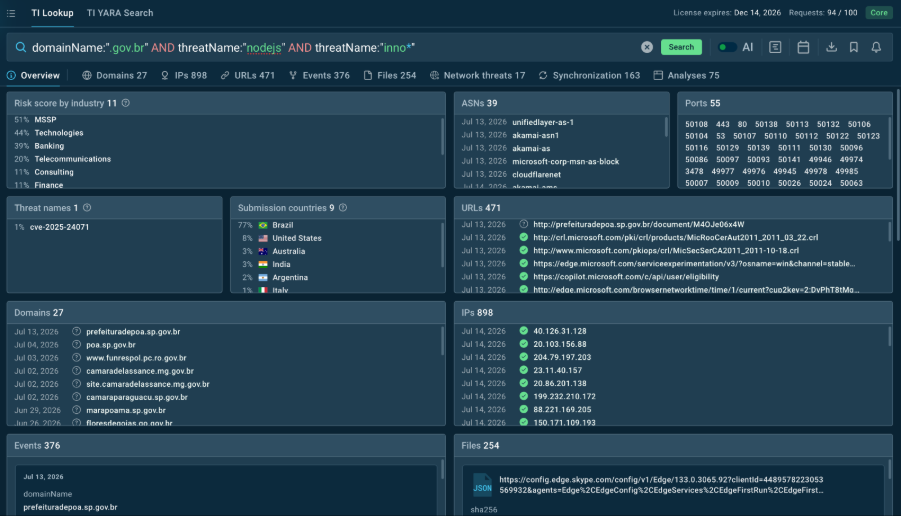
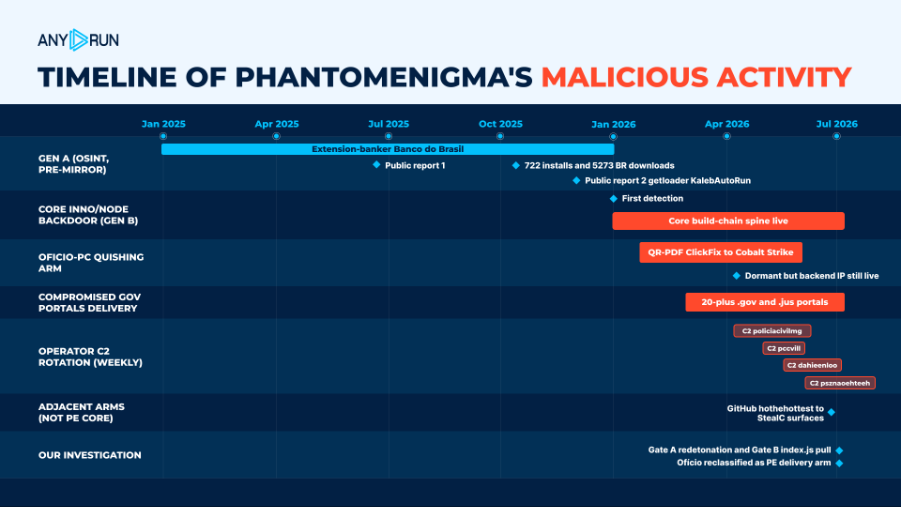
Security researchers at ANY.RUN uncovered a malware campaign named PhantomEnigma in which attackers compromised more than 20 Brazilian government websites. Adversaries altered legitimate download pages to distribute trojanized installers that deploy a Node.js-based backdoor.
By abusing trusted government domains as distribution points, the campaign increases victim trust and can evade some reputation-based security controls.
Technical Specifications
| Attribute | Details |
|---|---|
| Campaign Name | PhantomEnigma |
| Compromised Infrastructure | 20+ Brazilian government websites |
| Initial Delivery | Modified/replaced legitimate software installers on official download pages |
| Malware Type | Modular Node.js backdoor |
| Primary Capability | Remote JavaScript command execution |
| Host Profiling | Collects hostname, username, OS details, installed software |
| Persistence | Establishes startup persistence to survive reboot cycles |
| Network Behavior | Encrypted communications with attacker-controlled C2 |
| Payload Expansion | On-demand retrieval/execution of additional malware modules |
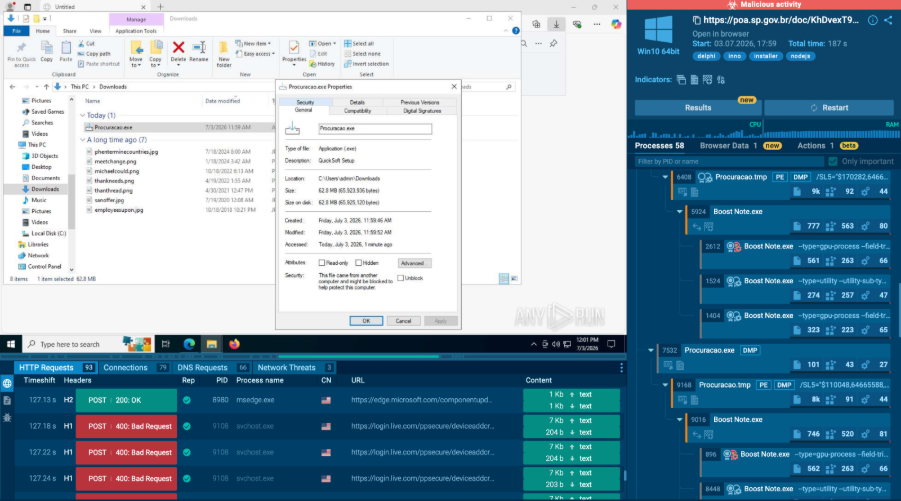
| Observed Trojanized Software | Includes modified installers for legitimate apps such as Boostnote |
Affected Products
- Users downloading software from compromised Brazilian government websites
- Organizations that rely on trust/reputation of government domains for software safety
- Endpoints vulnerable to unauthorized script and installer execution
- Enterprises where infected user endpoints can become internal pivot points
Attack Scenario
- Attackers compromise legitimate Brazilian government websites.
- Software download pages are modified to host trojanized installers.
- Victims download files believing they are safe because they originate from official domains.
- During installation, the embedded Node.js backdoor is deployed.
- Malware establishes persistence and fingerprints the host.
- Infected systems beacon to attacker-controlled C2 infrastructure.
- Operators execute remote commands, steal data, and deploy additional payloads such as stealers or banking trojans.
Impact Assessment
- Trojanized software execution undermines software trust chains
- Attackers can modify endpoint behavior and deliver follow-on payloads
- Persistent backdoors allow repeated tampering after initial compromise
- System reconnaissance can expose environment details and user context
- Credential theft and data exfiltration risks increase after C2 establishment
- Trusted-domain delivery improves success rate of sensitive data theft operations
- Additional payload deployment can degrade endpoint stability or uptime
- Incident response and containment can disrupt affected organizations
- Compromised endpoints may be weaponized for broader attacks, impacting business operations
Mitigation Strategies
Immediate Actions
- Verify installer authenticity through digital signatures and trusted checksums before deployment
- Block known malicious URLs, C2 indicators, and compromised distribution artifacts
- Isolate suspected hosts and remove unauthorized persistence mechanisms
Short-term Measures
- Restrict execution of unauthorized scripts and binaries through application control policies
- Monitor for suspicious Node.js activity in non-development endpoint contexts
- Harden browser/download controls for software acquisition from external sources
Monitoring & Detection
- Deploy EDR with behavioral analytics for script-based backdoors and child-process anomalies
Resources and References
Public Reporting
Last Updated: July 19, 2026