RoguePlanet – Microsoft Defender Zero-Day Local Privilege Escalation
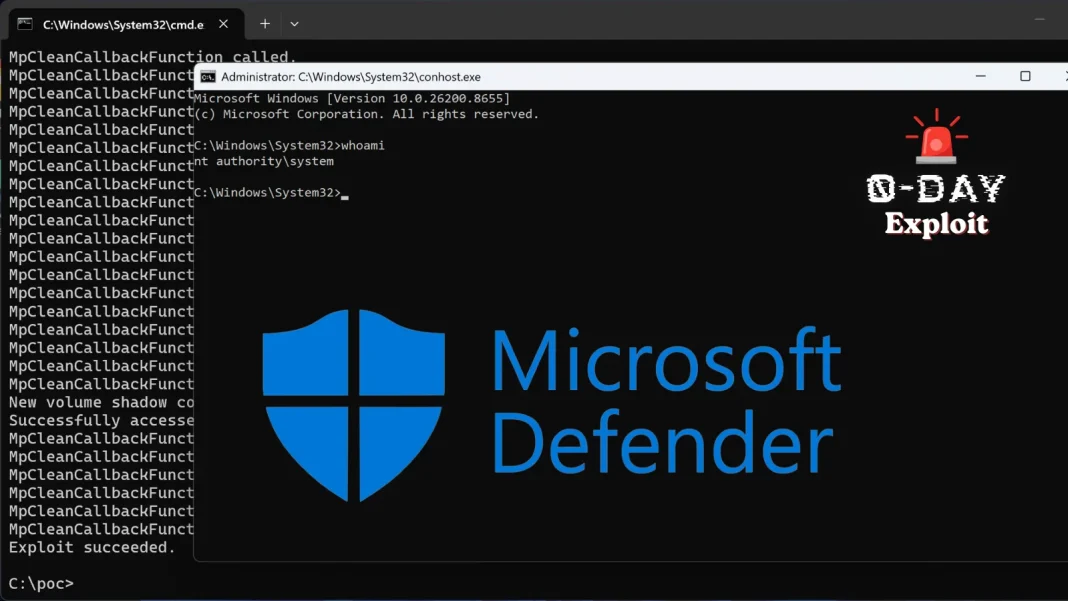
Zero-Day Privilege Escalation Race Condition Microsoft Defender
Overview
RoguePlanet is a zero-day vulnerability in Microsoft Defender that allows a low-privileged local attacker to escalate privileges to SYSTEM level. The flaw exists in Defender's internal remediation and file-handling workflow, where a race condition (TOCTOU – Time-of-Check to Time-of-Use) can be exploited to manipulate file operations during privileged execution, enabling a SYSTEM shell. No remote exploitation has been confirmed; local access is required.
Technical Specifications
| Attribute | Details |
|---|---|
| Vulnerability Name | RoguePlanet |
| Vulnerability Type | Race Condition — TOCTOU (Time-of-Check to Time-of-Use) |
| Affected Component | Microsoft Defender remediation engine |
| Attack Vector | Local |
| Authentication | Low-privileged local user |
| Complexity | High (race condition timing required) |
| User Interaction | Not Required (after initial access) |
| Remote Exploitation | Not confirmed |
| Exploitation Technique | Symbolic links / NTFS junction abuse during privileged file operations |
| Result | Privileged file overwrite or execution; SYSTEM shell spawning |
| Patch Status | Patch pending via MSRC advisory |
Affected Products
- Microsoft Defender on Windows (all versions where remediation engine performs privileged file operations)
- Enterprise environments relying primarily on Defender as the sole endpoint security solution
Attack Scenario
- Attacker gains local access via phishing, malware delivery, or user-assisted execution.
- Attacker runs the RoguePlanet exploit to trigger a race condition in the Defender remediation engine.
- Attacker manipulates filesystem state during Defender's privileged file operation using symbolic links or NTFS junctions.
- Defender performs a privileged operation on an attacker-controlled file path.
- A SYSTEM-level shell is spawned for the attacker.
- Attacker disables security tools, dumps credentials, and escalates the attack through lateral movement and persistence.
Impact
- Full SYSTEM-level compromise of the Windows host
- Disablement or bypass of Microsoft Defender and other security controls
- Potential ransomware deployment following privilege escalation
- Credential dumping via LSASS access at SYSTEM level
- Access to all files and secrets on the compromised host
- High risk for enterprise environments relying on Defender for endpoint protection
- Lateral movement across enterprise networks following SYSTEM compromise
- Disruption of endpoint security tooling through Defender disablement
- Operational impact from persistence mechanisms installed at SYSTEM level
Mitigations
Immediate Actions
- Apply Microsoft security updates as soon as patches are released via MSRC advisories
- Restrict local user access and minimize administrative privileges on endpoints
- Enable Defender Attack Surface Reduction (ASR) rules to limit exploitation surface
Short-term Measures
- Deploy layered EDR solutions rather than relying on Defender alone
- Restrict execution of unknown or unsigned binaries
- Audit local user accounts and remove unnecessary privileges
Monitoring & Detection
- Monitor for symbolic link and NTFS junction abuse on endpoints
- Alert on abnormal Defender remediation engine activity or unexpected file operations
- Monitor for SYSTEM process spawning from unusual parent processes
- Detect anomalous LSASS access attempts following local privilege escalation patterns
Long-term Solutions
- Enforce least-privilege access policies across enterprise endpoints
- Implement privileged access workstations (PAWs) for sensitive operations
- Maintain a defense-in-depth strategy with multiple endpoint security layers
Resources
Open-Source Reporting
Last Updated: June 10, 2026