MuddyWater MuddyViper Backdoor Campaign

APT Campaign
Iran-Aligned Threat Actor
Espionage
Overview
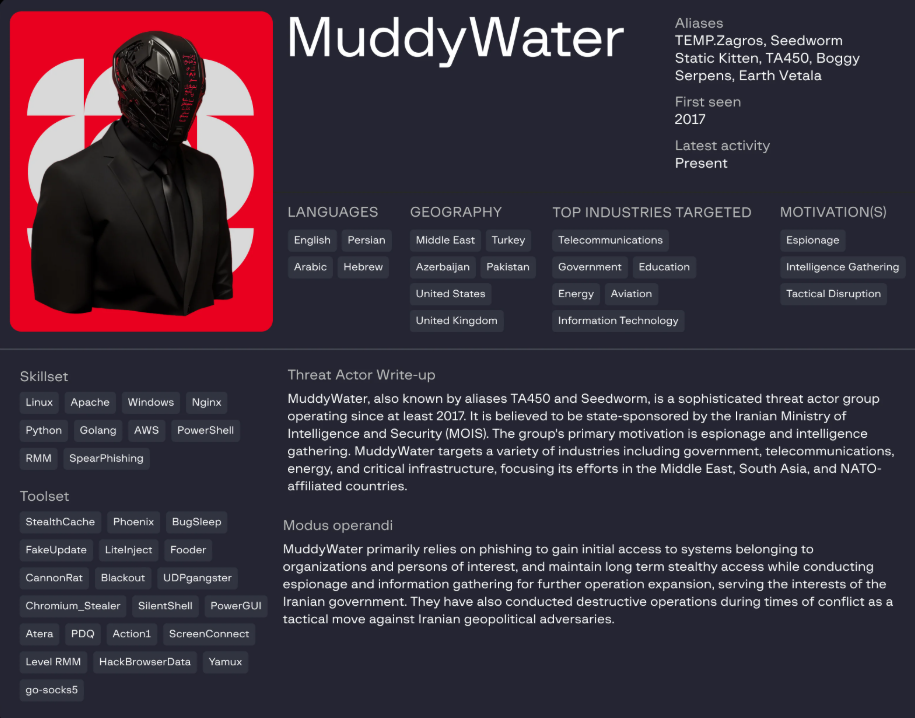
MuddyWater — a long-standing Iran-aligned APT — launched a targeted espionage campaign against Israeli organizations and at least one Egyptian organization. The group deployed a new custom malware toolkit centered around MuddyViper, a backdoor previously undocumented publicly. The campaign combined spear-phishing, social engineering, and advanced loader/backdoor techniques to stealthily penetrate and persist within victim networks.
Instead of the group's older, noisier methods, this operation exhibited technical sophistication — memory-only loaders, covert credential and browser-data theft, reverse tunneling for data exfiltration, and evasion techniques. This represents a notable escalation of capability and tradecraft for MuddyWater.
Technical Specifications
| Attribute | Details |
|---|---|
| Threat Actor | MuddyWater (Iran-aligned APT) |
| Target Region | Israel, Egypt |
| Target Sectors | Critical infrastructure (utilities, manufacturing, government, transportation) |
| Primary Malware | MuddyViper (backdoor), Fooder (loader) |
| Initial Access | Spear-phishing with RMM tool installers |
| Delivery Platform | OneHub, Egnyte, Mega (free file-sharing platforms) |
| RMM Tools Used | Atera, PDQ, SimpleHelp |
| Associated Group | Lyceum / OilRig (secondary access broker) |
Technical Details
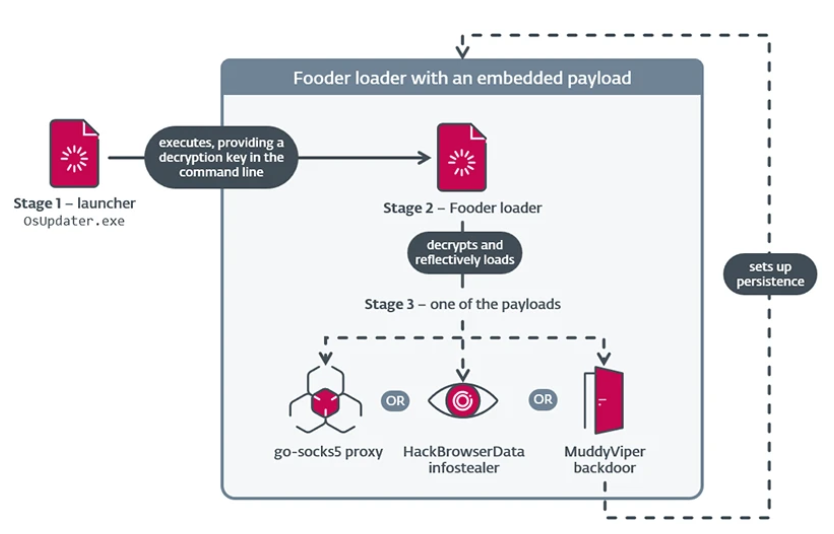
Fooder Loader
- Custom 64-bit loader
- Decrypts and reflectively loads MuddyViper directly into memory (no disk drop)
- Helps evade disk-based detection mechanisms
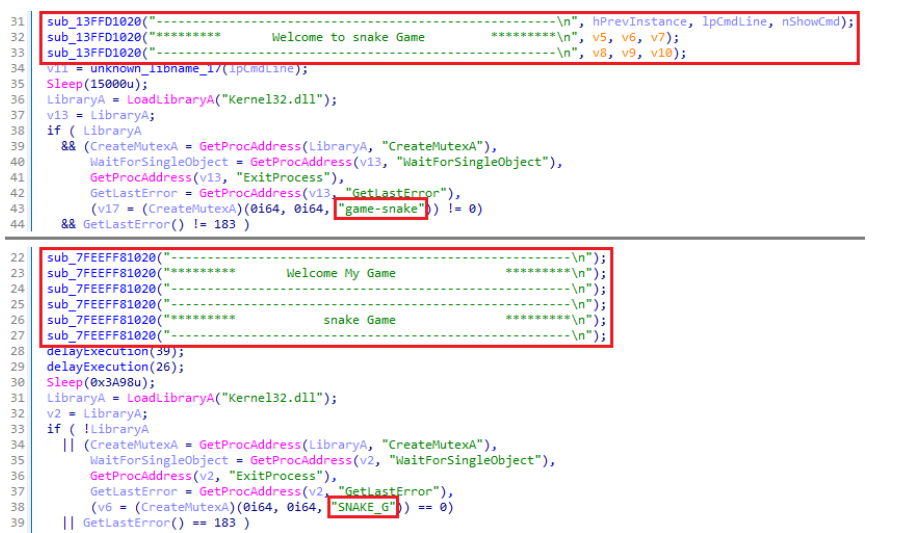
- Several variants masquerade as the classic "Snake" video game
- Uses custom delay to avoid sandbox/automated analysis:
- Mimics the game's logic
- Repeated "Sleep" API calls
MuddyViper Backdoor
- C/C++-based backdoor
- Capabilities include:
- Collecting system information
- Executing commands/files
- Transferring files
- Exfiltrating Windows login credentials and browser data
- Reverse-tunnel (e.g., via socks5) for remote access/tunneling
- Persistence mechanisms
Additional Tools
- CE-Notes: Targets Chromium-based browsers
- LP-Notes: For credential staging/verification
- Blub: Steals login data from multiple browsers
- Additional utility tools for reverse tunnels
Technical Sophistication
- Uses Windows Cryptography API Next Generation (CNG) for encryption/decryption
- Shows unusual sophistication and possibly indicates improved development resources
- Memory-only execution to evade detection
Initial Access Vector
- Typically spear-phishing emails
- Often containing PDF attachments that link to installers for Remote-Monitoring/Management (RMM) tools
- RMM installers hosted on free file-sharing platforms (OneHub, Egnyte, Mega)
- Once RMM tools installed, the chain would ultimately deploy Fooder + MuddyViper
Access Broker Activity
In some cases, MuddyWater acted as an initial access broker: after initial compromise, credentials or access were handed over to another Iran-aligned group, Lyceum (a subgroup of OilRig), which carried out further operations within the victim environment.
Attack Scenario
-
Spear-Phishing: Recipient receives PDF or link to RMM installer hosted on free file-sharing site.
-
RMM Installation: Victim downloads & installs the RMM tool (e.g., Atera, PDQ, SimpleHelp, etc.).
-
Loader Deployment: Using the RMM foothold (or via separate loader), attackers drop the Fooder loader.
-
Memory-Only Execution: Fooder runs (disguised as Snake game), reflectively loads MuddyViper into memory — no disk drop — to evade detection.
-
Persistence & C2: MuddyViper establishes persistence, connects to C2 infrastructure, and provides remote control capabilities.
-
Credential Theft: Attackers deploy credential / browser-data stealers (CE-Notes, LP-Notes, Blub).
-
Data Exfiltration: Set up reverse tunnels or socks5 proxies to exfiltrate data.
-
Access Handoff (in some cases): After initial compromise, credentials or access are passed to Lyceum / OilRig for further exploitation (e.g., in manufacturing-sector targets).
This chain demonstrates a move towards stealth, persistence, and multi-staged, modular attacks.
Impact Assessment
- Full remote control of infected systems
- Ability to execute arbitrary commands
- Potentially pivot across networks
- Escalate privileges
- Exfiltrate sensitive data
- Theft of Windows login credentials + browser data (passwords, stored credentials)
- Enabling further lateral movement, credential reuse, or access to other systems/accounts
- Data exfiltration back to attacker-controlled infrastructure
- Via reverse tunnels / socks proxies
- Could compromise sensitive corporate/government data, intellectual property, or personal data
- Memory-only loading and stealth techniques make detection hard
- Increasing the risk of long-term compromise and sustained espionage
- For organizations in affected sectors (especially critical infrastructure: utilities, manufacturing, government, transportation)
- Compromise could threaten operational integrity, confidentiality, and business continuity
- Risk to national security and sensitive infrastructure is substantial
Mitigations
📧 Email Security & Phishing Defenses
- Strengthen email security & phishing defenses
- Tighten filtering, block or closely monitor attachments (PDFs linking to RMM installers)
- Enforce macro-blocking or sandboxing
🔐 Authentication
- Require multi-factor authentication (MFA) across all accounts
- Especially for RMM tools, remote access, high-privilege accounts
🛡️ Endpoint & Network Detection
- Use behavior-based endpoint detection and response (EDR) and network detection & response (NDR)
- Since memory-only loaders + in-memory backdoors evade traditional antivirus/sig-based detection
📊 Monitoring
- Monitor for:
- Anomalous outbound connections
- Reverse tunnels
- Unusual remote-management software usage
🔧 RMM Tool Management
- Limit or strictly manage use of RMM / remote-management tools
- Treat them as high-risk
- Restrict to approved tools
- Monitor their installation & usage
🏗️ Network Architecture
- Segmentation, least-privilege principle, network egress filtering
- Limit ability of compromised endpoints to reach sensitive network segments or exfiltrate data
🔑 Credential Hygiene
- Rotate credentials regularly
- Monitor for abnormal login behavior
- Implement privilege separation & least privilege
🔍 Threat Hunting
- Hunt for indicators of compromise (IOCs) tied to known tools
- Track publicly released IOCs (hashes, domains, C2 infrastructure) linked to:
- MuddyViper
- Fooder
- Credential stealers (CE-Notes / LP-Notes / Blub)
Resources & References
Research & Analysis
- Iran's MuddyWater targets critical infrastructure in Israel and Egypt, masquerades as Snake game – ESET Research
- MuddyWater: Snakes by the riverbank
- MuddyWater cyber campaign adds new backdoors in latest wave of attacks - Help Net Security
- Iran's 'MuddyWater' Levels Up With MuddyViper Backdoor
- Iran-Linked Hackers Hit Israeli Sectors with New MuddyViper Backdoor in Targeted Attacks
- Unmasking MuddyWater's New Malware Toolkit Driving International Espionage | Group-IB Blog