China-Linked JDY Botnet Expands to 1,500+ Devices for Cyber Reconnaissance
China-Nexus APT IoT Botnet Reconnaissance Volt Typhoon Critical Infrastructure
Overview
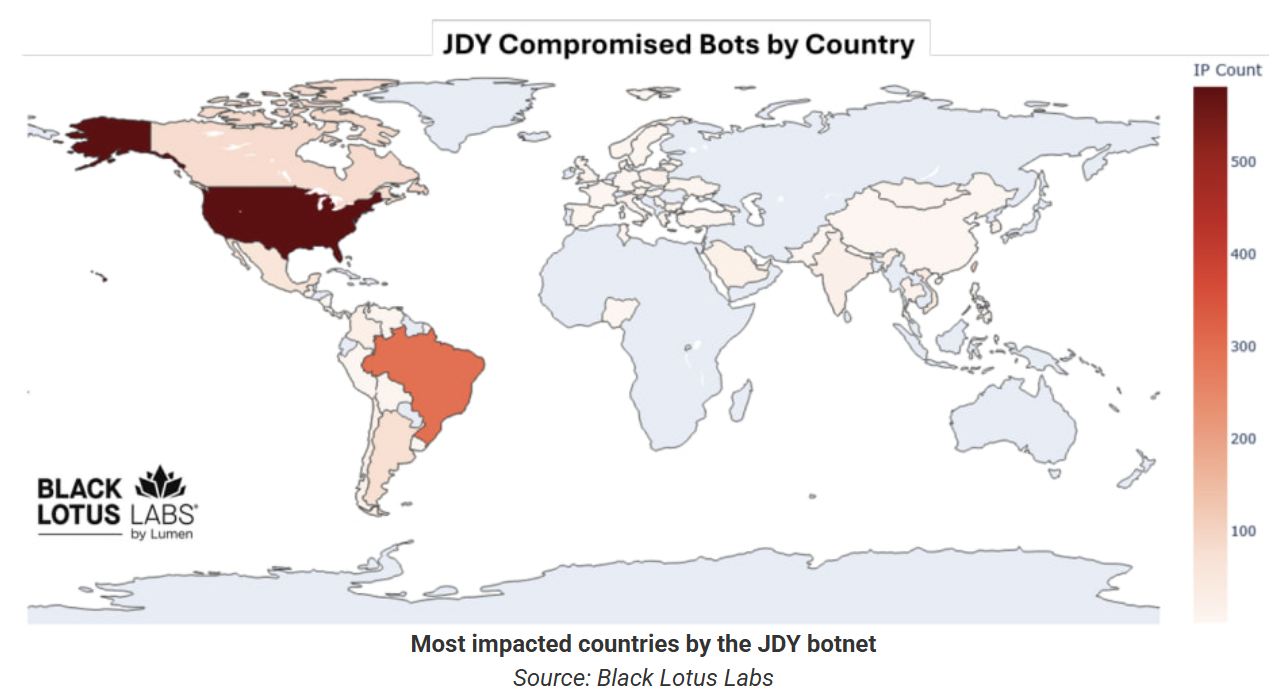
The JDY botnet is a China-linked network of over 1,500 compromised SOHO routers, firewalls, and IoT devices operating as a high-performance, centrally controlled scanning infrastructure. It maps and fingerprints exposed services worldwide, feeding targeting data to Chinese state-sponsored threat actors including Volt Typhoon. Following the U.S. takedown of the KV-botnet in 2024, JDY operators rebuilt and expanded — doubling the botnet from approximately 650 nodes in early 2024 to 1,500+ devices by mid-2026 — with the majority of bots concentrated in the United States and Brazil.
Technical Specifications
| Attribute | Details |
|---|---|
| Botnet Name | JDY |
| Threat Actor Association | China-nexus, Volt Typhoon |
| Primary Function | Dedicated reconnaissance and internet-wide scanning botnet |
| Device Types Targeted | SOHO routers, firewalls, IoT devices |
| Scale | 1,500+ active compromised nodes (as of mid-2026) |
| Geographic Concentration | United States, Brazil, Europe, Asia |
| Infection Vectors | Unpatched edge device CVEs, default/weak credentials, exposed management interfaces |
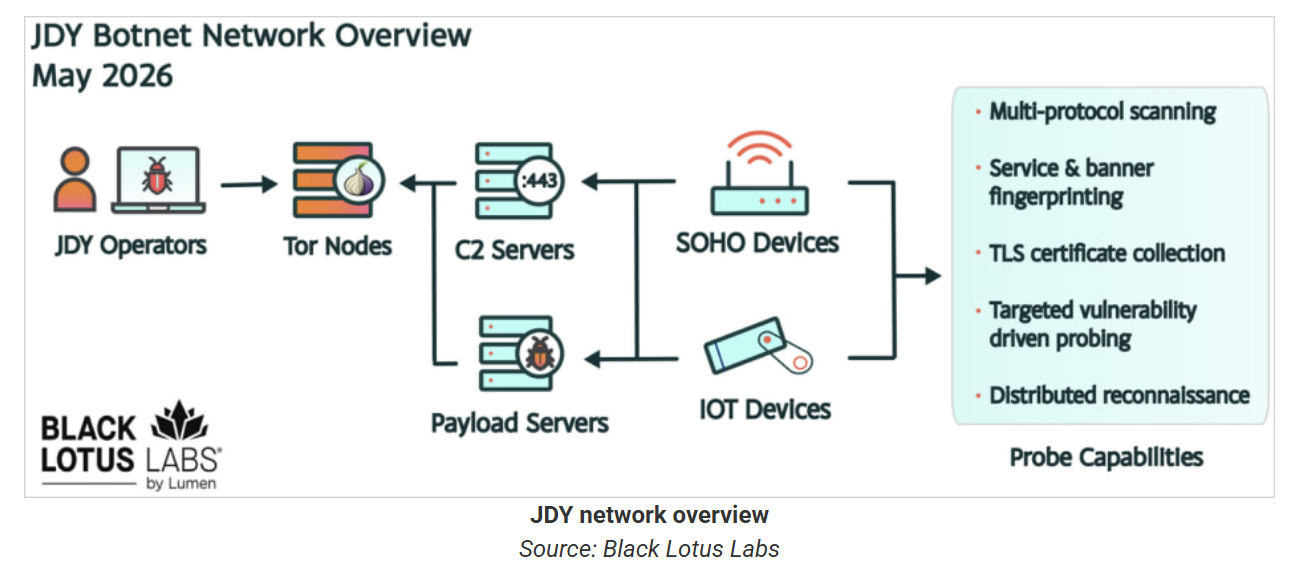
| C2 Architecture | Centrally coordinated; C2 nodes tied to China-nexus operators |
| Scanning Capabilities | Port scanning, service fingerprinting, banner/TLS/HTTP header collection, rapid CVE exposure detection |
| Predecessor | KV-botnet (disrupted by U.S. in 2024) |
| Research Attribution | Lumen Black Lotus Labs |
Affected Products
- SOHO routers, firewalls, and IoT devices with unpatched vulnerabilities or default credentials
- Edge devices with internet-exposed management interfaces
- Devices no longer receiving firmware security updates (end-of-life hardware)
- Organizations with poorly segmented network perimeters, particularly in the U.S., Brazil, Europe, and Asia
Attack Scenario
- Chinese operators scan the internet for unpatched SOHO routers, firewalls, and IoT devices with exposed management interfaces or known CVEs.
- Exploiting vulnerabilities or default credentials, a lightweight scanner implant is installed, enrolling the device into the JDY botnet.
- JDY's C2 issues scanning tasking to bots, targeting specific IP ranges (e.g., U.S. defense contractors, telecoms, infrastructure operators) and searching for hosts exposed to recently disclosed vulnerabilities.
- Bots conduct extensive port scanning and service fingerprinting, collecting open ports, protocols, banner information, TLS certificates, and indicators of remote management interfaces, VPNs, ICS gateways, and cloud services.
- Scan results are reported back to C2, providing operators a near-real-time targeting map of exposed and potentially vulnerable systems worldwide.
- Chinese APT teams (e.g., Volt Typhoon) select high-value targets and launch follow-on intrusions using tailored tools and TTPs.
- As takedown or sinkholing efforts occur, operators shift C2 nodes and rebuild infrastructure, maintaining JDY as a persistent reconnaissance asset.
Impact
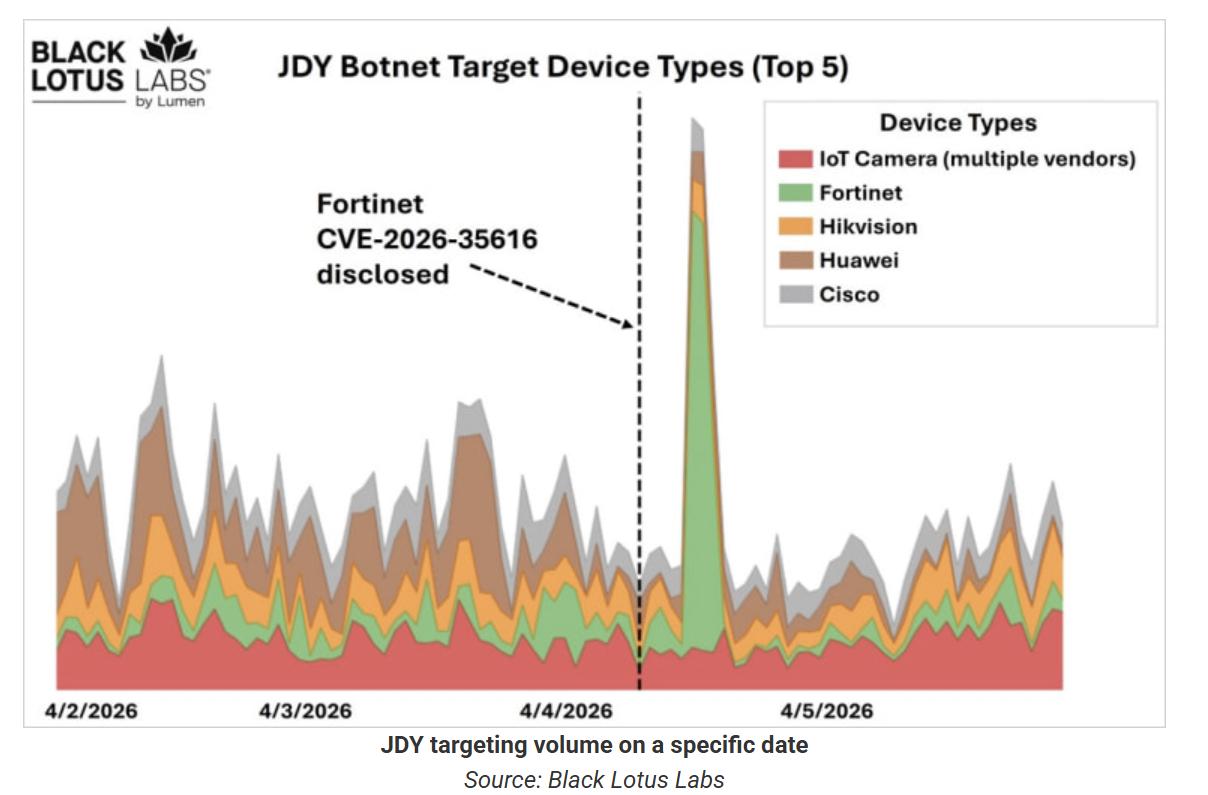
- JDY provides China-linked actors with a near-real-time global map of exposed services, enabling rapid exploitation after vulnerability disclosure
- Shortened window for defenders between CVE publication and state-actor exploitation attempts
- Enables pre-positioning and operational planning against critical infrastructure, telecoms, and military-adjacent networks
- Reconnaissance data collected supports targeted intrusions into sensitive U.S. and allied networks
- Botnet infrastructure enables stealthy scanning from geographically distributed, legitimate-looking IP ranges
- Link to Volt Typhoon aligns with broader Chinese efforts to pre-position inside critical infrastructure
- Compromised SOHO/IoT devices generate unusual outbound scan traffic and remain under attacker control long-term if unremediated
- Device owners may experience bandwidth spikes or ISP abuse notices
- National security risk: JDY maintains a strong focus on U.S. military and associated networks per Black Lotus Labs research
Mitigations
Immediate Actions
- Keep router, firewall, and IoT device firmware up to date; replace devices that no longer receive security updates
- Disable internet-facing remote management by default; restrict access via VPN or IP allowlists
- Change all default credentials and remove unused or default management accounts
Short-term Measures
- Minimize and monitor public-facing services, especially remote management interfaces, VPNs, ICS gateways, and OT/IT bridge points
- Rapidly patch high-impact vulnerabilities — JDY is specifically designed to find hosts exposed to freshly disclosed CVEs
- Factory-reset and re-flash suspected compromised devices with the latest firmware before re-securing
Monitoring & Detection
- Monitor for unusual outbound scanning traffic or ISP abuse notices on edge devices
- Use IDS/IPS and flow monitoring to detect JDY-like scanning patterns from edge networks
- Integrate JDY C2 IP indicators (from Lumen Black Lotus Labs and threat intel feeds) into blocklists and detection content
Long-term Solutions
- Implement network segmentation and zero-trust architecture to prevent scanning success from translating into lateral movement
- Ensure edge devices and remote offices are properly isolated from core networks
- Enforce automated patch management and asset inventory for all internet-exposed edge devices
Resources
Open-Source Reporting
Last Updated: June 11, 2026