UAT-11587 - Antino Backdoor Campaign
UAT-11587 China-nexus Antino Backdoor Rust Malware Government Targeting
Overview
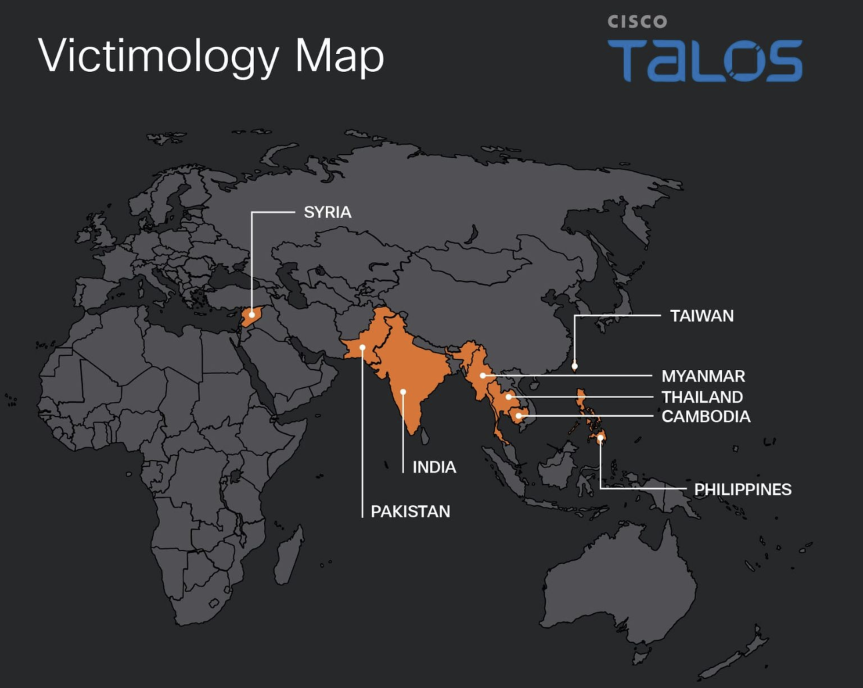
Cisco Talos identified UAT-11587 and assesses with high confidence that it is China-nexus activity targeting government and policy organizations across Asia.
The campaign uses highly tailored spear-phishing emails and decoy content to deliver Antino, a previously undocumented Rust-compiled Windows backdoor. Talos assesses with moderate confidence that the activity supports intelligence gathering.
Technical Details
Antino is a Rust-compiled Windows backdoor with capabilities for:
- Host reconnaissance
- Command shell and PowerShell execution
- File upload and download
- In-memory shellcode loading
- Persistence operations
A notable feature is command-and-control behavior using Microsoft Graph with Outlook and OneDrive workflows, leveraging Microsoft 365 objects as dead drops rather than relying only on traditional attacker-hosted C2 infrastructure.
Talos also documented abuse of Cloudflare infrastructure, including cloud-hosted payload staging.
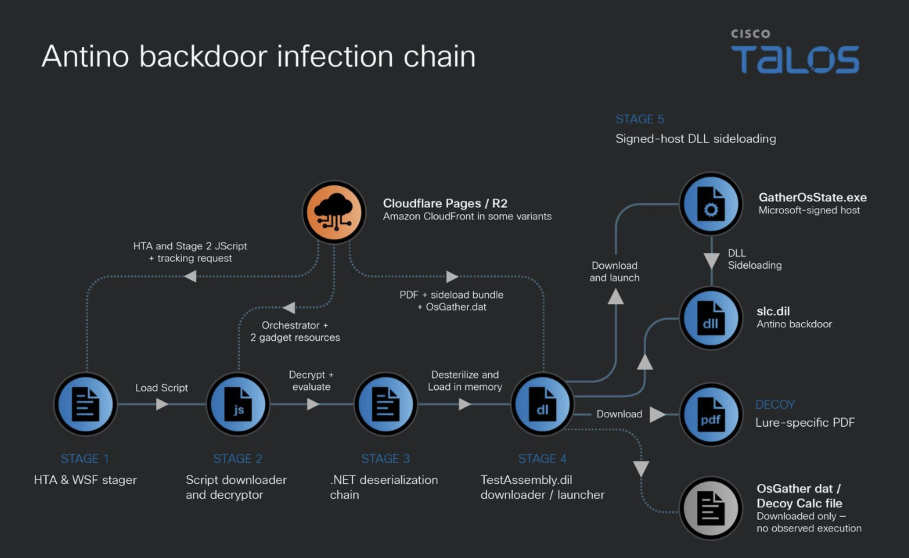
Reported recurring five-stage infection chain:
- Initial script execution.
- Encrypted payload retrieval and decryption.
- In-memory .NET loading.
- Payload staging.
- DLL sideloading through a legitimate Microsoft-signed executable.
Technical Specifications
| Attribute | Details |
|---|---|
| Threat Cluster | UAT-11587 (Talos tracking) |
| Assessed Nexus | China-nexus (high-confidence Talos assessment) |
| Malware Family | Antino backdoor (Rust-compiled, Windows) |
| Primary Targets | Government and policy organizations across Asia |
| C2 Characteristics | Microsoft Graph with Outlook and OneDrive dead-drop style operations |
| Delivery/Execution Chain | Multi-stage loader with encrypted payloads, in-memory .NET activity, and DLL sideloading |
Affected Products
- Windows endpoints at targeted organizations.
- Microsoft 365-connected enterprise environments where Outlook/OneDrive and OAuth/application access can be abused post-compromise.
- Email and cloud-content workflows susceptible to spear-phishing and staged payload retrieval.
Attack Scenario
- Attacker profiles a government or policy target.
- A highly customized spear-phishing email is sent, often using political, diplomatic, security, or regional-policy themes.
- Victim is directed to a decoy attachment or cloud-hosted content.
- A multi-stage loader retrieves and decrypts additional components.
- DLL sideloading is used to execute Antino.
- Antino establishes persistence and communicates through Microsoft 365 using Microsoft Graph, Outlook, and OneDrive.
- Attacker executes commands, runs PowerShell, collects information, transfers files, and can load additional shellcode.
Impact Assessment
- Persistent remote access to targeted endpoints
- Command execution and file-transfer capability supporting long-term intrusion
- Elevated risk of sensitive information theft from policy, diplomatic, and defense contexts
- Talos reporting indicates approximately 350 compromised endpoints across identified activity
- Centralized use of legitimate cloud services can reduce detection visibility for conventional network-based controls
- Activity pattern is consistent with intelligence-collection objectives and potential follow-on compromise
Mitigation Strategies
- Strengthen targeted-phishing defenses and user awareness for policy-themed lure content.
- Sandbox suspicious HTML/HTA and document-based content before user interaction.
- Monitor and alert on suspicious
mshta.exe, Windows Script Host, PowerShell, and unusual .NET in-memory execution. - Detect DLL sideloading patterns involving legitimate signed executables.
- Monitor abnormal Microsoft Graph, Outlook, and OneDrive activity.
- Investigate unusual OAuth/application permissions and token usage.
- Isolate endpoints quickly when Antino indicators are detected.
- Review and rotate credentials accessible from compromised systems.
- Use behavior-based EDR detections rather than relying only on IP/domain blocking, since activity can transit legitimate Microsoft 365 infrastructure.
Resources and References
Public Reporting
- China-nexus UAT-11587 targets government and policy organizations across Asia with Antino backdoor
- Antino Backdoor Targets Asian Government Organizations
- China-nexus UAT-11587 targets government and policy organizations across Asia with Antino backdoor - Live Threat Intelligence - Threat Radar | OffSeq.com
Last Updated: October 1, 2026