China-Linked Storm-1175 Zero-Day Exploitation Campaign

China-Linked APT Zero-Day Exploitation Medusa Ransomware
Overview
Storm-1175, a China-linked threat actor, has been observed conducting sophisticated zero-day and newly disclosed vulnerability exploitation campaigns against enterprise software. The group demonstrates rapid threat weaponization, quickly transitioning from initial access through exploitation of internet-facing systems to credential escalation, lateral movement, and deployment of Medusa ransomware. Attacks typically complete full system compromise within hours to 24 hours, employing double extortion tactics for financial gain.
Technical Specifications
| Attribute | Details |
|---|---|
| Threat Actor | Storm-1175 (China-Linked) |
| Attack Type | Vulnerability Exploitation, Ransomware Deployment |
| Primary TTP | Zero-Day & N-Day Weaponization |
| Initial Access Vector | Internet-Facing Applications |
| Persistence Method | RMM Tools, Admin Account Creation |
| Lateral Movement | RDP, Admin Tools, Network Scanning |
| Data Exfiltration | Cloud Sync Tools (Rclone) |
| Impact | Ransomware Encryption, Data Theft (Double Extortion) |
| Timeline | Hours to 24 Hours for Full Compromise |
Affected Products
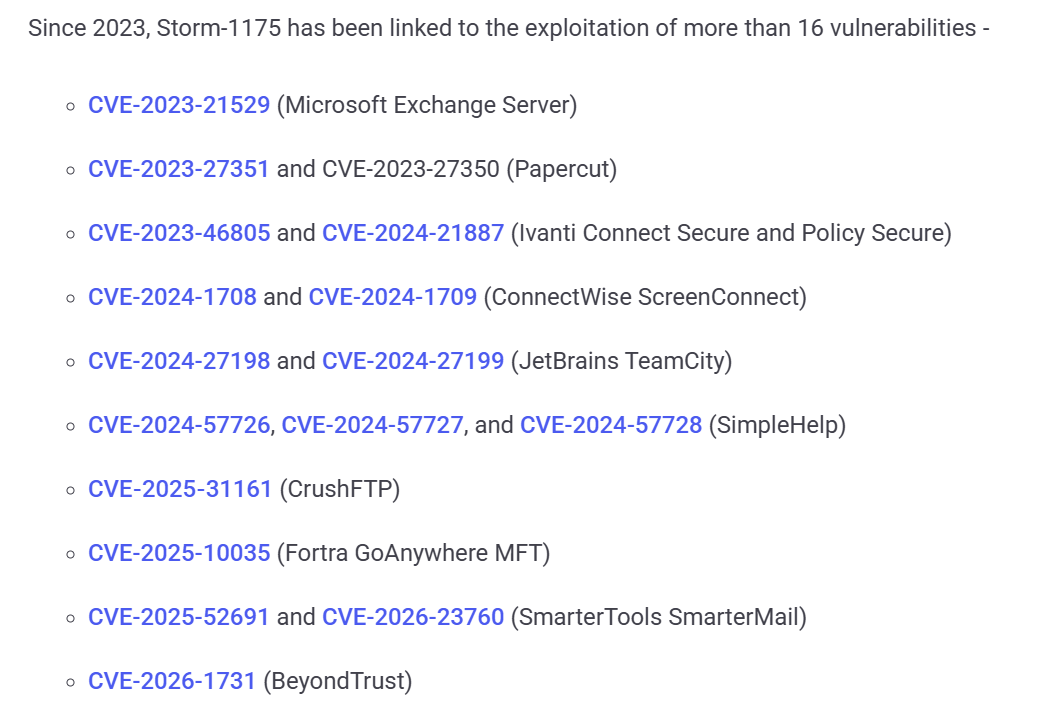
- Email Infrastructure: Microsoft Exchange, SmarterMail
- VPN & Remote Access: Ivanti VPN
- Collaboration & IT Management: ConnectWise, TeamCity
- Printer/Document Services: PaperCut
- Internet-Facing Applications: Any publicly accessible enterprise software
Technical Details
- Exploits zero-day vulnerabilities (e.g., authentication bypass in SmarterMail) with minimal public disclosure lag
- Rapidly weaponizes N-day vulnerabilities after official disclosure
- Targets public-facing applications including email servers, managed file transfer (MFT) solutions, VPNs, and CI/CD platforms
- Deploys Remote Monitoring & Management (RMM) tools (ConnectWise, Splashtop) for persistent backdoor access
- Uses credential harvesting and privilege escalation techniques to elevate from initial foothold to administrative access
- Employs network reconnaissance tools (Netscan, AdvancedIPScanner) to enumerate systems and identify high-value targets
- Exfiltrates sensitive data using cloud synchronization tools like Rclone, AWS S3 CLI, or similar cloud storage clients
- Disables or removes security controls (antivirus, EDR, logging) before ransomware deployment
- Conducts double extortion campaign: encrypts systems with Medusa ransomware while threatening public data disclosure for additional ransom payment
Attack Scenario
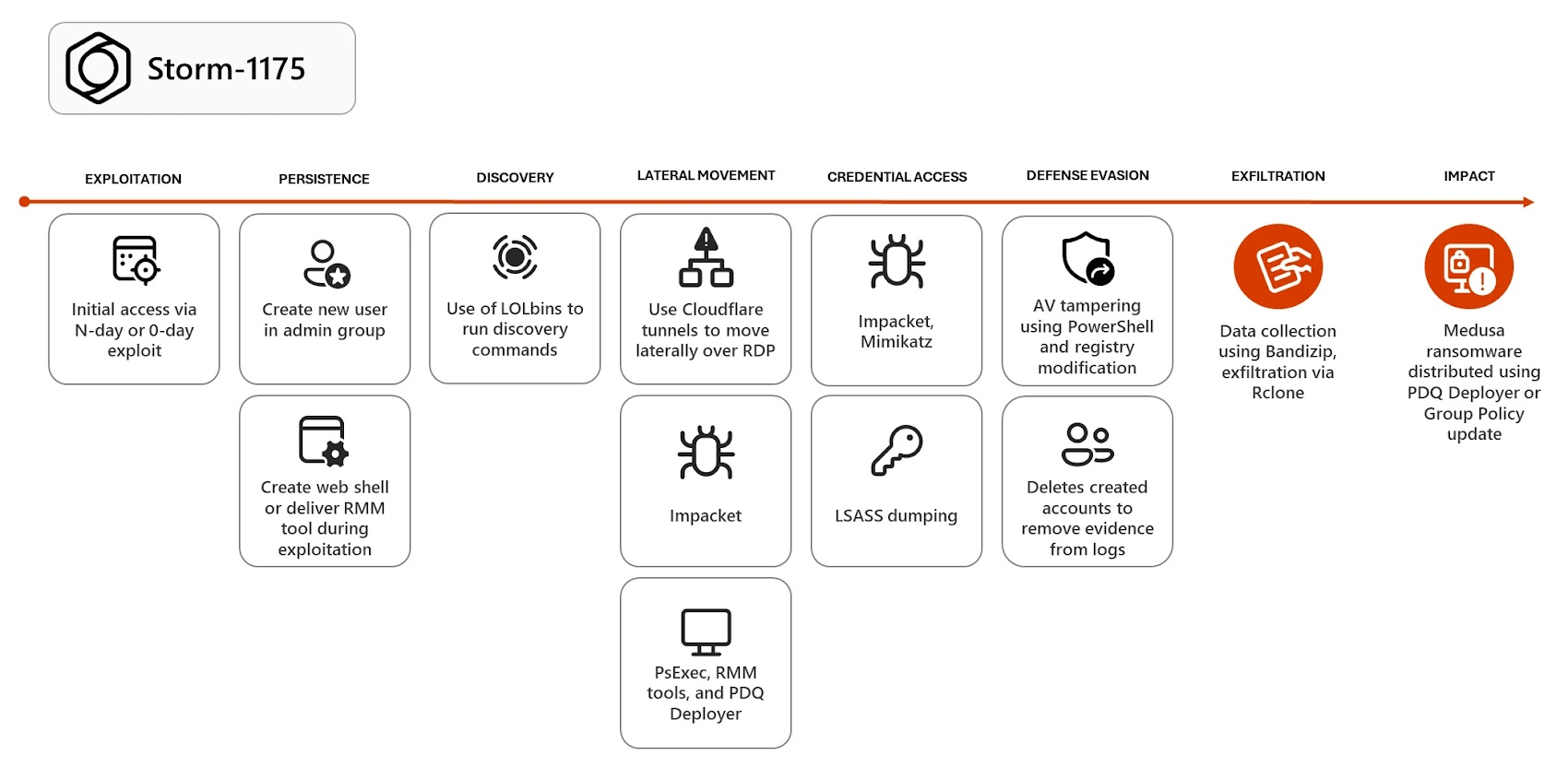
- Initial Access: Exploit zero-day or recently disclosed vulnerability in an internet-facing system (email server, VPN, application) to gain initial shell access or command execution
- Establish Foothold: Create persistent admin accounts, install RMM tools (ConnectWise, TeamCity agents), establish reverse shells and beacon communication channels; disable security controls and logging
- Lateral Movement: Move across the network via RDP, admin consoles, and RMM tool interfaces; enumerate systems, privileges, and network topology using built-in Windows tools and custom scripts
- Credential Access: Harvest domain credentials from memory, SAM hives, and LSASS processes; crack weak passwords; exploit Kerberos weaknesses to obtain domain admin privileges
- Data Exfiltration: Identify and steal sensitive data (intellectual property, customer records, financial data, employee information); exfiltrate using cloud sync tools and S3 uploads; often a multi-day process for large data volumes
- Impact & Encryption: Deploy Medusa ransomware to all accessible systems; encrypt files with strong encryption; display ransom note; contact victim organizations with double extortion threat (publish stolen data if ransom not paid)
Impact Assessment
- System Compromise: Full compromise of affected systems within hours of initial access
- Data Integrity Loss: Encryption of critical business documents and databases
- Credential Compromise: Exposure of domain credentials, service accounts, and administrative privileges
- Security Control Bypass: Antivirus and EDR evasion enables undetected persistence and lateral movement
- Ransomware Deployment: Difficulty in system recovery without recent, offline backups
- Business Continuity Disruption: Encrypted systems unable to operate; critical business functions halted
- Prolonged Downtime: Recovery effort can take days to weeks depending on backup availability and system complexity
- Double Extortion Threat: Pressure to pay ransom to both decrypt systems and prevent public data release
- Incident Response Burden: Extensive forensics, system rebuilds, and credential resets required
- Supply Chain Risk: Exfiltrated data may include vendor, customer, and partner information
- Financial Loss: Ransom payments (often $1M+), downtime costs, recovery expenses, and potential regulated notification costs
- Reputational Damage: Public disclosure of breached data harms customer trust, investor confidence, and brand reputation
- Regulatory Consequences: GDPR fines, SOX violations, and industry-specific compliance penalties for data loss
- Competitive Disadvantage: Theft of intellectual property benefits competitors; disclosure of proprietary processes
- Geopolitical Implications: Links to Chinese state-sponsored activities amplify diplomatic and legal consequences
Mitigation Strategies
- Patch Management: Apply security updates immediately upon release, with priority given to internet-facing systems; implement automated patching where possible; maintain inventory of all software versions in production
- Attack Surface Reduction: Disable unused services and ports; restrict access to critical systems (VPNs, MFT, email) via IP whitelisting, multi-factor authentication, and zero-trust network access controls
- Vulnerability Scanning: Perform regular vulnerability assessments of internet-facing applications; implement continuous scanning for known vulnerabilities; use security headers and WAF rules to block exploitation attempts
- Access Control: Enforce principle of least privilege; separate user, admin, and service accounts; disable local admin accounts where possible; use privileged access management (PAM) solutions
- Email Security: Deploy advanced email filtering to detect phishing and malware; enable DMARC, SPF, and DKIM; implement sandboxing for suspicious attachments and links
- Network Segmentation: Implement network segmentation using VLANs, firewalls, and zero-trust architecture; isolate critical systems and data stores; restrict lateral movement via microsegmentation
- Monitoring & Detection: Monitor for unusual account creation, failed login attempts, and permission changes; detect RMM tool installation and suspicious process execution; alert on unusual outbound traffic to cloud services
- Endpoint Detection & Response (EDR): Deploy EDR solutions across all systems; enable process monitoring, memory analysis, and behavioral detection; maintain 24/7 SOC monitoring
- Backup Strategy: Implement immutable, offline backups; test backup recovery regularly; maintain multiple backup copies in geographically dispersed locations; ensure backups are not connected to production networks
- Incident Response Planning: Develop and test incident response procedures; establish communication protocols with law enforcement and incident response firms; maintain updated asset inventory and network diagrams
- RMM Tool Security: Audit and restrict RMM tool usage; disable RMM tools not in active use; monitor RMM connections for suspicious behavior; control administrative tool access with PAM
- Data Exfiltration Prevention: Monitor cloud storage uploads; use Data Loss Prevention (DLP) tools to block unauthorized data transfer; encrypt sensitive data at rest and in transit; implement egress filtering rules
Resources
Open-Source Reporting