MikroTrick - MikroTik RouterOS SSH Exploitation Chain
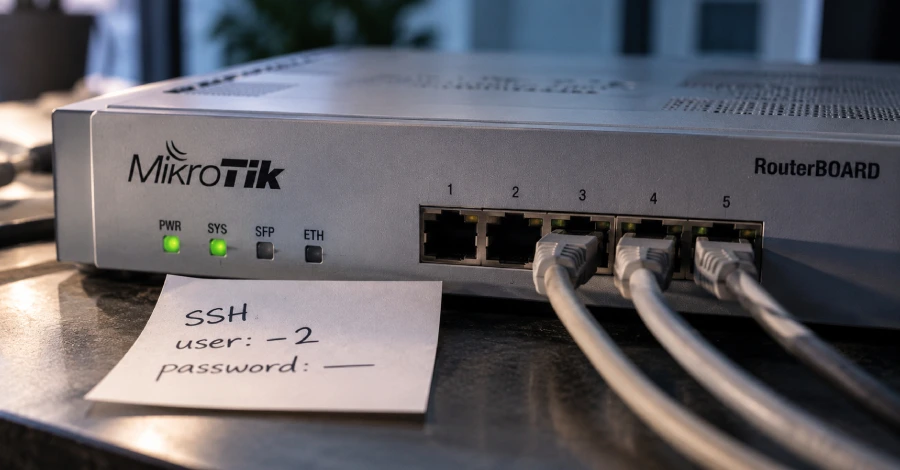
MikroTik RouterOS MikroTrick CVE-2026-67276 CVE-2026-86060 SSH Administrative Takeover
Overview
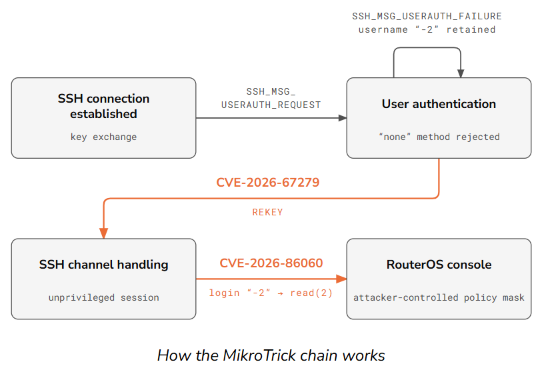
Attackers are exploiting a vulnerability chain known as MikroTrick that targets MikroTik RouterOS. Public reporting indicates the chain can let attackers with network reachability to a router's SSH service obtain full administrative access without a valid password or SSH private key.
The chain combines authentication-bypass behavior with privilege/session manipulation, enabling direct compromise of exposed network-edge infrastructure.
Technical Details
Core Vulnerabilities
- CVE-2026-67276: SSH RSA public-key authentication bypass in RouterOS.
- CVE-2026-86060: SSH session privilege-manipulation / argument-injection weakness.
- CVE-2026-67277: additional issue disclosed by CERT Polska affecting the bandwidth-test service.
Exploitation Characteristics
- Primary exposure condition: router SSH reachable from untrusted networks, including the internet.
- Authentication bypass can remove need for valid SSH password/key material.
- Crafted session/username manipulation can elevate privileges to administrative context.
Technical Specifications
| Attribute | Details |
|---|---|
| Chain Name | MikroTrick |
| Primary Targets | MikroTik RouterOS devices |
| Core CVEs | CVE-2026-67276, CVE-2026-86060, CVE-2026-67277 |
| Primary Entry Path | Internet/LAN-reachable SSH management service |
| Security Outcome | Full RouterOS administrative session takeover |
| Follow-On Risk | Persistence, traffic manipulation, tunneling/proxying, lateral movement |
Affected Products
- MikroTik RouterOS systems that remain on vulnerable releases.
- Routers exposing SSH management services to untrusted networks.
- Environments relying on router trust boundaries for segmentation and transit security.
Attack Scenario
- Attacker identifies a MikroTik router with publicly reachable SSH.
- RouterOS SSH authentication weakness is exploited.
- Crafted SSH username/session context is used to manipulate privileges.
- Administrative RouterOS session is obtained.
- Router configuration is modified for persistence, traffic control, tunneling/proxying, or further network access.
Impact Assessment
- Full administrative compromise of affected routers
- Unauthorized account creation and privilege persistence
- Firewall, NAT, and routing-policy tampering
- Traffic interception, redirection, or degradation
- Establishment of tunnels/proxies for hidden command-and-control or pivoting
- Use of compromised routers as footholds into connected internal environments
- Critical for internet-exposed vulnerable devices due to unauthenticated administrative takeover potential
Mitigation Strategies
Patch Immediately
Upgrade to fixed RouterOS releases:
- 7.24.2+
- 7.23.4+
- 6.49.21+
- 7.25 beta 3+
Restrict Management Exposure
- Restrict SSH to trusted management networks only.
- Avoid direct exposure of management interfaces to the public internet.
- Use allowlisting, VPN/jump-host administration, and least-privilege management paths.
Post-Patch Validation
- Review router logs/configuration for unknown users, scripts, schedulers, proxies, tunnels, and unexpected policy changes.
- Audit startup/persistence mechanisms and management accounts.
Incident Response if Compromise Is Suspected
- Preserve evidence before broad cleanup actions.
- Isolate affected router(s) from critical network paths.
- Factory-reset and rebuild from trusted baseline configurations.
- Rotate passwords, SSH keys, and related secrets tied to affected infrastructure.
Resources and References
Public Reporting
Last Updated: September 24, 2026