CVE-2026-24061 – GNU InetUtils telnetd Remote Authentication Bypass
Overview
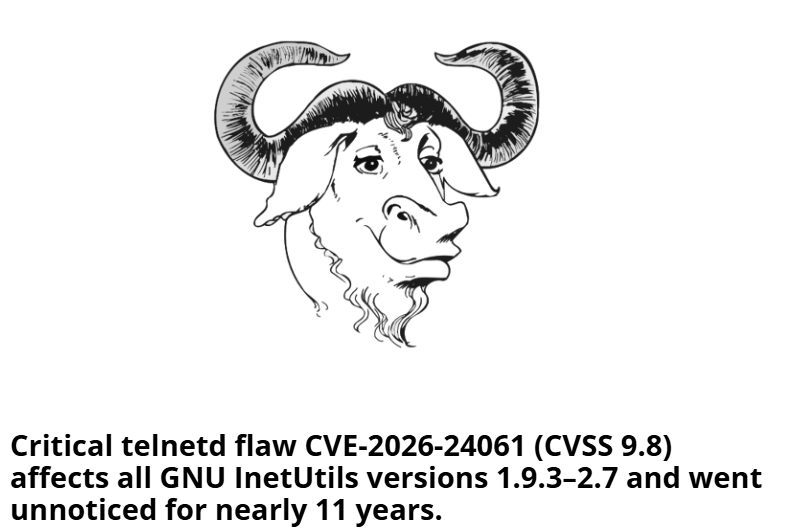
A critical remote authentication bypass vulnerability (CVE-2026-24061) has been discovered in the Telnet daemon (telnetd) component of GNU InetUtils, a suite of common networking utilities maintained by the GNU Project. This 11-year-old vulnerability, present in the codebase since 2014 but only recently identified in 2026, allows unauthenticated remote attackers to obtain root shell access on vulnerable systems by exploiting improper handling of the USER environment variable during the authentication handshake. The flaw enables complete system compromise without requiring any credentials, making it one of the most severe authentication bypass vulnerabilities affecting Unix-like operating systems in recent years.
GNU InetUtils provides fundamental networking tools including telnet, telnetd, ftp, ftpd, rsh, rshd, rlogin, rlogind, tftp, tftpd, talk, talkd, inetd, ping, traceroute, hostname, dnsdomainname, ifconfig, and logger. The telnetd daemon specifically implements the server-side Telnet protocol (RFC 854) for remote terminal access, historically used for system administration before SSH became the standard secure alternative. Despite Telnet's well-known security weaknesses—including transmission of credentials in plaintext and lack of encryption—telnetd remains deployed on legacy systems, embedded devices, industrial control systems, network equipment, and enterprise environments where compatibility with vintage software is required.
The vulnerability stems from telnetd's failure to sanitize user-supplied environment variables before passing them to the system's login(1) program. When a remote attacker connects with a specially crafted USER environment variable value of "-f root" (using Telnet's --login or -a automatic login flags), telnetd forwards this unsanitized input directly to /usr/bin/login. The login program interprets the "-f" flag as a trusted login bypass option originally intended for use by privileged local processes, granting immediate root shell access without password verification. This design flaw represents a catastrophic failure in security boundary enforcement between network-exposed services and privileged system authentication mechanisms.
The vulnerability affects GNU InetUtils versions 1.9.3 through 2.7, spanning an 11-year period from 2014 to 2025. Security researchers estimate that tens of thousands of systems globally remain vulnerable, including embedded devices, legacy Unix servers, industrial SCADA systems, network equipment (routers, switches, firewalls), and containerized environments where telnetd has been inadvertently included. Evidence of active exploitation emerged within hours of public disclosure, with mass scanning campaigns targeting TCP port 23 and automated exploitation frameworks integrating CVE-2026-24061 payloads. The combination of trivial exploitation (requiring only standard telnet client tools), unauthenticated remote root access, and widespread deployment across diverse system types creates an urgent remediation imperative for organizations maintaining any Telnet-enabled infrastructure.
Vulnerability Specifications
| Attribute | Details |
|---|---|
| CVE ID | CVE-2026-24061 |
| Vulnerability Type | Remote Authentication Bypass |
| CWE Classification | CWE-287: Improper Authentication |
| Affected Software | GNU InetUtils telnetd (Telnet Daemon) |
| Vulnerable Versions | 1.9.3 through 2.7 (2014-2025, 11-year vulnerability window) |
| Fixed Version | 2.8 and later |
| Attack Vector | Network (Remote) |
| Attack Complexity | Low (Single command, standard Telnet client) |
| Privileges Required | None (Unauthenticated) |
| User Interaction | None |
| Scope | Changed (Complete System Compromise) |
| Confidentiality Impact | High (Full root access to all files) |
| Integrity Impact | High (Complete system control) |
| Availability Impact | High (System shutdown, service disruption) |
| CVSS 3.1 Base Score | 9.8 (Critical) |
| Public Disclosure Date | January 2026 |
| Patch Availability | GNU InetUtils 2.8 (January 2026) |
| Exploitation Status | Active Exploitation Confirmed (Mass Scanning Observed) |
Technical Details
Telnet Protocol and Authentication Flow
The Telnet protocol (defined in RFC 854) provides bidirectional interactive text-oriented communication over TCP. The telnetd daemon listens on TCP port 23 and implements the server-side protocol handling.
In the normal authentication flow, the Telnet client establishes a TCP connection to the telnetd daemon, which initiates protocol negotiation including terminal type and environment variable options. The daemon then spawns the login process, which prompts for username and password credentials. These credentials are validated against the system's authentication database (PAM, /etc/passwd, /etc/shadow), and upon successful verification, the user receives a shell session with appropriate permissions.
Vulnerability: Environment Variable Injection
The vulnerability exists in telnetd's failure to sanitize the USER environment variable before passing it to the login process during automatic login mode. When a remote attacker connects with a specially crafted USER environment variable containing "-f root", telnetd forwards this unsanitized input directly to the login program.
The login program interprets the "-f" flag as a trusted login bypass option, originally designed for use only by privileged local processes such as su or sshd. This flag was intended to skip authentication checks when the calling process has already verified the user's identity through other means. However, when telnetd passes untrusted network input containing this flag, it creates a critical security boundary violation.
Vulnerable Code Analysis
The vulnerability stems from insufficient input validation in telnetd's environment variable handling. When processing the Telnet ENVIRON option, telnetd directly sets environment variables with user-supplied values without sanitization. In automatic login mode, the USER environment variable is then used to construct arguments for the login process.
The login program's "-f" flag implementation bypasses all authentication checks, including password verification. When invoked as login -f root, the login program immediately grants root shell access without requiring any credentials. This design flaw—where a network-exposed service can trigger a privileged bypass mechanism—represents a catastrophic failure in security boundary enforcement.
Exploitation Mechanics
Exploitation requires only standard telnet client tools. An attacker simply needs to establish a Telnet connection with the malicious USER environment variable set to "-f root". Telnetd forwards this unsanitized value to login, which interprets it as a command-line flag requesting authentication bypass for the root user.
The attack is trivial to execute because: - Standard Telnet clients are available on virtually all systems - No specialized exploitation tools or techniques are required - The attack requires no knowledge of valid credentials - Telnetd processes the environment variable automatically without user interaction - The login bypass mechanism responds immediately without delay
Verification of Vulnerability
System administrators can determine if their systems are vulnerable by checking the installed version of GNU InetUtils. Vulnerable versions span from 1.9.3 through 2.7, released between 2014 and 2025. Any system running telnetd with these version numbers is susceptible to unauthenticated remote root access.
Additionally, systems can be checked to determine if telnetd is currently active and listening on TCP port 23. Even if the vulnerable software is installed, systems where telnetd is disabled or not running face reduced but not eliminated risk, as the service can be trivially re-enabled.
Attack Scenario: Manufacturing SCADA System Compromise via Legacy Telnet Access
Scenario Overview:
A sophisticated threat actor gains unauthorized access to a manufacturing facility's plant control systems through CVE-2026-24061. The attacker exploits the vulnerable telnetd service running on a legacy SCADA server to obtain root access without authentication. From this position, the attacker can manipulate production systems, disable safety controls, and deploy ransomware across the industrial network.
Attack Phases:
Phase 1: Reconnaissance and Network Mapping
The threat actor identifies the manufacturing organization's IT infrastructure and conducts internal network reconnaissance. They discover multiple systems with telnet services exposed on port 23 across the operational technology (OT) network. A vulnerable SCADA master control server is identified as a high-value target due to its role in coordinating critical production systems.
Phase 2: Exploitation of CVE-2026-24061
The attacker establishes a telnet connection to the SCADA server and sends a specially crafted USER environment variable containing "-f root". The vulnerable telnetd service forwards this unsanitized input to the login process, which interprets the "-f" flag as a bypass instruction. The attacker gains immediate root shell access without providing any credentials.
Phase 3: Post-Exploitation and System Reconnaissance
With root access, the attacker enumerates the SCADA infrastructure:
- Discovers hundreds of connected programmable logic controllers (PLCs)
- Accesses production schedules and work orders
- Retrieves system credentials and configuration files
- Maps the complete industrial control system topology
- Identifies connections to related facilities and systems
Phase 4: Malicious Activity and System Compromise
The attacker modifies PLC control logic and deploys ransomware throughout the industrial environment. Safety monitoring systems are disabled, and equipment control parameters are altered to unsafe levels. Ransomware encrypts critical SCADA data, configuration files, and production records. The attack extends to related systems across the organization's network.
Phase 5: Production Disruption and Impact
The compromised systems cause immediate production disruption. Equipment operates outside safe parameters, causing mechanical failures and damage. Manufacturing lines halt operations as systems become unavailable. The attacker delivers a ransom demand, threatening permanent equipment destruction if demands are not met.
Impact Assessment
Critical Infrastructure Risk
CVE-2026-24061 poses severe risks to organizations maintaining legacy Unix/Linux systems with telnetd enabled:
- Unauthenticated Root Access: Complete system compromise without credentials
- Trivial Exploitation: Single command execution using standard telnet client tools
- No Detection: Legitimate telnet traffic provides no obvious exploitation indicators
- Lateral Movement: Root access enables rapid compromise of adjacent systems
- Persistence: Attackers can install backdoors, create privileged accounts, modify system files
- Data Exfiltration: Full access to sensitive files, databases, configuration data
- Operational Disruption: Production system compromise causing manufacturing shutdowns
- Ransomware Risk: Root access enables destructive attacks targeting ICS/SCADA environments
- Data Breach: Exposure of intellectual property, customer data, trade secrets
- Compliance Violations: HIPAA, PCI DSS, NERC CIP, NIST 800-171 failures for inadequate authentication
- Reputational Damage: Public disclosure of 11-year-old vulnerability in production systems
- Financial Losses: Downtime costs, incident response, regulatory fines, customer penalties
- Manufacturing/ICS: SCADA server compromise enabling production disruption, safety system tampering, equipment damage
- Healthcare: Medical device management systems, PACS servers, electronic health record (EHR) infrastructure
- Energy/Utilities: Power generation control systems, SCADA networks, distribution automation
- Telecommunications: Network management systems, billing platforms, routing infrastructure
- Government: Legacy Unix servers in federal agencies, military installations, research facilities
- Education: University research systems, administrative servers, legacy computing infrastructure
Vulnerability Scope
Affected Systems:
- Legacy Unix Servers: AIX, HP-UX, Solaris, SCO OpenServer with GNU InetUtils telnetd
- Embedded Devices: Industrial controllers, network equipment, medical devices with telnetd
- Container Images: Docker/Kubernetes deployments inadvertently including vulnerable telnetd
- Virtual Machines: Legacy VM images maintained for compatibility with vintage software
- Development Environments: Sandbox/testing systems with telnetd enabled for troubleshooting
Exploitation Difficulty: LOW
- Standard telnet client required (available on all Unix-like systems)
- No specialized tools or exploits needed
- Single command achieves unauthenticated root access
- Automated exploitation frameworks widely available
Detection Difficulty: HIGH
- Telnet traffic uses legitimate protocol on standard port (TCP/23)
- Exploitation leaves minimal forensic artifacts
- Login process appears as normal root login in audit logs
- Network intrusion detection systems cannot identify malicious USER variable content
Mitigation Strategies
Immediate Actions (Emergency Response - Complete within 24 hours)
Priority 1: Disable Telnet Services
- Check if telnetd is running and terminate any active processes.
- Disable telnetd in systemd and xinetd configurations.
- Block TCP port 23 at the firewall level.
- Verify that telnet service is disabled.
Priority 2: Threat Hunting for Exploitation Indicators
- Analyze authentication logs for suspicious root logins and telnet activity.
- Check for unauthorized user accounts.
- Inspect temporary directories for suspicious files.
- Verify the integrity of critical system binaries.
- Monitor network connections for unusual outbound traffic.
- Review common locations for potential backdoors.
Priority 3: Patch Deployment (Complete within 72 hours for critical systems)
- Upgrade GNU InetUtils to version 2.8 or later.
- Verify that the patch was successful and that the system is no longer vulnerable.
Long-Term Security Enhancements
1. Migration to SSH
- Transition from Telnet to SSH for secure remote access.
- Configure SSH with security hardening measures.
2. Network Segmentation & Access Controls
- Implement firewall rules to restrict legacy protocol access.
- Promote SSH as the primary remote access method.
- Isolate critical networks from corporate IT.
3. Continuous Monitoring & Detection
- Establish a monitoring system for telnet connections.
- Set up alerts for any detected telnet activity.
- Ensure incident response procedures are in place for unauthorized connections.
- Review exploitation indicators regularly.
Resources
Vulnerability Databases & Analysis
- 11-Year-Old critical telnetd flaw found in GNU InetUtils (CVE-2026-24061)
- CVE-2026-24061 – Critical GNU InetUtils Telnetd Remote Authentication Bypass
- Critical GNU InetUtils telnetd Flaw Lets Attackers Bypass Login and Gain Root Access
- NVD - CVE-2026-24061
- CVE-2026-24061 - Critical Vulnerability - TheHackerWire
- oss-security - GNU InetUtils Security Advisory: remote authentication by-pass in telnetd
Last Updated: January 25, 2026