US and Allies Warn of Russian APT Groups Targeting Routers and Network Devices
Russian State-Sponsored Activity Network Infrastructure Targeting Credential Abuse Router Hygiene Critical Infrastructure Risk
Overview
A joint cybersecurity advisory from NSA, CISA, FBI, and allied agencies warns that Russian state-sponsored actors are actively targeting internet-exposed network infrastructure, including routers, switches, firewalls, VPN gateways, and related appliances.
The activity is attributed to FSB Center 16-linked operations (also tracked as Berserk Bear, Dragonfly, Energetic Bear, and Crouching Yeti). Rather than depending primarily on new zero-days, attackers are exploiting weak security hygiene such as default credentials, exposed management interfaces, outdated firmware, and legacy protocols to establish persistence for espionage and potential follow-on disruptive operations.
Technical Specifications
| Attribute | Details |
|---|---|
| Threat Cluster | Russian FSB Center 16-linked activity |
| Known Tracking Names | Berserk Bear, Dragonfly, Energetic Bear, Crouching Yeti |
| Primary Target Surface | Internet-exposed network infrastructure devices |
| Targeted Device Types | Routers, switches, firewalls, VPN gateways, network appliances |
| Primary Access Methods | Weak/default credentials, password spraying, credential reuse |
| Secondary Access Methods | Exploitation of known patched vulnerabilities, exposed admin interfaces |
| Legacy/Weak Protocol Abuse | SNMPv1/v2, TFTP, Telnet, Cisco Smart Install |
| Post-Compromise Objectives | Config theft, credential harvesting, topology mapping, persistent foothold |
| Data at Risk | Config files, admin creds, VPN secrets/PSKs, routing and firewall rules, internal addressing |
| Advisory Focus | Immediate router hygiene and infrastructure hardening |
Affected Products
- Internet-facing routers, switches, firewalls, VPN gateways, and network appliances
- Environments retaining unsupported firmware or end-of-life network hardware
- Organizations exposing management interfaces directly to the internet
- Networks still relying on insecure legacy protocols (for example Telnet, TFTP, SNMPv1/v2)
Attack Scenario
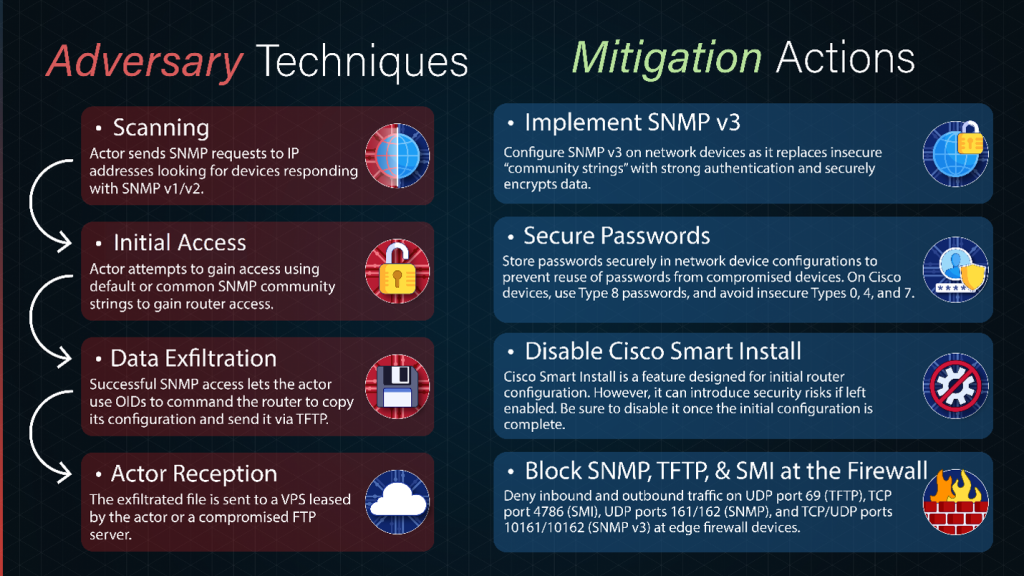
- Attackers perform internet-wide reconnaissance for exposed network-device management interfaces.
- Vulnerable targets are identified based on old firmware, weak access controls, or legacy protocol exposure.
- Threat actors gain administrative access using default credentials, password spraying, credential reuse, or known exploitable weaknesses.
- Device configuration files are extracted, often via insecure transfer paths (for example TFTP).
- Stolen credentials and topology data are used to map internal environments and support lateral movement.
- Compromised edge devices are retained as long-term persistence points for espionage and potential future disruptive operations.
Impact Assessment
- Unauthorized administrative control can alter routing, ACLs, and firewall policy enforcement
- Attackers can tamper with device configurations to create covert persistence
- Trust in network segmentation and control-plane integrity is degraded
- Exposure of configuration files, admin credentials, VPN secrets, and internal topology
- Sensitive network architecture intelligence can be harvested for broader intrusion planning
- Persistent edge footholds can facilitate long-term intelligence collection
- Compromised network devices can be degraded or disrupted, affecting enterprise connectivity
- Misconfiguration or malicious policy changes can cause outages in critical services
- Critical infrastructure operators face increased risk of future disruptive follow-on attacks
Mitigation Strategies
Immediate Actions
- Replace unsupported and end-of-life network devices
- Apply latest firmware and security updates across all managed network infrastructure
- Remove internet exposure of administrative interfaces wherever possible
Short-term Measures
- Disable unnecessary and insecure services such as Telnet, TFTP, and Cisco Smart Install
- Migrate SNMPv1/v2 deployments to SNMPv3 with strong authentication and encryption
- Restrict device-management access to trusted admin networks or VPN paths only
Monitoring & Detection
- Continuously monitor logs for suspicious admin logins, config exports, and privilege changes
- Alert on abnormal use of legacy management protocols and failed login bursts
- Audit for unauthorized configuration drift in routing, firewall, and VPN settings
Long-term Solutions
- Enforce strong, unique administrator credentials and rotate high-value secrets regularly
- Implement MFA on management planes where supported
- Institutionalize network-device hardening baselines and periodic compliance validation
Resources and References
Public Reporting
- US and allied Governments' Recommendations: Securing Network Devices Against Russian APT Groups
- Improve Router Hygiene to Protect Against Russian State-Sponsored Targeting | CISA
- NSA and Partners Release Guidance on Improving Router Hygiene to Protect Against Russian State-Sponsored Targeting
- CSA Improve Router Hygiene Advisory PDF
Last Updated: July 16, 2026