Russia-linked Hackers Target Signal and WhatsApp Accounts of Officials Globally
Russia-Linked Threat Activity Account Hijacking Signal Abuse WhatsApp Abuse
Overview
Dutch intelligence and the Dutch government warned that Russia-linked state hackers are running a large-scale global campaign to hijack Signal and WhatsApp accounts belonging to officials, military personnel, journalists, and other high-value targets.
The campaign does not rely on breaking Signal or WhatsApp encryption and does not require a new remote code execution vulnerability. Instead, attackers abuse account lifecycle workflows, linked-device features, and social engineering to gain access and persistence.
Technical Specifications
| Attribute | Details |
|---|---|
| Vulnerability Type | Social engineering, credential/OTP theft, linked-device abuse |
| Attack Vector | Remote (messaging chats, QR/deep-link lures, fake support interactions) |
| Authentication | User-assisted compromise through stolen verification code/PIN or malicious device-link approval |
| Complexity | Low to Medium (depends on target awareness and operational security) |
| User Interaction | Required |
| Affected Platforms | Signal and WhatsApp account recovery and multi-device linking flows |
Affected Products
- Signal accounts used by government and high-value users
- WhatsApp accounts used by government and high-value users
- Individuals specifically highlighted by Dutch agencies: officials, civil servants, military personnel, diplomats, journalists
- Organizations dependent on consumer messaging apps for sensitive coordination
Technical Details
No New CVE or Encryption Break
- There is no public evidence of broken Signal or WhatsApp encryption.
- The operation focuses on account takeover mechanics and human-targeted deception.
Core Tradecraft
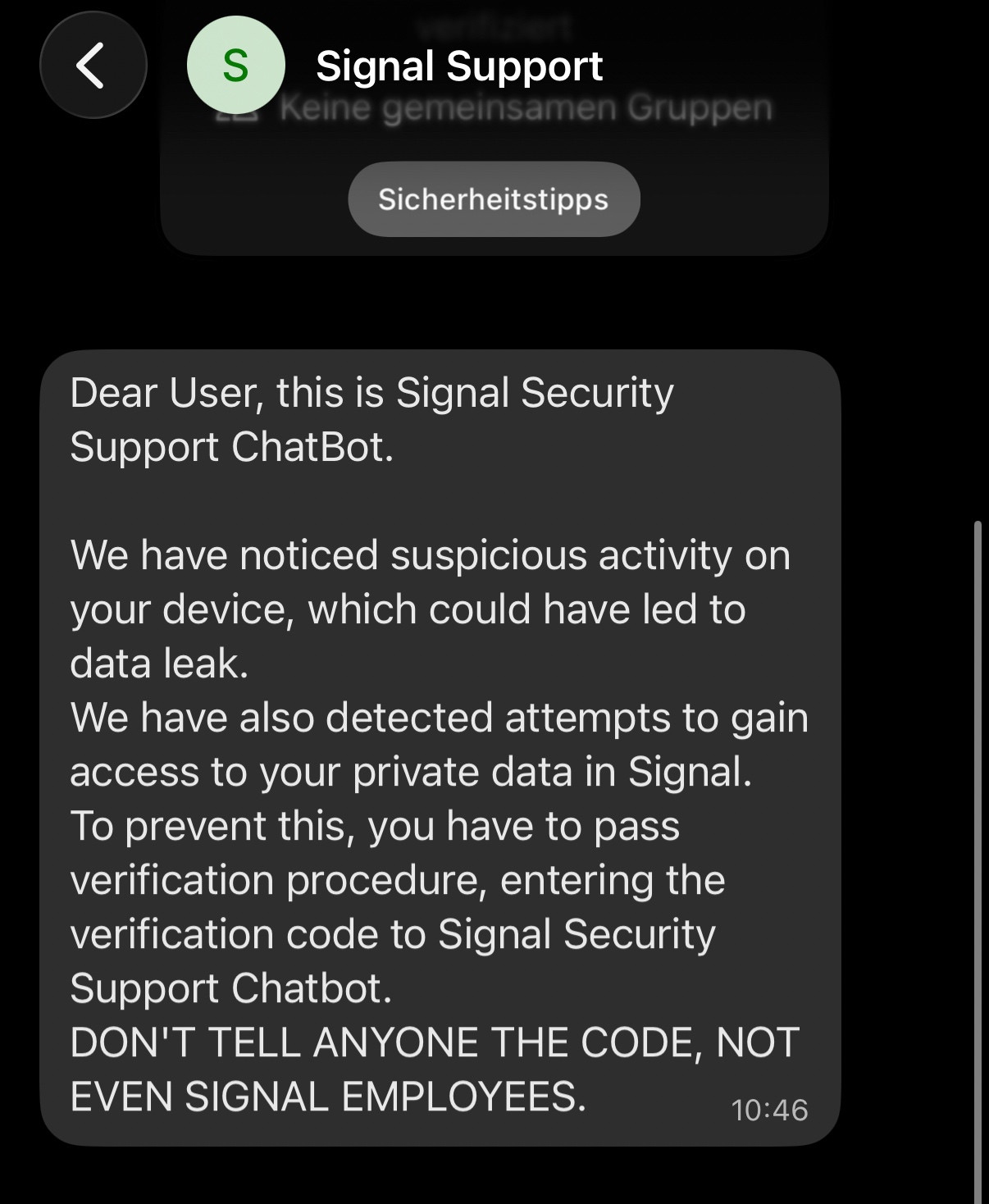
- Phishing for verification codes and registration PINs via fake "support" chats.
- Automated fake support chatbots requesting codes to "secure" accounts.
- Malicious QR codes or deep links that abuse legitimate linked-device flows.
- Silent profile renaming (for example to "Deleted account") to reduce suspicion after takeover.
WhatsApp Linked-Device Abuse
- Victims may be tricked into approving a linked-device prompt or scanning a malicious QR code.
- Attackers can mirror chats on attacker-controlled devices and maintain visibility with limited immediate signs.
Attack Scenario
-
Recon and Target Selection: Russian-linked operators identify phone numbers used by officials, diplomats, military staff, and journalists likely to use Signal or WhatsApp for sensitive communications.
-
Initial Contact and Social Engineering: Attackers message targets while impersonating support or trusted contacts, then create urgency around account suspension, policy updates, or account risk.
-
Code/PIN Harvesting or Device Linking: In parallel, attackers trigger legitimate verification events and trick the victim into sharing codes/PINs or scanning malicious QR/deep links.
-
Account Hijack and Persistence: Attackers register the account on a new device or keep a linked device attached, potentially renaming profiles to appear as "Deleted account" and reducing detection.
-
Exploitation of Access: Attackers read private/group chats, impersonate victims, request sensitive documents, and collect policy, military, or diplomatic information.
Impact Assessment
- Impersonation of officials to send false instructions or disinformation
- Manipulation of trusted communication channels used for coordination
- Erosion of trust when compromised identities continue to appear legitimate
- Exposure of government, military, diplomatic, and journalistic communications
- Strategic intelligence collection from ongoing sensitive discussions
- Potential leakage of contacts, workflows, and operational context
- Temporary account lockouts and communication disruption during re-registration
- Prolonged compromise if linked devices remain attached after recovery
- Incident-response overhead and reduced confidence in messaging continuity
Mitigation Strategies
Immediate Actions
- Never share Signal or WhatsApp verification codes or PINs in any chat.
- If compromise is suspected, immediately re-register the account and revoke unknown linked devices.
- Notify trusted contacts that impersonation may have occurred and treat recent chats as potentially exposed.
Short-term Measures
- Enable Signal Registration Lock PIN and WhatsApp two-step verification.
- Verify any "support" interaction only through official, out-of-band channels.
- Establish and enforce staff guidance on linked-device approvals and QR/deep-link safety.
Monitoring & Detection
- Regularly audit linked-device lists for unknown or inactive sessions.
- Watch for suspicious prompts, unexpected verification requests, and unusual profile/account changes.
- For organizations, monitor for coordinated phishing patterns targeting diplomats, military staff, and officials.
Resources and References
Open-Source Reporting
- Dutch government warning on Signal and WhatsApp account hijacking attacks
- Russian government hackers targeting Signal and WhatsApp users, Dutch spies warn | TechCrunch
- Russian hackers crack into officials’ Signal and WhatsApp accounts - Help Net Security
- Russia-backed hackers breach Signal, WhatsApp accounts of officials, journalists, Netherlands warns | Reuters
- Russia-linked hackers target Signal, WhatsApp of officials globally | SOC Defenders
Last Updated: March 10, 2026