‘Copy Fail’ Logic Flaw in Linux Kernel Enables System Takeover

CVE-2026-31431 Copy Fail Linux Privilege Escalation CISA KEV Active Exploitation
Overview
CISA added a Linux privilege-escalation vulnerability to its Known Exploited Vulnerabilities (KEV) catalog, indicating confirmed real-world exploitation activity. The flaw enables attackers with limited access to escalate privileges to root on affected systems.
For organizations with Linux-heavy infrastructure, this significantly increases post-compromise risk and accelerates patch urgency.
Technical Specifications
| Attribute | Details |
|---|---|
| CVE | CVE-2026-31431 |
| Status | Added to CISA KEV (actively exploited) |
| Affected Scope | Linux systems at kernel/system-utility privilege boundary layers |
| Root Cause Class | Improper permission handling / flawed access-control logic |
| Attack Requirement | Local low-privileged execution context |
| Outcome | Privilege escalation to root (UID 0) |
| Common Exploit Patterns | SUID abuse, race/logic flaw exploitation, kernel/user boundary manipulation |
Affected Products
- Linux endpoints and servers running vulnerable unpatched builds
- Multi-user environments where low-privilege shell access is possible
- Internet-exposed systems where attackers can chain initial foothold plus local LPE
- Enterprises lacking rapid patch and hardening workflows for Linux hosts
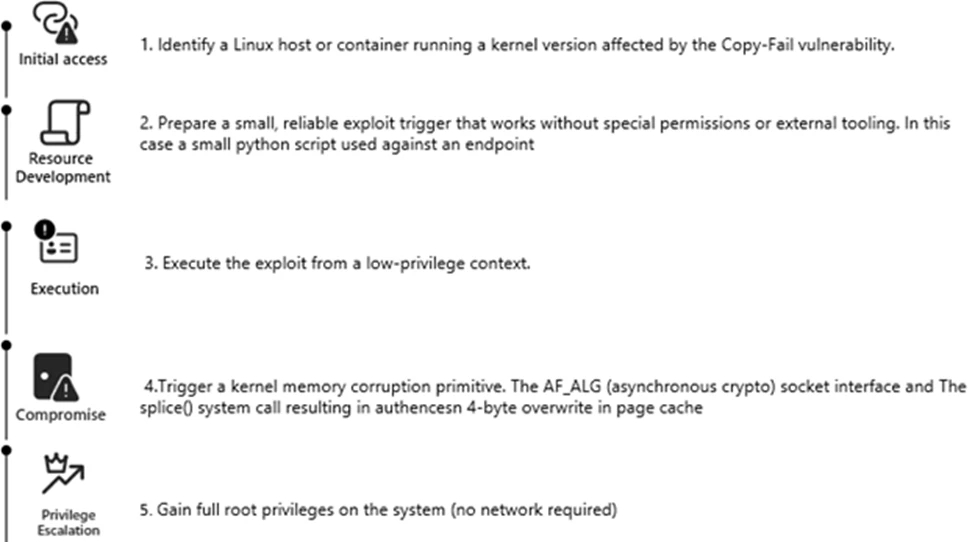
Attack Scenario
-
Initial Foothold: Attacker obtains low-privileged access (phishing payload, exposed service, weak credentials, or existing malware foothold).
-
Local Execution: Exploit code runs as non-root user.
-
Privilege Escalation: Vulnerable kernel/system path is triggered to obtain root privileges.
-
Post-Root Actions: Attacker installs persistence, steals data, and expands laterally across infrastructure.
Impact Assessment
- Full root-level control of affected Linux hosts
- Security-tool tampering and privileged persistence deployment
- Increased ability to stage follow-on compromise across trusted systems
- Unauthorized access to sensitive host and application data
- Credential and token theft risk after root compromise
- Expanded reconnaissance and intelligence collection from compromised nodes
- Service disruption from malware deployment or defensive containment actions
- Elevated downtime risk if critical Linux infrastructure is affected
- Broader operational impact through lateral movement and chained attacks
Mitigation Strategies
Immediate Actions
- Apply security patches for CVE-2026-31431 immediately across affected Linux systems.
- Prioritize exposed and high-value assets for emergency remediation.
Hardening and Access Control
- Enforce least-privilege account models and reduce interactive shell exposure.
- Restrict and regularly audit SUID/privileged binaries.
- Maintain secure configuration baselines and rapid drift correction.
Monitoring & Detection
- Monitor for anomalous privilege-escalation behavior and root process anomalies.
- Deploy EDR/XDR coverage for Linux hosts with escalation-focused detections.
- Conduct threat hunting for suspicious root-level persistence and credential access.
Long-term Resilience
- Regularly patch and harden Linux systems through automated governance.
- Segment networks to reduce lateral movement opportunities.
- Perform recurring security assessments for privilege-escalation exposure.
Resources and References
Open-Source Reporting
Last Updated: May 3, 2026