Nexcorium (Mirai Variant IoT Botnet Campaign)

Mirai Variant IoT Botnet DVR/Router Exploitation DDoS Threat
Overview
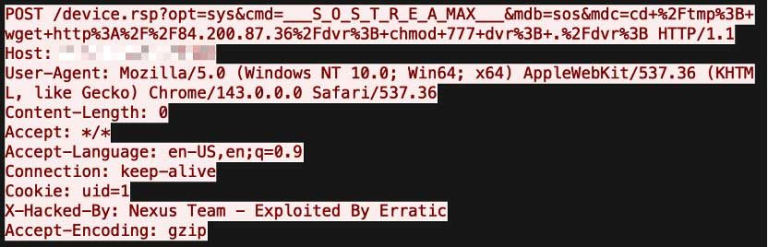
A newly identified Mirai-based malware variant, Nexcorium, is actively targeting vulnerable IoT devices including DVR systems and outdated routers. The malware exploits known vulnerabilities to gain remote access, deploys architecture-specific payloads, and enrolls compromised hosts into a DDoS botnet.
The campaign combines vulnerability exploitation, weak credential abuse, and rapid propagation to scale attack capacity.
Technical Specifications
| Attribute | Details |
|---|---|
| Malware Family | Mirai variant (Nexcorium) |
| Primary Targets | TBK DVR devices, legacy/EOL routers, exposed IoT infrastructure |
| Exploited CVEs | CVE-2024-3721 (TBK DVR command injection), CVE-2023-33538 (TP-Link), CVE-2017-17215 (Huawei lateral spread path) |
| Initial Execution Flow | Exploit triggers command injection and downloads shell script |
| Payload Selection | Script fingerprints architecture (ARM, MIPS, x86) and fetches matching binary |
| Persistence Methods | Cron job insertion (crontab) and/or service persistence (systemd) |
| Propagation Methods | Telnet brute-force, default credential abuse, network scanning |
| DDoS Capabilities | UDP flood, TCP SYN/ACK flood, SMTP flood, VSE flood |
Affected Products
- Vulnerable TBK DVR deployments exposed to internet access
- End-of-life TP-Link routers and other unpatched edge devices
- Huawei router environments susceptible to CVE-2017-17215-based spread attempts
- Networks with weak IoT segmentation, default credentials, or open Telnet services
Attack Scenario
-
Discovery: Attackers scan internet-exposed DVR/router devices for known-vulnerable services.
-
Initial Exploitation: CVE-2024-3721 is abused to execute remote commands on target devices.
-
Loader Stage: A malicious shell script is downloaded and executed.
-
Payload Deployment: The script selects architecture-specific malware binary and executes Nexcorium.
-
Persistence and Spread: Malware sets persistence, then scans/brute-forces additional devices.
-
Botnet Operations: Infected nodes are coordinated to launch large-scale DDoS attacks.
Impact Assessment
- Unauthorized remote control over IoT and surveillance-class devices
- Potential manipulation of device behavior and configuration states
- Expanded attacker foothold across poorly segmented networks
- Increased risk of unauthorized access to video/network device data
- Exposure of internal topology through compromised edge assets
- Potential intelligence collection from persistent IoT compromise
- Large-scale DDoS disruption against external targets
- Local network degradation from scanning and flooding traffic
- Operational downtime and service instability in affected environments
Mitigation Strategies
Immediate Actions
- Replace end-of-life routers, especially unsupported TP-Link models.
- Patch vulnerable DVR/edge devices where vendor updates are available.
- Disable Telnet and remove unnecessary internet exposure.
Hardening Measures
- Change all default credentials and enforce strong unique passwords.
- Segment IoT/OT devices from core business networks.
- Restrict management interfaces to trusted, authenticated access paths.
Monitoring & Detection
- Monitor outbound traffic for unusual flood/scanning behavior.
- Watch for unknown cron jobs and suspicious system services.
- Alert on repeated failed login attempts and brute-force patterns.
Long-term Controls
- Maintain continuous IoT asset inventory and exposure management.
- Apply regular vulnerability assessments to edge/embedded devices.
- Integrate IoT telemetry into SOC/SIEM detection workflows.
Resources and References
Open-Source Reporting
- Nexcorium Mirai variant exploits TBK DVR flaw to launch DDoS attacks
- Mirai Variant Nexcorium Exploits CVE-2024-3721 to Hijack TBK DVRs for DDoS Botnet
- Tracking Mirai Variant Nexcorium: A Vulnerability-Driven IoT Botnet Campaign | FortiGuard Labs
- Nexcorium malware targets IoT devices, leverages Mirai variant for DDoS attacks | brief | SC Media
- Nexcorium-Associated Mirai Variant Uses TBK DVR Exploit to Scale Botnet Operations | Cryptika Cybersecurity
Last Updated: April 19, 2026