Cisco Unified Communications Products Remote Code Execution Vulnerability
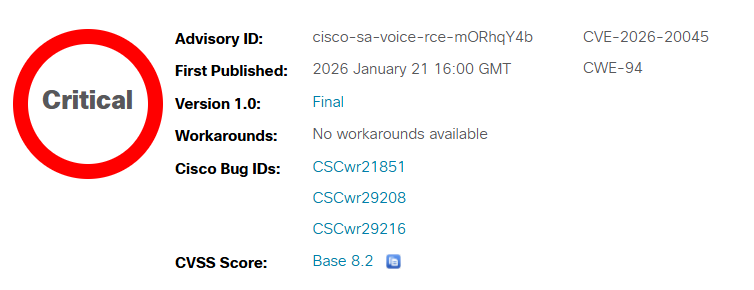
CVE-2026-20045 Remote Code Execution Unauthenticated Zero-Day Active Exploitation CVSS 8.2
Overview
A critical remote code execution vulnerability (CVE-2026-20045) has been discovered and actively exploited in Cisco's Unified Communications product suite, affecting millions of enterprise voice, video, and messaging deployments worldwide. The zero-day flaw allows unauthenticated attackers to execute arbitrary OS commands on vulnerable Cisco Unified Communications Manager (CUCM), Unified CM Session Management Edition (SME), Unified CM IM & Presence (IM&P), Unity Connection, and Webex Calling Dedicated Instance servers by sending specially crafted HTTP requests to the device's web management interface.
This vulnerability represents a severe threat to enterprise communication infrastructure, as Unified Communications systems serve as critical platforms for voice calls, video conferencing, instant messaging, and voicemail services across organizations. The flaw's unauthenticated remote attack vector, combined with the potential for privilege escalation to root access, enables complete system compromise without requiring any user interaction or credentials. Evidence of active exploitation in the wild prompted CISA to add CVE-2026-20045 to the Known Exploited Vulnerabilities (KEV) Catalog.
The vulnerability stems from improper validation of user-supplied input in HTTP requests processed by the web interface, a classic code injection weakness (CWE-94) that has plagued enterprise software for decades. Unlike typical authenticated RCE flaws, CVE-2026-20045's unauthenticated nature dramatically increases its exploitability and risk profile. Attackers can target externally exposed UC management interfaces directly from the internet, bypassing traditional perimeter defenses that assume administrative interfaces require authentication. For organizations running hybrid cloud communication platforms or providing remote administration capabilities, this vulnerability creates critical exposure to threat actors ranging from financially motivated cybercriminals to nation-state APT groups.
Vulnerability Specifications
| Attribute | Details |
|---|---|
| CVE ID | CVE-2026-20045 |
| Vulnerability Type | Remote Code Execution (RCE) / Command Injection |
| Affected Products | Cisco Unified Communications Manager (CUCM), Unified CM SME, Unified CM IM&P, Unity Connection, Webex Calling Dedicated Instance |
| Attack Vector | Network (Remote, Unauthenticated) |
| Attack Complexity | Low |
| Privileges Required | None (Unauthenticated) |
| User Interaction | None |
| Scope | Changed (Privilege Escalation to Root) |
| CVSS Base Score | 8.2 (HIGH) |
| CWE Classification | CWE-94: Improper Control of Generation of Code (Code Injection) |
| Exploitation Status | Active Exploitation Confirmed (Zero-Day) |
| Public Disclosure Date | January 2026 |
Technical Details
Architecture and Attack Surface
Cisco Unified Communications Manager serves as the core call processing and session management engine for enterprise VoIP deployments, handling call routing, signaling protocols (SIP, H.323, MGCP), and integration with PSTN gateways and IP phones. The platform exposes multiple web-based administration interfaces for system configuration, user management, and monitoring, typically accessible on ports 443 (HTTPS) and 8443 (alternate HTTPS).
The vulnerability exists in the HTTP request processing logic that handles administrative operations. When the web interface processes certain requests, user-supplied input is passed to system-level functions without proper sanitization, allowing attackers to inject arbitrary OS commands. The web administration interface includes system configuration, user/phone management, service management, and diagnostics/logging components, with the vulnerable code path residing in the request processing engine that lacks proper input validation and sanitization controls.
Exploitation Mechanics
The attack leverages command injection techniques to execute arbitrary code on the underlying Linux operating system running Cisco Unified Communications Manager. Attackers can identify vulnerable Cisco UC instances through network reconnaissance, targeting ports 443 and 8443, and using banner grabbing techniques to identify version information from administrative interfaces.
The vulnerability can be triggered through specially crafted HTTP requests to specific web interface endpoints. Attackers inject malicious payloads containing shell metacharacters and commands within HTTP POST parameters. These payloads bypass insufficient input validation and are executed in the context of the web server process. Once initial command execution is achieved, attackers can enumerate system information, check current user privileges, and leverage various privilege escalation techniques including SUID binaries, kernel exploits, or service misconfigurations to gain root access.
Post-exploitation activities typically include deploying persistent backdoors, creating privileged user accounts, and establishing command-and-control channels for maintaining long-term access to the compromised system.
Affected Versions and Products
Vulnerable product versions include:
Cisco Unified Communications Manager (CUCM): - 14.x versions prior to 14SU5 - 15.x versions prior to 15SU4
Cisco Unity Connection: - 14.x versions prior to 14SU5 - 15.x versions prior to 15SU4
Cisco Unified CM IM & Presence: - 14.x versions prior to 14SU5 - 15.x versions prior to 15SU4
Cisco Webex Calling Dedicated Instance: - Multiple versions requiring patches through Cisco Technical Assistance Center (TAC)
Attack Scenario: Financial Services Communication Infrastructure Breach
Scenario Context:
GlobalFinance Corp, a multinational investment bank with employees across multiple countries, operates a centralized Cisco Unified Communications infrastructure for voice, video conferencing, and instant messaging services. Their UC platform handles daily calls including sensitive M&A negotiations, client portfolio discussions, and executive board meetings. The organization's Cisco CUCM cluster manages IP phones, Webex Room devices, and provides voicemail services through Unity Connection.
A financially motivated threat actor group targeting the financial services sector discovered CVE-2026-20045 as a zero-day vulnerability and began scanning the internet for externally accessible Cisco UC management interfaces.
Phase 1: Discovery and Initial Compromise
The attackers' reconnaissance identified GlobalFinance's CUCM Serviceability web interface exposed on the internet to support remote administration. Using their zero-day exploit, the attackers sent crafted HTTP requests to the vulnerable endpoint, injecting commands that downloaded and executed a payload, establishing a reverse shell connection to their command-and-control infrastructure. The attackers quickly escalated from the web user to root access by exploiting a misconfigured system policy.
Phase 2: Persistence and Lateral Movement
With root access on the primary CUCM node, the attackers deployed persistent implants, harvested credentials from configuration files, accessed call detail records, compromised voicemail systems to exfiltrate executive recordings, and used CUCM as a pivot point to access network management VLANs.
Phase 3: Data Exfiltration and Intelligence Gathering
The attackers maintained access for several weeks, during which they intercepted executive voicemails containing M&A discussions and regulatory disclosures, captured call metadata records revealing communication patterns, recorded conference calls by exploiting built-in recording features, and identified insider trading opportunities by correlating call patterns with upcoming market-moving announcements. The exfiltrated intelligence was sold on underground forums and used for coordinated securities fraud schemes.
Phase 4: Detection and Response
GlobalFinance's SOC detected the breach after noticing anomalous database queries in audit logs and unusual outbound traffic. Incident response teams discovered exfiltrated data including voicemail recordings and call logs, root-level persistence mechanisms on all CUCM cluster nodes, evidence of lateral movement to other network infrastructure devices, and backdoor accounts created via compromised UC integration.
Impact Assessment
Enterprise Communication Infrastructure Risk
CVE-2026-20045 poses critical risks to organizations relying on Cisco Unified Communications for business-critical voice and video services:
- Complete System Compromise: Root-level access enables attackers to control all UC platform functions
- Call Interception: Ability to monitor, record, and manipulate voice/video communications in real-time
- Data Exfiltration: Access to call detail records, voicemail databases, contact lists, conference recordings
- Service Disruption: Potential for denial-of-service attacks against enterprise communication infrastructure
- Persistence: Root access allows deployment of backdoors surviving system reboots and basic security scans
- Lateral Movement: Compromised UC servers provide pivot points to access management VLANs and critical network infrastructure
- Confidentiality Breach: Exposure of sensitive business communications including M&A negotiations, financial discussions, strategic planning
- Intellectual Property Theft: Access to recorded conferences and voicemails containing trade secrets and proprietary information
- Regulatory Non-Compliance: Violations of data protection regulations (GDPR, HIPAA, SOX, FINRA) requiring notification and penalties
- Reputational Damage: Loss of customer and partner trust following disclosure of communication system compromises
- Operational Disruption: Emergency patching and system rebuilds causing business continuity impacts
- Financial Losses: Incident response costs, regulatory fines, litigation, insurance premium increases
- Active Exploitation: Confirmed in-the-wild attacks by sophisticated threat actors
- APT Interest: Nation-state groups targeting government and critical infrastructure UC platforms for espionage
- Ransomware Potential: Financially motivated actors using RCE access to deploy ransomware across enterprise networks
- Supply Chain Risks: MSPs and hosting providers with vulnerable UC infrastructure exposing multiple downstream clients
- Zero-Day Window: Organizations were vulnerable for unknown period before patch availability
- CISA KEV Listing: Federal mandate for remediation indicates government sector targeting and high threat priority
Sector-Specific Risks
Government: Espionage risks for classified discussions, diplomatic communications, military command coordination
Healthcare: HIPAA violations from patient communication records exposure, disruption of telehealth services
Financial Services: Insider trading opportunities from M&A intelligence, SEC/FINRA regulatory enforcement
Manufacturing: Exposure of supply chain negotiations, product development communications, customer order details
Legal: Attorney-client privilege breaches, exposure of case strategy discussions, regulatory investigation details
Mitigation Strategies
Immediate Actions (Emergency Response)
Priority 1: Patch Deployment (Complete within 72 hours)
- Identify all Cisco UC product instances using network scanning and asset inventory tools
- Verify current versions through Cisco Unified OS Administration interface
- Download appropriate patches from Cisco Software Download portal (requires valid support contracts)
- Apply patches to affected systems: CUCM 14.x requires upgrade to 14SU5, CUCM 15.x requires upgrade to 15SU4
- Schedule deployments during maintenance windows to minimize service disruption
- Verify successful patch installation and restart services as needed
Priority 2: Network Segmentation (Implement immediately)
- Restrict UC management interface access to authorized administrative networks only
- Block external access to ports 443 and 8443 on UC servers via firewall rules
- Implement access control lists allowing connections only from designated management VLANs
- Remove any internet-facing exposure of administrative interfaces
Priority 3: Threat Hunting (Begin within 24 hours)
- Review Tomcat and web server logs for suspicious HTTP requests containing command injection patterns
- Search for indicators of exploitation including wget, curl, bash, or shell commands in POST/GET parameters
- Audit user accounts for unauthorized additions or privilege escalations
- Examine system services and scheduled tasks for persistence mechanisms
- Check web application directories for recently modified or suspicious files
- Review outbound network connections for command-and-control traffic patterns
Long-Term Security Enhancements
Architecture Hardening:
-
Zero-Trust Network Design
- Deploy VPN or privileged access management solutions for administrative access to UC management interfaces
- Implement network micro-segmentation isolating UC VLANs from general corporate networks
- Require multi-factor authentication for all CUCM, Unity Connection, and IM&P administrative logins
-
Monitoring & Detection
- Configure SIEM integration for CUCM audit logs, call detail records, and web server access logs
- Deploy network behavior analytics to detect anomalous UC traffic patterns
- Implement file integrity monitoring on CUCM system directories and web application paths
- Create detection rules for command injection attempts in HTTP requests
- Establish baseline behavior profiles for administrative activities
-
Vulnerability Management
- Subscribe to Cisco Security Advisories for automated vulnerability notifications
- Implement quarterly patching cycles for UC infrastructure as minimum standard
- Conduct annual penetration testing of UC platforms by qualified third-party security firms
- Maintain current inventory of all UC components and their patch status
Best Practices:
- Principle of Least Privilege: Restrict CUCM administrative roles to necessary personnel only with role-based access controls
- Secure Development: Review custom UC integrations and API implementations for injection vulnerabilities
- Backup & Recovery: Maintain offline backups of CUCM configurations and databases for rapid recovery scenarios
- Incident Response: Develop UC-specific incident response playbooks covering communication system compromise scenarios
- Change Management: Implement formal change control processes for UC infrastructure modifications
Industry Recommendations:
- Financial Services: Treat as SEC/FINRA control deficiency requiring immediate remediation and disclosure consideration
- Healthcare: Address under HIPAA Security Rule technical safeguards for protecting electronic protected health information
- Critical Infrastructure: Align remediation with NIST Cybersecurity Framework vulnerability management requirements
- All Sectors: Consider breach notification obligations if evidence of exploitation or data exfiltration exists
Resources
Vulnerability Databases & Analysis
- Cisco Fixes Actively Exploited Zero-Day CVE-2026-20045 in Unified CM and Webex
- Cisco Unified Communications Products Remote Code Execution Vulnerability
- Cisco Unified Communications 0-day RCE Vulnerability Exploited in the Wild to Gain Root Access
- Cisco fixes Unified Communications RCE zero day exploited in attacks
- NVD - CVE-2026-20045
- Cisco fixed actively exploited Unified Communications zero day
Last Updated: January 22, 2026