Cisco AsyncOS Zero-Day Exploitation Campaign
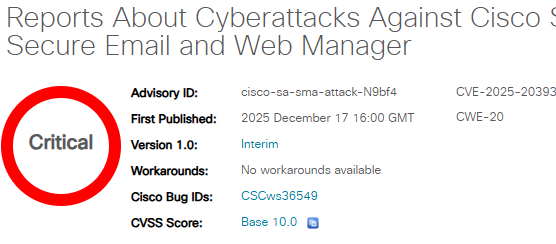
CVE-2025-20393 Zero-Day Remote Code Execution
Overview
Cisco has identified a critical zero-day vulnerability in its AsyncOS software that enables remote, unauthenticated attackers to execute arbitrary commands with root privileges on affected email security appliances. The vulnerability is being actively exploited in the wild by a China-linked advanced persistent threat group tracked as UAT-9686. The flaw stems from improper input validation in the Spam Quarantine feature of AsyncOS and affects both physical and virtual Cisco Secure Email Gateway and Cisco Secure Email and Web Manager appliances. At the time of disclosure, no patch is available, and attackers are deploying sophisticated post-exploitation tools including custom backdoors, tunneling utilities, and log-clearing mechanisms to maintain persistent, stealthy access.
Technical Specifications
| Attribute | Details |
|---|---|
| CVE ID | CVE-2025-20393 |
| Vulnerability Type | Improper Input Validation (CWE-20) |
| Attack Vector | Network (remote, unauthenticated) |
| Authentication | None required |
| Complexity | Low |
| User Interaction | Not required |
| Affected Component | AsyncOS Spam Quarantine feature |
| Exploitation Status | Actively exploited in the wild (Zero-Day) |
| Patch Status | No patch available at time of disclosure |
Affected Products
- Cisco Secure Email Gateway
- Cisco Secure Email and Web Manager
Exploitation Requirements
- Spam Quarantine enabled: Feature must be active on the appliance
- Internet exposure: Spam Quarantine interface must be accessible from the Internet
- Note: Default configurations do not expose Spam Quarantine to the Internet, but custom deployments may
Threat Actor Attribution
UAT-9686
- Origin: China-linked advanced persistent threat group
- Sophistication: High - deploying custom toolset for post-exploitation
- Objectives: Likely espionage, credential harvesting, network reconnaissance
- Custom Tools Deployed:
- AquaShell: Python-based backdoor for remote command execution
- AquaTunnel: Reverse SSH tunnel for maintaining persistent access
- Chisel: HTTP/SOCKS5 tunneling tool for bypassing firewalls
- AquaPurge: Log-clearing utility to evade detection and hide activity
Vulnerability Details
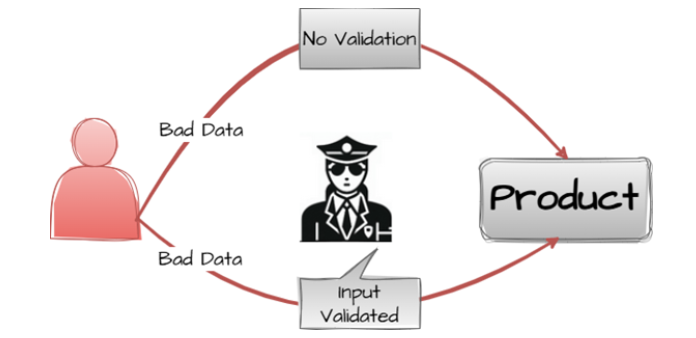
Improper Input Validation (CWE-20)
The vulnerability exists in the Spam Quarantine feature of Cisco AsyncOS. The software fails to properly validate and sanitize user-supplied input before processing it, allowing attackers to inject malicious commands that are executed by the system.
Spam Quarantine Feature
Spam Quarantine is a feature that allows users to review, release, or delete messages flagged as spam. When exposed to the Internet, it provides an attack surface that UAT-9686 has successfully exploited.
Root-Level Access
Successful exploitation grants attackers root privileges on the affected appliance, providing: - Complete control over the email security appliance - Ability to read, modify, or delete any data - Capability to install persistent backdoors - Access to intercept and manipulate email traffic - Power to disable security features and logging
Attack Scenario
- Target Identification: Attacker identifies a vulnerable Cisco email security appliance with Spam Quarantine feature enabled and exposed publicly to the Internet
- Exploitation: Attacker sends specially crafted HTTP requests that trigger the improper input validation flaw in the Spam Quarantine interface
- Command Execution: Malicious input is processed by the system, executing arbitrary commands with root privileges on the appliance
- Post-Exploitation Tool Deployment: Attacker deploys sophisticated persistence and post-exploitation toolkit:
- AquaShell: Python backdoor for persistent remote command execution
- AquaTunnel: Reverse SSH tunnel establishing covert communication channel
- Chisel: HTTP/SOCKS5 tunneling tool for bypassing network restrictions
- AquaPurge: Log-clearing utility to remove traces of compromise
- Persistence & Stealth: With backdoors installed and logs cleared, attacker maintains stealthy access, evades detection, and potentially pivots to internal networks using the compromised email gateway as a foothold
Impact Assessment
- Full compromise of email security appliances at root level
- Unauthorized modification of email security policies
- Manipulation of email filtering and quarantine decisions
- Installation of persistent backdoors and malicious tools
- Tampering with security configurations
- Interception of email traffic passing through appliance
- Access to quarantined messages and sensitive communications
- Exposure of email metadata and routing information
- Harvesting of user credentials from email traffic
- Access to appliance configurations and security policies
- Potential disruption of email security processing
- Service degradation through malicious configurations
- Risk of email service outages
- Denial of legitimate email delivery
- Resource exhaustion through malicious activity
- Security Bypass: Ability to allow malicious emails to bypass filtering
- Spam/Malware Injection: Capability to inject spam or malware into email stream
- Policy Manipulation: Modification of email security policies and rules
- Detection Evasion: Disabling or manipulation of threat detection mechanisms
- Trust Violation: Compromise of trusted email security infrastructure
Mitigation Strategies
🔄 Immediate Actions (No Patch Available)
- Disable Spam Quarantine: Disable Spam Quarantine feature if not critically needed
- Restrict Internet Access: Ensure Spam Quarantine is NOT exposed to the Internet
- Access Control Review: Verify only trusted internal networks can access appliance management interfaces
- Network Segmentation: Place appliances behind firewall/VPN segmentation
- Emergency Isolation: Consider isolating suspected compromised appliances immediately
🛡️ Access Restriction & Hardening
- Trusted Networks Only: Restrict appliance access to trusted internal networks exclusively
- Firewall Rules: Implement strict firewall rules blocking external access to management interfaces
- VPN Requirement: Require VPN access for any remote administration
- IP Whitelisting: Allow access only from specific trusted IP addresses
- Network Perimeter Protection: Deploy additional protective layers (IPS, WAF) in front of appliances
🔒 Authentication & Access Control
- Strong Authentication: Implement strong authentication mechanisms for all appliance access
- Multi-Factor Authentication: Enable MFA for administrative access where supported
- TLS Enforcement: Use TLS/SSL for all management interface connections
- Credential Rotation: Rotate all credentials, especially if compromise is suspected
- Privilege Management: Apply least-privilege principles to user accounts
🔍 Detection & Monitoring
- Log Analysis: Monitor logs and network traffic for suspicious activity
- Unusual POST Requests: Alert on unexpected POST requests to Spam Quarantine interfaces
- Command Execution Monitoring: Watch for unusual command executions or process launches
- Network Traffic Analysis: Monitor for reverse SSH connections, tunneling activity, or unusual outbound connections
- File Integrity Monitoring: Deploy FIM to detect unauthorized file modifications
- Indicator Detection: Search for indicators of AquaShell, AquaTunnel, Chisel, and AquaPurge
📊 Continuous Actions
- Vendor Monitoring: Stay ready to apply vendor patches as soon as they are released
- Security Advisories: Monitor Cisco security advisories closely for updates
- Configuration Audits: Regularly audit appliance configurations for security best practices
- Penetration Testing: Include email security appliances in regular security assessments
Indicators of Compromise (IOCs)
Custom Tool Signatures
- AquaShell: Python-based backdoor (search for unusual Python processes)
- AquaTunnel: Reverse SSH tunnel connections (monitor for unexpected SSH sessions)
- Chisel: HTTP/SOCKS5 tunneling tool (detect Chisel binaries or processes)
- AquaPurge: Log-clearing utility (identify gaps in logs or log manipulation)
Behavioral Indicators
- Unexpected outbound SSH connections from email appliances
- Unusual HTTP/HTTPS tunneling traffic
- Suspicious Python processes running on appliances
- Log deletion or manipulation events
- Unexpected administrative logins or command executions
- Network connections to known UAT-9686 infrastructure
Resources and References
Official Documentation & Analysis
- Reports About Cyberattacks Against Cisco Secure Email Gateway And Cisco Secure Email and Web Manager
- Cisco AsyncOS 0-Day Vulnerability Exploited in the Wild to run System-level Commands
- Cisco Warns of Active Attacks Exploiting Unpatched 0-Day in AsyncOS Email Security Appliances
- Cisco warns of unpatched AsyncOS zero-day exploited in attacks
- Cisco email security appliances rooted and backdoored via still unpatched zero-day - Help Net Security
- Cisco Warns of Active Attacks Exploiting Unpatched 0-Day in AsyncOS Email Security Appliances | OffSeq Threat Radar
- Cisco AsyncOS Zero-Day Actively Exploited to Execute System-Level Commands
Critical Zero-Day Warning
This vulnerability is being actively exploited in the wild by a China-linked APT group (UAT-9686) and no patch is currently available. Organizations using Cisco email security appliances must implement immediate mitigations to prevent compromise. The sophisticated post-exploitation toolkit suggests long-term espionage objectives.
No Patch Available
At the time of disclosure, Cisco has not released a patch for this vulnerability. Organizations must rely on workarounds and mitigations until a security update becomes available. Monitor Cisco security advisories closely for patch release.
Security Best Practice
For email security infrastructure protection:
- Never expose email security appliance management interfaces to the Internet
- Disable unnecessary features like Spam Quarantine if not required
- Implement network segmentation for email security infrastructure
- Deploy defense-in-depth with multiple security layers
- Monitor for APT indicators and anomalous behavior
- Apply patches immediately when released