China-Linked "Ink Dragon" APT Espionage Campaign

APT Campaign China-Linked ShadowPad Government Targets
Overview
Ink Dragon is a China-linked APT cluster conducting cyber espionage operations across multiple continents in 2025, targeting government and telecom networks in Asia, South America, and Europe. The campaign leverages misconfigured Microsoft IIS and SharePoint servers as initial access vectors, exploiting predictable ASP.NET machine keys for ViewState deserialization attacks to achieve remote code execution. The threat actor deploys advanced malware including ShadowPad backdoor and FINALDRAFT (Squidoor) remote administration tools to maintain stealthy long-term persistence, exfiltrate sensitive data, and transform compromised systems into C2 relay nodes. The relay network architecture blends malicious traffic with legitimate communications, complicating detection and containment. The campaign demonstrates sophisticated tradecraft targeting governmental infrastructure with potential impact on regional and global decision-making.
Campaign Specifications
| Attribute | Details |
|---|---|
| Threat Actor | Ink Dragon (China-Linked APT Cluster) |
| Campaign Timeline | Active and expanding in 2025 |
| Target Sectors | Government, Telecommunications |
| Target Regions | Asia, South America, Europe, Africa |
| Initial Access Vector | Misconfigured Microsoft IIS and SharePoint servers |
| Primary Exploit | ASP.NET ViewState Deserialization (predictable machine keys) |
| Malware Families | ShadowPad, FINALDRAFT (Squidoor), VARGEIT, NANOREMOTE |
| Attack Objectives | Espionage, Data Exfiltration, Network Relay Establishment |
| Persistence Mechanisms | Scheduled tasks, Windows services, firewall rule modifications |
| Lateral Movement | Credential dumping (LSASS), registry hive extraction, privilege escalation |
| C2 Architecture | Multi-hop relay network using compromised IIS servers |
| Attribution Confidence | Medium-High (China-linked based on malware, targets, and TTPs) |
| Detection Difficulty | High (stealthy implants, relay obfuscation, legitimate traffic blending) |
Technical Details
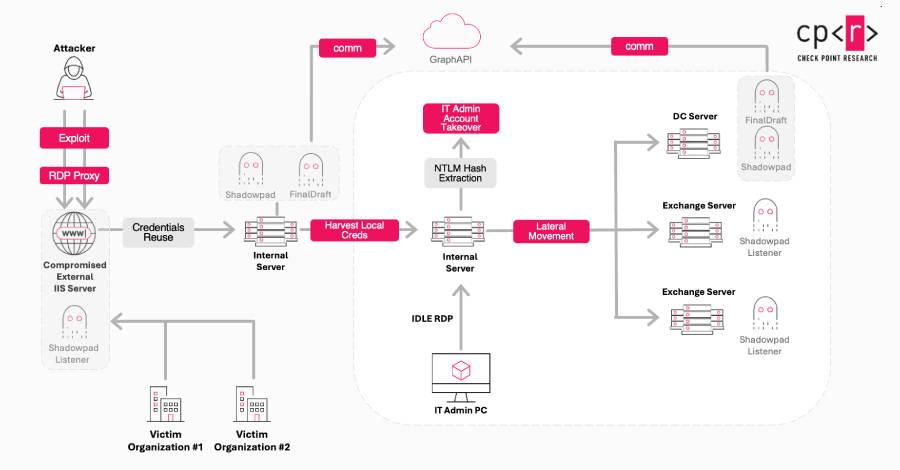
Initial Access and Exploitation
Ink Dragon gains initial foothold through exploitation of internet-facing web applications:
- Misconfigured IIS Servers: Targets Microsoft Internet Information Services (IIS) servers with insecure configurations, weak authentication, or outdated security settings
- SharePoint Vulnerabilities: Exploits misconfigured or unpatched SharePoint installations exposed to internet
- ASP.NET ViewState Deserialization: Leverages predictable or weak ASP.NET machine keys to craft malicious ViewState payloads that trigger deserialization vulnerabilities, achieving remote code execution without authentication
- Web Shell Deployment: After initial exploitation, deploys ASP.NET web shells (ASPX files) for persistent command execution and file upload capabilities
Malware Arsenal
ShadowPad Backdoor
ShadowPad is a modular remote access trojan (RAT) widely used by Chinese APT groups:
- Modular Architecture: Plugin-based framework allowing operators to load additional capabilities on demand (keylogging, screen capture, file operations)
- Encrypted Communications: Uses custom encryption protocols to hide C2 traffic from network inspection
- IIS Listener Module: Custom ShadowPad variant includes IIS listener component that embeds backdoor functionality into legitimate IIS processes, allowing compromised web servers to act as C2 relays
- Stealth Techniques: Process injection, DLL side-loading, and memory-only execution to evade endpoint detection
FINALDRAFT (Squidoor)
FINALDRAFT (also tracked as Squidoor) is an advanced remote administration malware:
- Enhanced Stealth: Designed for long-term persistence with minimal forensic footprint
- Data Exfiltration: Specialized modules for identifying, compressing, and exfiltrating sensitive documents and credentials
- Network Reconnaissance: Built-in capabilities for network mapping, asset discovery, and identification of high-value targets
- Multi-Stage Deployment: Typically deployed after initial ShadowPad infection, indicating escalation to high-priority targets
Supporting Tools
- VARGEIT: Component of toolkit, specific functionality not fully disclosed (likely credential harvesting or lateral movement module)
- NANOREMOTE: Lightweight remote access component, possibly used for initial reconnaissance or low-footprint persistence
Relay Network Architecture
Ink Dragon's most distinctive capability is the establishment of C2 relay networks:
- Compromised IIS Servers as Relays: Infected web servers configured to forward C2 commands between attacker infrastructure and deeper network targets
- Traffic Blending: Relay nodes mix malicious C2 traffic with legitimate HTTP/HTTPS web traffic, making network-based detection extremely difficult
- Multi-Hop Communication: Commands routed through multiple compromised hosts before reaching final target, complicating attribution and takedown
- Resilient Infrastructure: Loss of individual relay nodes doesn't disrupt entire operation; network can dynamically reconfigure
Credential Harvesting and Privilege Escalation
- LSASS Memory Dumps: Extracts credentials from Local Security Authority Subsystem Service (LSASS) process memory using tools like ProcDump or custom dumpers
- Registry Hive Extraction: Copies SAM, SECURITY, and SYSTEM registry hives for offline password hash cracking
- Pass-the-Hash Attacks: Uses harvested NTLM hashes for lateral movement without needing plaintext passwords
- Domain Enumeration: Active Directory reconnaissance to identify privileged accounts, domain controllers, and critical servers
Persistence and Defense Evasion
- Scheduled Tasks: Creates tasks that periodically execute malware loaders, often disguised with legitimate-sounding names
- Windows Services: Installs malware as system services for automatic startup and SYSTEM-level privileges
- Firewall Rule Modification: Adds permissive outbound firewall rules to allow C2 communications and data exfiltration
- Legitimate Tool Abuse: Uses built-in Windows utilities (PowerShell, WMI, WMIC, net commands) to minimize custom tooling and evade behavioral detection
Attack Scenario
Step-by-Step Campaign Execution
-
External Reconnaissance
Ink Dragon conducts internet-wide scanning for exposed Microsoft IIS and SharePoint servers. Identifies misconfigured instances with predictable ASP.NET machine keys or known vulnerabilities. Uses tools like Shodan, Censys, and custom scanners to enumerate targets in government and telecom sectors across Asia, South America, and Europe. -
Initial Exploitation — ViewState Deserialization
Attackers craft malicious ASP.NET ViewState payloads exploiting predictable machine keys. Sends crafted HTTP requests triggering deserialization vulnerability, achieving remote code execution on IIS/SharePoint server. No authentication required. Executes commands with IIS application pool privileges. -
Web Shell Deployment
Uploads ASPX web shell to compromised server for persistent command execution. Web shell typically disguised as legitimate file (e.g.,error.aspx,upload.aspx) in rarely-monitored directories. Provides file upload, command execution, and network pivoting capabilities. -
Malware Installation — ShadowPad and FINALDRAFT
Deploys ShadowPad backdoor via web shell or staged loader. Installs IIS listener module to convert server into C2 relay node. For high-value targets, deploys FINALDRAFT for advanced exfiltration and reconnaissance. Additional components (VARGEIT, NANOREMOTE) installed based on operational requirements. -
Credential Harvesting and Privilege Escalation
Dumps LSASS process memory to extract plaintext passwords, NTLM hashes, and Kerberos tickets. Copies registry hives (SAM, SECURITY, SYSTEM) for offline analysis. Uses harvested credentials for lateral movement to domain controllers, file servers, and workstations. Escalates to domain administrator privileges. -
Persistence Establishment
Creates scheduled tasks for periodic malware execution. Installs malware as Windows services with automatic startup. Modifies Windows Firewall rules to allow broad outbound connectivity. Deploys multiple persistence mechanisms to survive reboots and detection attempts. -
Relay Network Configuration
Configures compromised IIS servers as C2 relay nodes using ShadowPad IIS listener. Relay nodes forward commands between attacker-controlled infrastructure and internal targets. Malicious traffic blends with legitimate HTTP/HTTPS traffic, evading network monitoring. Multi-hop architecture provides operational resilience and attribution complexity. -
Data Exfiltration and Long-Term Espionage
Identifies and exfiltrates sensitive government documents, diplomatic communications, operational data, and network architecture information. Maintains stealthy long-term presence for ongoing intelligence collection. Monitors victim communications, policy discussions, and strategic decision-making processes.
Impact Assessment
- Compromise of government networks in multiple countries provides China-linked actors with strategic intelligence on policy decisions, diplomatic strategies, and regional negotiations.
- Access to sensitive communications enables anticipation of government positions, potential blackmail opportunities, and influence operations.
- Long-term persistence allows real-time monitoring of evolving political situations.
- Impact extends beyond data theft to potential disruption of democratic processes and national sovereignty violations.
- Targeting of telecom networks provides access to communications metadata and content for surveillance of specific individuals, organizations, or government officials.
- Compromised telecom infrastructure enables interception of calls, SMS, and data traffic.
- Attackers can identify targets' locations, communication patterns, and social networks.
- Access to telecom routing and signaling systems could enable traffic manipulation or service disruption.
- Relay network architecture makes detection and remediation extremely challenging.
- Compromised systems continue forwarding traffic even after apparent cleanup, requiring comprehensive network-wide investigation.
- Credential theft enables persistent re-entry even after malware removal.
- Organizations face extended incident response timelines and uncertainty about full scope of compromise.
- False sense of security after partial remediation allows attackers to maintain access.
- Multi-continent targeting (Asia, South America, Europe) suggests coordinated intelligence collection supporting China's geopolitical objectives.
- Compromised governmental infrastructure could influence international negotiations, trade agreements, and security partnerships.
- Intelligence collected may support economic espionage, intellectual property theft, or diplomatic coercion.
- Revelation of extensive compromise could damage international trust and strain diplomatic relations.
Mitigation Strategies
Preventive Actions
- IIS and SharePoint Hardening: Remove unnecessary features, disable directory browsing, implement principle of least privilege for application pools. Restrict administrative access to trusted IPs only.
- Machine Key Rotation: Regenerate ASP.NET machine keys with cryptographically strong random values. Configure unique keys per application. Store keys securely outside web directories. Rotate keys regularly.
- Security Patching: Maintain current patch levels for Windows Server, IIS, SharePoint, and .NET Framework. Subscribe to Microsoft security advisories. Implement automated patch management where feasible.
- Network Segmentation: Isolate internet-facing web servers in DMZ with strict firewall rules. Prevent direct communication between DMZ and internal corporate network. Require proxy or jump host for any DMZ-to-internal access.
- Input Validation: Implement strict input validation for all web applications. Disable ViewState where not required. Enable ViewState MAC (Message Authentication Code) validation.
Detection and Monitoring
- EDR Deployment: Deploy Endpoint Detection and Response (EDR) solutions across all servers and workstations. Configure behavioral analytics to detect LSASS dumping, suspicious scheduled tasks, and unusual outbound connections.
- Network Traffic Analysis: Monitor for unusual HTTP/HTTPS patterns from IIS servers, especially to unexpected external IPs. Detect multi-hop traffic patterns indicating relay behavior. Analyze SSL/TLS certificate anomalies.
- Web Server Integrity Monitoring: Implement file integrity monitoring (FIM) for IIS and SharePoint directories. Alert on creation of new ASPX files, DLL modifications, or IIS configuration changes. Review IIS logs for anomalous requests.
- Credential Monitoring: Deploy honeypot accounts and monitor for unauthorized access attempts. Alert on privilege escalation events. Track usage of administrative credentials across network.
- Scheduled Task Auditing: Monitor creation of new scheduled tasks. Investigate tasks with suspicious names, unusual execution times, or references to temporary directories. Correlate with user authentication logs.
Threat Hunting
- ShadowPad Indicators: Hunt for ShadowPad artifacts: encrypted configuration files, characteristic DLL names, registry keys, and network beaconing patterns documented in threat intelligence reports.
- FINALDRAFT Signatures: Search for FINALDRAFT file hashes, mutex names, and command-and-control patterns. Review archives and staging directories for exfiltration preparation.
- Relay Node Identification: Analyze IIS servers forwarding traffic to unusual destinations. Identify systems acting as proxy or relay without legitimate business justification. Investigate systems with both inbound and outbound connections to external IPs.
- Registry and LSASS Dumps: Hunt for ProcDump usage, registry hive copies in unusual locations (TEMP, user directories), or SAM database exports. Investigate unexplained memory dumps.
Incident Response
- System Isolation: Immediately isolate suspected compromised hosts from network. Maintain forensic copies of volatile memory and disk for investigation. Do not immediately reboot (destroys memory evidence).
- Credential Reset: Force password reset for all user accounts in affected domains, prioritizing administrative and service accounts. Invalidate cached credentials and Kerberos tickets. Assume all credentials harvested.
- Relay Node Elimination: Identify and remediate all relay nodes in network. Removing only directly-compromised systems insufficient; attackers maintain access through relay infrastructure. Network-wide investigation required.
- Malware Removal: Use known indicators of compromise (IOCs) to search for and remove ShadowPad, FINALDRAFT, and associated tools across entire environment. Rebuild critical systems from known-clean media.
- Firewall Rule Review: Audit all firewall rules, especially outbound rules. Remove any permissive rules added by attackers. Implement default-deny egress policy with explicit allows for required services.
Long-Term Hardening
- Zero Trust Architecture: Implement zero trust principles requiring authentication and authorization for all network communications, even between internal systems. Eliminate implicit trust based on network location.
- Privileged Access Workstations (PAWs): Restrict administrative access to hardened workstations used solely for administration. Prevent privileged credential use on general-purpose systems.
- Multi-Factor Authentication: Enforce MFA for all administrative access, VPN connections, and access to sensitive systems. Use phishing-resistant MFA (FIDO2, smart cards) where possible.
- Regular Security Audits: Conduct periodic penetration testing and red team exercises specifically testing for IIS/SharePoint misconfigurations and credential harvesting resilience.
Resources
Threat Intelligence Reports
- Chinese-based Ink Dragon Compromises Asia and South America into European
- China-Linked Ink Dragon Hacks Governments Using ShadowPad and FINALDRAFT Malware
- Experts Warn Chinese "Ink Dragon" Hackers Extend Reach into European Governments — TechRadar
- Ink Dragon's Relay Network and Stealthy Offensive Operation