Cisco SD-WAN Zero-Day CVE-2026-20127 Exploited Since 2023 for Admin Access
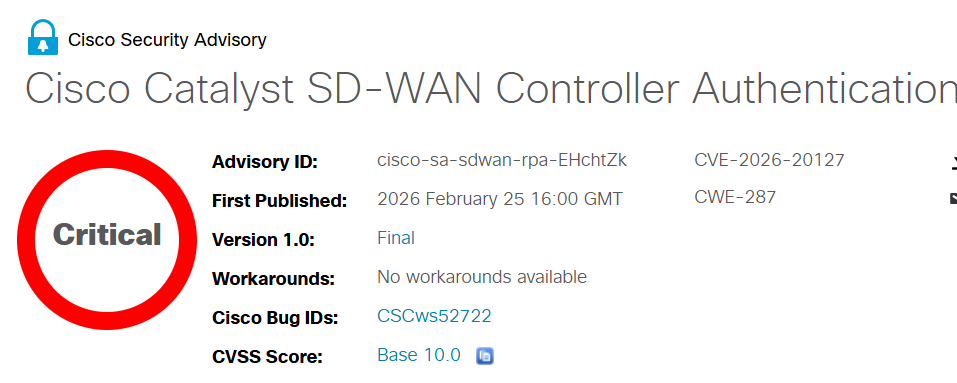
CVE-2026-20127 Authentication Bypass CVSS 10.0 Zero-Day UAT-8616
Overview
Cisco disclosed a critical zero-day authentication bypass vulnerability in Cisco Catalyst SD-WAN Controller (vSmart) and Cisco Catalyst SD-WAN Manager (vManage), tracked as CVE-2026-20127 (CVSS 10.0). The flaw has reportedly been actively exploited since at least 2023 by a sophisticated threat actor tracked as UAT-8616 to gain high-privileged access and establish long-term persistence in SD-WAN infrastructures.
Technical Specifications
| Attribute | Details |
|---|---|
| CVE ID | CVE-2026-20127 |
| Vulnerability Type | Improper authentication / authentication bypass (CWE-287) |
| CVSS Score | 10.0 (Critical) |
| Affected Products | Cisco Catalyst SD-WAN Controller (vSmart), Cisco Catalyst SD-WAN Manager (vManage) |
| Root Cause | Peering authentication mechanism does not function correctly, allowing crafted request bypass |
| Access Requirements | Remote unauthenticated network access to reachable controller/manager interfaces |
| Initial Access Outcome | Login as internal high-privileged non-root user with NETCONF/API access |
| Threat Actor | UAT-8616 (per Cisco Talos), active exploitation observed since at least 2023 |
Affected Products
- Cisco Catalyst SD-WAN Controller (formerly vSmart)
- Cisco Catalyst SD-WAN Manager (formerly vManage)
- Certain vulnerable software versions listed in Cisco’s advisory
- Enterprise and government SD-WAN deployments where controller/manager interfaces are reachable
- Status: Actively exploited; patching required
Technical Details
Vulnerability Mechanics
- CVE-2026-20127 is an authentication bypass in the SD-WAN peering authentication mechanism.
- A remote unauthenticated attacker can send specially crafted requests to bypass normal authentication checks.
- Successful exploitation grants access as an internal high-privileged non-root account.
Post-Authentication Abuse Path
- With high-privileged access, attackers can use NETCONF and management APIs.
- They can alter SD-WAN fabric configuration, modify peers, and change route/policy behavior.
- This enables potential interception, redirection, or disruption of branch-to-data-center traffic.
Observed Escalation Chain (Cisco/ACSC Reporting)
- Actor adds rogue peers and manipulates control-plane state.
- Device/software is downgraded to a release vulnerable to CVE-2022-20775 (path traversal).
- CVE-2022-20775 is exploited to obtain root access.
- System is upgraded back while preserving persistence and privileged foothold.
Attack Scenario
-
Target Discovery:
- Attacker identifies internet-exposed or otherwise reachable Cisco SD-WAN Controllers/Managers.
-
Zero-Day Exploitation:
- Crafted requests exploit CVE-2026-20127 to bypass authentication.
- Attacker logs in as an internal high-privileged non-root user.
-
Control-Plane Manipulation:
- Attacker accesses NETCONF and management APIs.
- Rogue SD-WAN peers are added and configuration/policies are modified.
-
Root Escalation & Persistence:
- Attacker downgrades software to a version vulnerable to CVE-2022-20775.
- Path traversal exploit is used to gain root, followed by re-upgrade to conceal activity.
-
Long-Term Operations:
- Persistent access supports traffic interception, policy tampering, stealth monitoring, and potential pivoting into connected branch/data-center networks.
Impact Assessment
- Unauthorized changes to routing, VPN, and SD-WAN policy across the fabric
- Injection of rogue peers and manipulation of control-plane relationships
- Potential tampering with enterprise-wide traffic handling behavior
- Traffic interception and monitoring opportunities between sites
- Exposure of sensitive operational and network management data
- Elevated espionage risk in enterprise/government environments
- Disruption of inter-site connectivity and branch operations
- Potential outage conditions from malicious configuration changes
- Increased recovery complexity when persistence/root access is established
Mitigation Strategies
Immediate Actions
- Patch immediately to fixed Cisco software versions listed in the official advisory
- Treat patching as mandatory; there are no configuration-only workarounds that remove the vulnerability
- Follow Cisco temporary hardening guidance only as interim risk reduction
Network Hardening
- Restrict management and peering interface access to trusted management networks and approved peers only
- Avoid direct internet exposure of SD-WAN controllers/managers
- Enforce strict ACLs and segmentation around SD-WAN control-plane systems
Threat Hunting & Detection
- Hunt for unexplained configuration changes (new peers, altered NETCONF settings)
- Investigate unusual downgrade/upgrade sequences around vulnerable releases
- Review for unauthorized root access indicators and suspicious local account activity
- Correlate alerts with national-agency and vendor IoCs related to UAT-8616 activity
Resources and References
Official & Security Reporting
- Cisco Catalyst SD-WAN Controller Authentication Bypass Vulnerability
- Cisco SD-WAN Zero-Day CVE-2026-20127 Exploited Since 2023 for Admin Access
- Critical Cisco SD-WAN bug exploited in zero-day attacks since 2023
- Governments issue warning over Cisco zero-day attacks dating back to 2023 | CyberScoop
- Threat actor leveraged Cisco SD-WAN zero-day since 2023 (CVE-2026-20127) - Help Net Security
- CVE-2026-20127 Zero-Day Auth Bypass Exploited | Tenable®
- CVE-2026-20127 - Cisco Catalyst Zero-Day Vulnerability | eSentire
Last Updated: February 26, 2026