Suspected Russian Hackers Abuse Google OAuth and WhatsApp Linking to Hijack Accounts
Account Hijacking OAuth Phishing Social Engineering Russian APT MFA Bypass Device Linking Abuse
Overview
Three suspected Russian cyber-espionage clusters — UNC6293, UNC7005, and UNC5976 — conducted persistent phishing campaigns designed to compromise victims' personal accounts.
Rather than directly exploiting vulnerabilities in Google or WhatsApp, the attackers abused legitimate authentication and device-linking functionality. Victims were socially engineered into authenticating through Google OAuth flows or linking an attacker-controlled WhatsApp device, enabling account takeover without requiring password compromise.
Technical Specifications
| Attribute | Details |
|---|---|
| Attack Groups | UNC6293, UNC7005, UNC5976 (suspected Russian cyber-espionage) |
| Primary Attack Vector | OAuth phishing and device-linking abuse |
| Authentication Method Abused | Google OAuth (legitimate flow), WhatsApp device linking (legitimate flow) |
| Exploitation Technique | Social engineering, phishing pages impersonating trusted services, redirect infrastructure |
| Account Access Method | OAuth token theft or attacker-controlled device linking |
| Key Weakness | User-approved legitimate flows without authentication resistance or device verification |
| Target Profile | High-value individuals including executives, researchers, diplomats, defense personnel |
| Exploitation Status at Disclosure | Ongoing campaigns documented by security researchers |
Affected Products
- Google Workspace and personal Google accounts
- WhatsApp messaging application
- File-sharing services commonly used by target organizations
- Any organization whose personnel are targeted by phishing campaigns
- Email providers and document-storage platforms accessed via OAuth integration
Attack Scenario
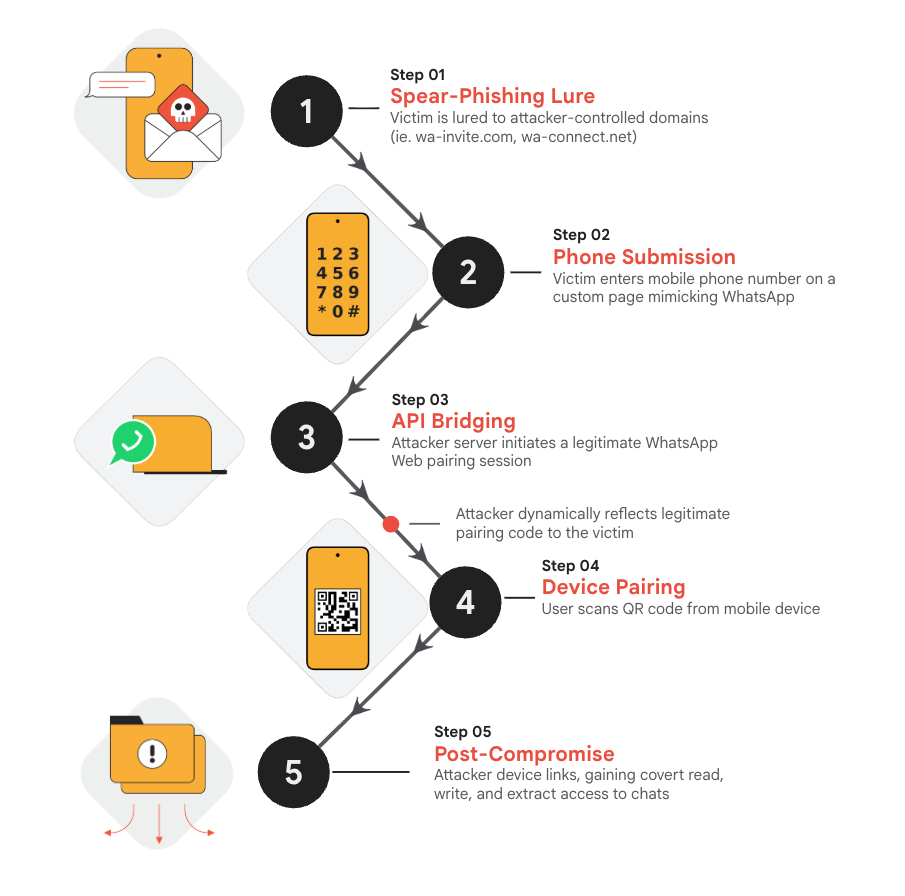
- Attacker identifies a high-value target (executive, researcher, diplomat, or defense personnel).
- Attacker sends tailored phishing message with malicious link or attachment.
- Victim visits a convincing malicious website impersonating a file-sharing service or trusted organization.
- Victim is seamlessly directed through a legitimate Google OAuth authentication process or WhatsApp device-linking workflow.
- Victim authenticates or approves the device-linking request, believing it is legitimate.
- Attacker obtains OAuth token or successfully links their own device to the victim's WhatsApp account.
- Attacker accesses the compromised account, reading emails, documents, and messaging communications.
- Attacker may conduct further credential theft, surveillance, malware deployment, or contact targeting.
Impact Assessment
- Account credentials and session tokens compromised and exploitable by attackers
- Potential lateral movement to linked services and contacts
- Victim accounts used to conduct follow-on phishing and social engineering
- Malware or remote-access tools potentially deployed through compromised accounts
- Full access to personal email and document storage
- Complete access to messaging history and contacts
- Exposure of organizational intelligence and operational information
- Risk to follow-on targets identified through compromised contacts and communications
- Account unavailability due to attacker control or password changes
- Disruption of victim's ability to communicate securely
- Potential service disruptions from incident response and remediation efforts
- Organizational impact from compromised personnel communications
Mitigation Strategies
Immediate Actions
- Enable phishing-resistant authentication such as passkeys or hardware security keys.
- Review OAuth application grants and revoke suspicious or unrecognized third-party applications.
- Inspect and remove unrecognized or suspicious devices from WhatsApp Linked Devices.
- Reset passwords for all potentially affected accounts and clear active sessions.
Short-term Measures
- Enable and enforce multi-factor authentication on all critical accounts.
- Review OAuth token activity logs and revoke any suspicious or unexplained tokens.
- Monitor authentication logs for unusual sign-in patterns, locations, or devices.
- Never approve a WhatsApp device-linking request solely because a website instructs you to—use official WhatsApp workflows only.
Monitoring & Detection
- Monitor for suspicious OAuth token creation or API access patterns.
- Alert on authentication from unusual locations, devices, or times.
- Review email forwarding rules, recovery contacts, and connected applications for unauthorized changes.
- Monitor domains impersonating organizational partners, conferences, file-sharing services, and defense organizations.
Long-term Solutions
- Strengthen phishing and social-engineering awareness training, with particular focus on executives, researchers, diplomats, and defense personnel.
- Implement conditional access policies to restrict authentication from unusual or high-risk locations.
- Maintain endpoint protection to detect and prevent installation of infostealer malware or remote-access trojans.
- Establish regular account audits and access reviews for high-value personnel.
- Deploy email security controls to detect and block OAuth phishing campaigns.
Resources and References
Public Reporting and Advisories
Last Updated: August 23, 2026