Vercel Confirms Breach as Hackers Claim to Be Selling Stolen Data
Cloud Platform Breach OAuth Abuse Third-Party Risk Supply Chain Exposure
Overview
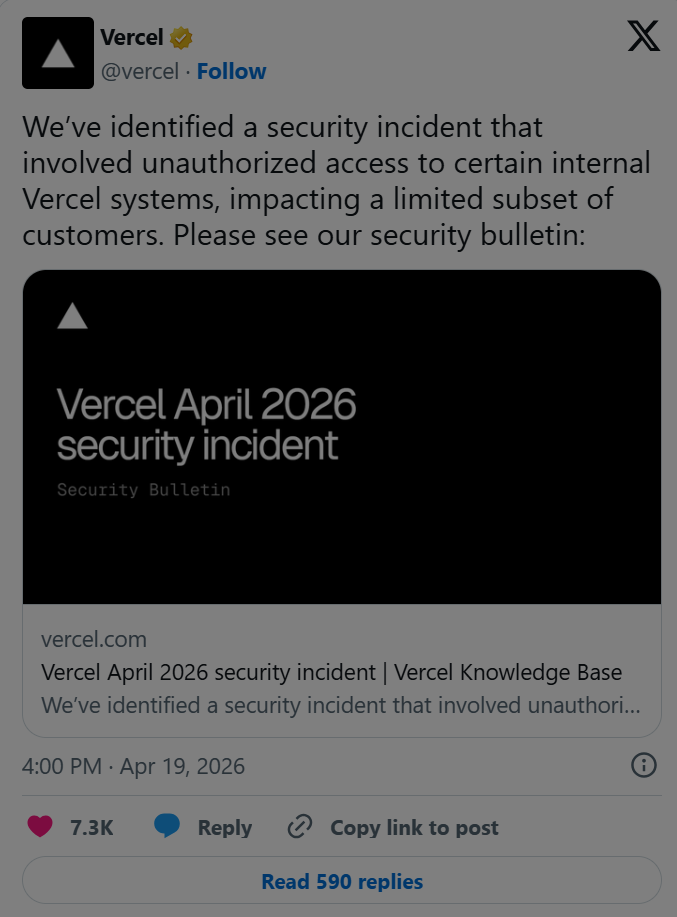
Vercel confirmed a security incident in April 2026 after attackers claimed they were selling stolen data from the company. According to Vercel, the intrusion originated from a compromised third-party integration, and the observed impact affected only a limited subset of users. The attacker path reportedly involved abuse of a Google Workspace OAuth application, which enabled unauthorized access to an employee account and subsequent movement into internal systems.
Technical Specifications
| Attribute | Details |
|---|---|
| Incident Type | Unauthorized access / cloud platform breach |
| Initial Access Vector | Compromised third-party integration (Context.ai) |
| Identity Abuse Method | Malicious or abused Google Workspace OAuth app |
| Compromised Principal | Vercel employee account |
| Post-Compromise Activity | Internal pivoting and data access |
| Data Accessed | Internal docs/systems, employee metadata, non-sensitive environment variables |
| Sensitive Env Vars | Reported as protected and not exposed |
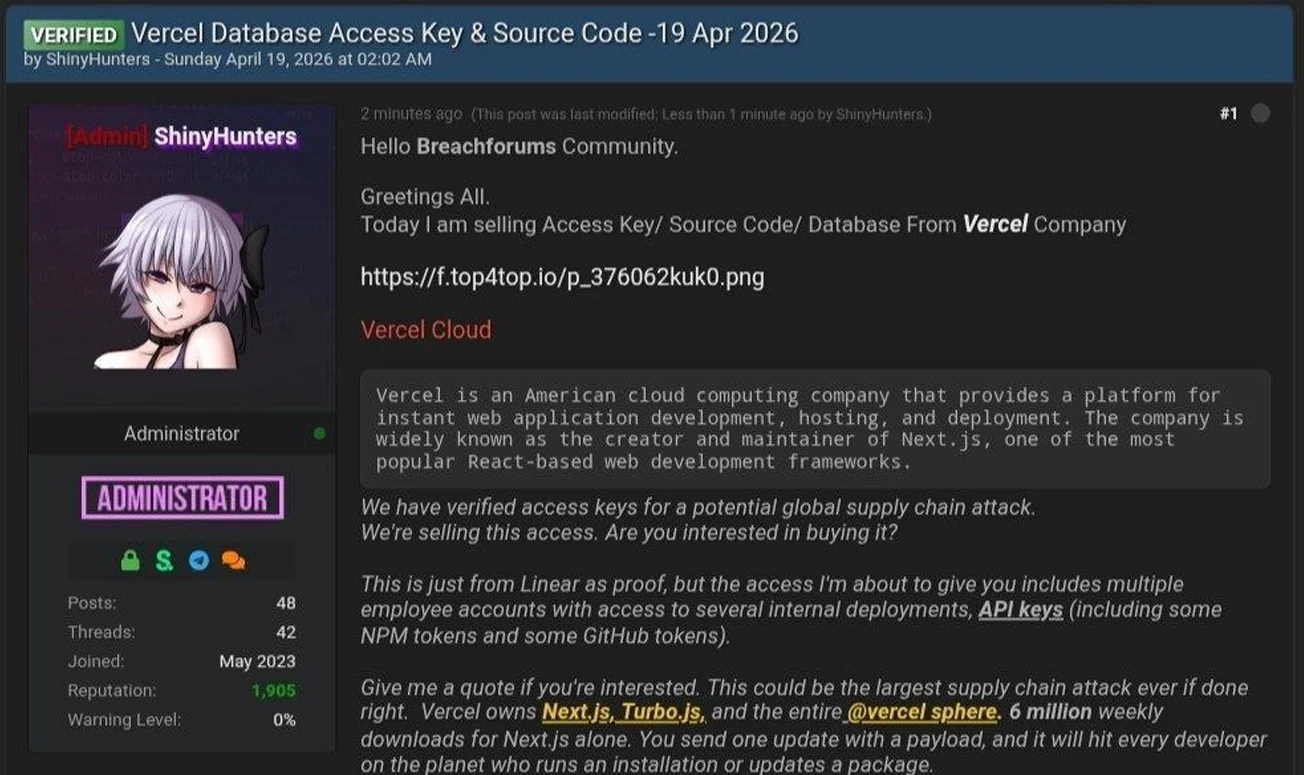
| External Threat Activity | Data advertised for sale on hacking forums |
Affected Products
- Vercel internal systems and documentation portals
- A limited subset of customer-related environments (per company statement)
- Employee account metadata (names, email addresses)
- Non-sensitive environment variables
Attack Scenario
- Attacker compromises Context.ai, a third-party AI service integrated into enterprise workflows.
- A Google Workspace OAuth application is abused to obtain broad permissions.
- OAuth token access enables compromise of a Vercel employee account.
- Attacker uses the trusted identity context to pivot into internal systems.
- Internal documentation and selected systems are queried for useful operational data.
- Employee metadata and non-sensitive environment variables are collected.
- Extracted data is staged and exfiltrated to attacker infrastructure.
- Threat actor advertises the stolen dataset for sale on underground forums.
Impact
- Unauthorized access to internal systems via federated identity abuse.
- Exposure of employee metadata and non-sensitive environment variables.
- Elevated risk of follow-on attacks using harvested organizational context.
- Potential for token replay or OAuth abuse if controls are weak.
- Reputational pressure from public breach claims and dark-web sale posts.
- Incident response costs for key/token rotation, auditing, and customer communication.
- Trust erosion around third-party integrations and SaaS operational security.
- Reinforces third-party integration risk in modern cloud development stacks.
- Highlights OAuth governance gaps as a practical entry point for attackers.
- Encourages stronger vendor vetting and scoped app consent models.
Mitigations
Immediate Actions
- Rotate API keys, access tokens, and environment variables across affected scopes.
- Audit all Google Workspace OAuth applications and revoke untrusted grants.
- Remove or suspend risky third-party integrations pending investigation.
- Monitor identity and application logs for anomalous token usage and lateral movement.
Hardening Measures
- Use sensitive environment variable classification for secrets and enforce access boundaries.
- Apply least-privilege access controls to users, service accounts, and integrations.
- Enforce periodic OAuth consent reviews and app allowlisting in Google Workspace.
- Implement integration risk scoring with approval workflows for third-party tools.
Resources
Open-Source Reporting
- Vercel confirms breach as hackers claim to be selling stolen data
- Vercel April 2026 security incident | Vercel Knowledge Base
- Vercel Breach Tied to Context AI Hack Exposes Limited Customer Credentials
- Breaking: Vercel Breach Linked to Infostealer Infection at Context.ai | InfoStealers
- Cloud development platform Vercel was hacked | The Verge
- Vercel's April 2026 Breach Explained: How a Context.ai OAuth Compromise Reached Customer Environments
Last Updated: April 20, 2026