NGate Android Malware (NFC Relay Attack Campaign)

Android Malware NFC Relay Attack Financial Fraud Banking Trojan
Overview
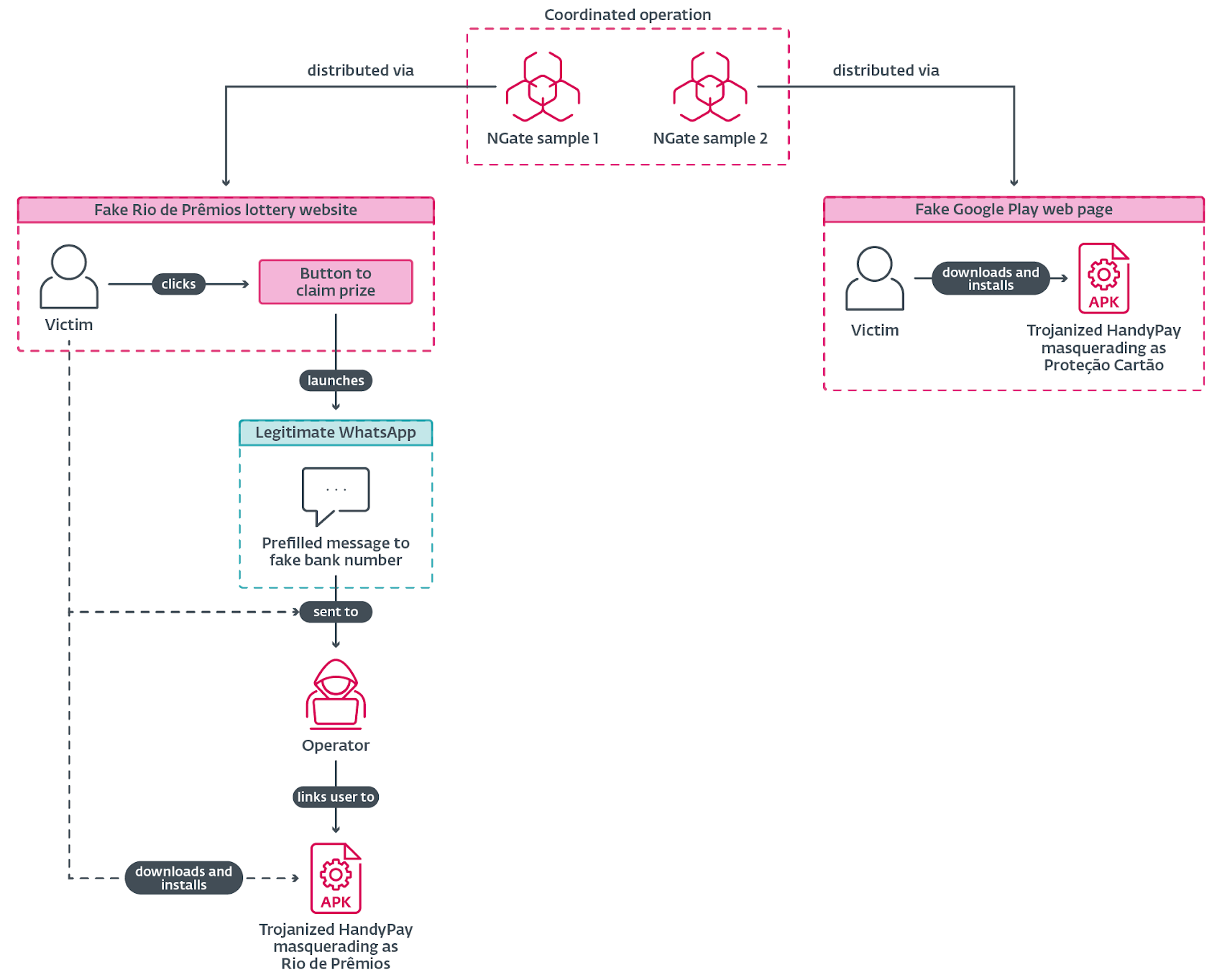
NGate is a sophisticated Android malware that abuses NFC (Near Field Communication) capabilities to capture and relay payment card data in real time. Victims are socially engineered into installing malicious applications — distributed as Progressive Web Apps (PWAs) or fake banking utilities — and then guided to place their physical payment cards near their phones while NFC is active. The malware silently reads the card data and transmits it live to attacker-controlled devices, which can then emulate the captured card to perform fraudulent ATM withdrawals and contactless payments. NGate is based on a modified version of the legitimate NFCGate research tool and does not require root access to operate.
Technical Specifications
| Attribute | Details |
|---|---|
| Malware Family | NGate (based on modified NFCGate) |
| Platform | Android |
| NFC Mechanism | Uses Android NFC APIs to read ISO 14443 smart card data |
| Relay Method | Real-time data relay to attacker-controlled device over encrypted channels (HTTPS) |
| Distribution | Phishing SMS/calls → fake PWA/WebAPK or banking utility app installation |
| Root Required | No |
| Key Prerequisite | NFC enabled on victim device; physical card in proximity |
| Fraudulent Actions | ATM cash withdrawal, contactless payment emulation |
| Known Campaign Target | Brazil (HandyPay impersonation); broader regional targeting observed |
Affected Products
- Android devices with NFC capability — no root required for compromise
- Contactless payment cards (credit/debit) — EMV/NFC-enabled cards susceptible to relay capture
- Financial institutions — ATMs and contactless POS terminals targeted via emulated cards
Attack Scenario
- Victim receives a phishing SMS or vishing call impersonating their bank, warning of a security issue requiring immediate action
- Victim is directed to install a malicious application — delivered as a PWA/WebAPK or disguised banking utility (e.g., a fake "HandyPay" NFC app)
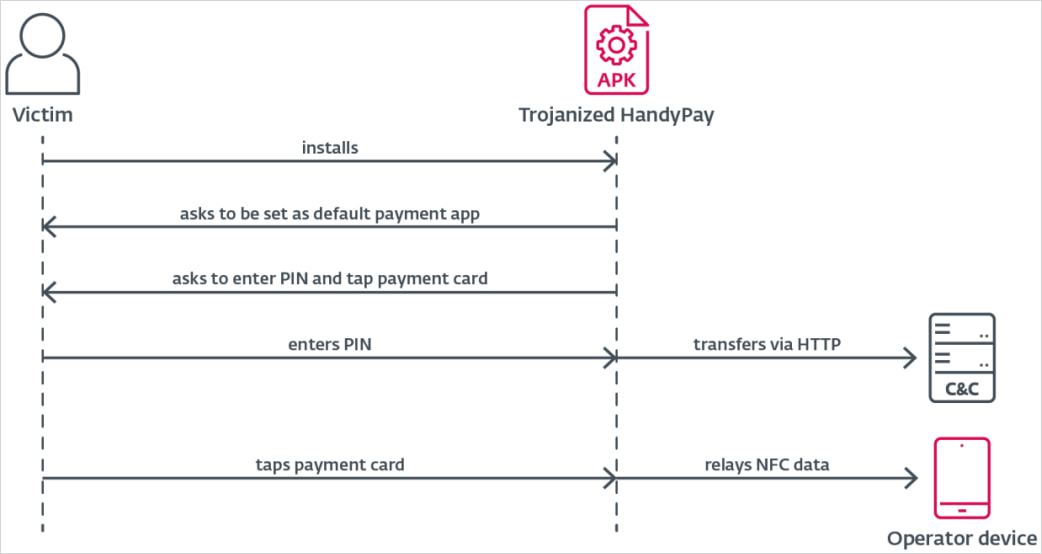
- Attacker instructs the victim (via in-app prompt or call) to enable NFC on their device
- Victim is told to hold their physical payment card near the back of their phone as a verification step
- NGate reads the card's NFC data silently using Android NFC APIs
- Captured card data is relayed in real time over an encrypted channel to an attacker-controlled device
- Attacker loads the relayed data onto their own Android device running a card emulation app
- Attacker performs fraudulent transactions: ATM cash withdrawals or contactless payments using the emulated card
Impact
- Real-time NFC relay enables card cloning without physical card theft
- Transactions performed by the attacker appear as legitimate cardholder activity
- No device root required — broader victim pool across standard Android devices
- Malware operates without persistent system-level indicators, complicating detection
- Encrypted relay traffic blends with normal HTTPS activity
- Direct financial loss to victims from unauthorized ATM withdrawals and contactless payments
- Fraudulent transactions are difficult to detect in real time due to legitimate card data being used
- Chargeback and dispute processing costs for issuing banks
- Reputational damage to financial institutions whose branding is impersonated in delivery campaigns
- Demonstrates weaponization of legitimate security research tooling (NFCGate) for criminal campaigns
- NFC relay attack methodology bypasses traditional card-not-present fraud controls
- Campaign scalability via PWA distribution — no app store approval required
- Signals emerging threat to contactless payment infrastructure beyond digital card compromise
Mitigations
For Users
- Install apps only from trusted sources such as the official Google Play Store; avoid installing apps linked from SMS messages or calls
- Do not click links in unsolicited messages purporting to be from your bank
- Never place your physical payment card near your phone when instructed by an unknown party — no legitimate bank process requires this
- Disable NFC when not actively in use to eliminate the passive capture surface
For Organizations
- Monitor for unusual patterns of ATM withdrawals and contactless transactions — especially clustered or rapid-sequence activity
- Implement behavioral fraud analytics and transaction risk scoring to flag relay-pattern anomalies
- Deploy step-up authentication (e.g., PIN confirmation, push notification) for high-value or suspicious transactions
- Raise customer awareness through in-app messaging about smishing and vishing tactics used to deliver NFC malware
- Collaborate with card networks to implement velocity checks targeting relay-emulation transaction patterns
Resources
Open-Source Reporting
Last Updated: April 22, 2026