Three Threat Clusters Target Russian Enterprises With Backdoors, Ransomware, and Wipers
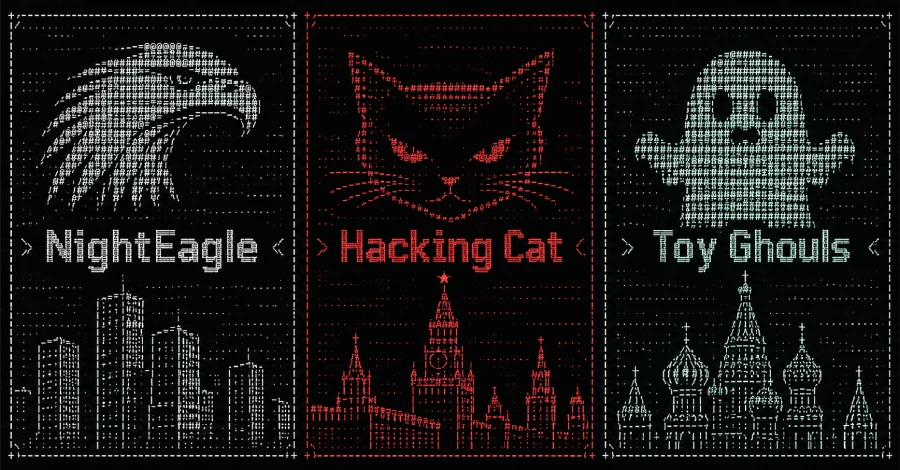
NightEagle (APT-Q-95) Hacking Cat Toy Ghouls Exchange Exploitation Ransomware and Wipers
Overview
Kaspersky reports three distinct threat-activity clusters targeting Russian enterprises: NightEagle (APT-Q-95), Hacking Cat, and Toy Ghouls. The campaigns use different intrusion methods and post-compromise goals, including credential-based VPN access, Microsoft Exchange exploitation, persistent backdoors, ransomware deployment, wiper behavior, and custom command-and-control channels.
This is not a single intrusion set but a collection of ongoing or recently observed activity against Russian organizations. Reported motivations and tactics differ across the clusters: NightEagle appears focused on long-term access and Active Directory compromise, Hacking Cat is described as a pro-Ukrainian hacktivist entity with encryption and destructive operations, and Toy Ghouls is assessed as financially motivated and recently introduced a custom backdoor.
Technical Details
NightEagle / APT-Q-95
- Initial access through credential-based VPN abuse.
- Backdoor operations to maintain foothold and support internal movement.
- Exchange-linked delivery activity for follow-on access.
- Lateral movement and Active Directory compromise behavior.
Hacking Cat
- Reported attribution includes pro-Ukrainian hacktivist alignment and potential collaboration links.
- Initial access includes Exchange exploitation paths.
- Remote access tooling supports reconnaissance and further staging.
- Deployment of Monkey ransomware and wiper-capable destructive components.
- Additional destructive payload usage has been observed.
Toy Ghouls
- Historically associated with financially motivated tooling.
- Use of a newly reported custom backdoor (Bird Agent).
- Delivery observed via remote-administration channels including WinRM.
- Execution, configuration, and persistence mechanics tied to host-specific setup.
- Command-and-control behavior includes custom channels.
Technical Specifications
| Attribute | Details |
|---|---|
| Threat Clusters | NightEagle (APT-Q-95), Hacking Cat, Toy Ghouls |
| Primary Target Set | Russian enterprises |
| Initial Access Patterns | Compromised VPN credentials, Exchange exploitation, WinRM-enabled deployment |
| Core Malicious Capabilities | Backdoors, AD compromise, ransomware encryption, wiper behavior |
| Impacted Platforms | Windows, Linux, VMware ESXi, Exchange, Active Directory environments |
| Remote Management Abuse | RDP and WinRM-related attacker operations |
| C2 Characteristics | Custom communications, including MQTT and Matrix/Element-style channels |
Affected Products
- Microsoft Exchange deployments with known exploitable exposure.
- Active Directory domain environments.
- Enterprise VPN infrastructure with weak or reused credentials.
- Windows, Linux, and VMware ESXi systems susceptible to ransomware/wiper operations.
- Organizations exposing or weakly controlling RDP/WinRM administration paths.
Attack Scenario
NightEagle - Representative Scenario
- Attacker gains access using compromised VPN credentials.
- Exchange access is leveraged to deploy GhostContainer-like tooling.
- Persistence and tunneling are established for stealthy internal access.
- Privilege escalation and Active Directory targeting follow.
- Domain compromise enables credential theft and sustained control.
Hacking Cat - Representative Scenario
- Threat actor exploits vulnerable Exchange infrastructure.
- Remote access and reconnaissance expand internal visibility.
- Ransomware encryption or destructive wiper actions are launched.
- Recovery-inhibition actions increase downtime and response complexity.
Toy Ghouls - Representative Scenario
- WinRM-based deployment introduces custom malware components.
- Malware configuration is bound to system-specific identifiers.
- Persistence is established and C2 channeling begins.
- Attacker executes follow-on commands based on campaign objectives.
Impact Assessment
- Russian enterprises are targeted by three distinct clusters using backdoors, credential abuse, ransomware, and wiper-linked techniques
- Campaign activity demonstrates repeatable compromise paths against enterprise identity, email, and remote-administration infrastructure
- NightEagle activity indicates elevated risk of long-term enterprise persistence and Active Directory/domain compromise
- Hacking Cat activity can produce severe business interruption via encryption, destructive behavior, and recovery inhibition across Windows, Linux, and ESXi
- Toy Ghouls backdoor activity enables durable command execution and covert follow-on operations
- NightEagle activity can enable password-hash theft and Kerberos-ticket abuse through AD compromise
- Hacking Cat-linked tooling has been associated with system-information collection and Outlook credential theft
- Public reporting does not quantify total exfiltrated data or provide a complete public victim list
- The abused technology stack (Exchange, AD, VPN, RDP, WinRM, Windows/Linux/ESXi) is widely used across Egyptian public and private sectors
- No public reporting currently confirms direct targeting of Egyptian organizations in these campaigns
- Critical due to combined enterprise attack paths spanning identity compromise, email server exploitation, cross-platform encryption, and destructive malware risk
Mitigation Strategies
Secure and Monitor VPN Access
- Rotate exposed and reused credentials immediately.
- Enforce phishing-resistant MFA for VPN and privileged remote access.
- Restrict VPN access by role, device posture, geography, and risk signals.
- Investigate anomalous VPN login sources, anonymization networks, and unusual infrastructure pivots.
Patch Exchange, RDP, and Identity Infrastructure
- Prioritize Microsoft Exchange updates, including known exploited vulnerabilities such as CVE-2021-26855.
- Review exposure and remediation status for CVE-2026-42897 where applicable.
- Address CVE-2019-0708 (BlueKeep) on all supported assets and harden/limit RDP exposure.
Hunt for NightEagle-Like Activity
- Examine Exchange systems for anomalous modules, processes, ASP.NET behavior, and unauthorized key/config access.
- Detect suspicious tunneling patterns (for example, dev tunnels, rdp2tcp, Neo-reGeorg-like behaviors).
- Alert on unexpected admin account creation, RDP user-group changes, and suspicious replication requests.
Protect Active Directory
- Minimize domain-admin privileges and privileged-group sprawl.
- Monitor changes to Administrators and Remote Desktop Users groups.
- Implement tiered administration, privileged workstations, and rapid credential rotation after suspected compromise.
- Validate and monitor DC replication permissions to detect unauthorized DCSync-like access.
Prepare for Ransomware and Wiper Activity
- Maintain immutable, offline, tested backups for Windows, Linux, and ESXi workloads.
- Segment backup systems and hard-limit administrative paths into backup infrastructure.
- Monitor for VSS deletion, log clearing, backup-service tampering, defense evasion, and persistence artifacts.
- Enforce application allowlisting and EDR controls for unapproved Rust, Go, .NET, and C++ payload execution.
Secure WinRM and Remote Administration
- Disable WinRM where not required; otherwise restrict to trusted management segments and jump hosts.
- Monitor for Evil-WinRM usage, suspicious noninteractive PowerShell patterns, and unauthorized service creation.
- Block unnecessary east-west remote-management traffic between user and server segments.
Monitor Unconventional C2 Channels
- Inspect outbound MQTT and Matrix/Element traffic from assets lacking business justification.
- Correlate unusual C2 traffic with suspicious service creation, encrypted local config files, and hidden command execution.
Containment and Recovery
- Isolate suspected backdoor/ransomware/wiper systems immediately.
- Preserve endpoint, AD, VPN, Exchange, and network evidence before rebuild.
- Rebuild confirmed compromised domain controllers, Exchange hosts, and endpoints from trusted media.
- Rotate privileged credentials, Kerberos keys, service-account secrets, VPN secrets, and remote-management credentials after scoping.
Resources and References
Public Reporting
Last Updated: September 17, 2026