Microsoft Defender Zero-Day Vulnerabilities (BlueHammer, RedSun, UnDefend)

Microsoft Defender Zero-Day Exposure Privilege Escalation Defense Tampering Risk
Overview
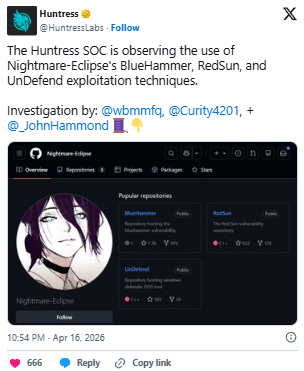
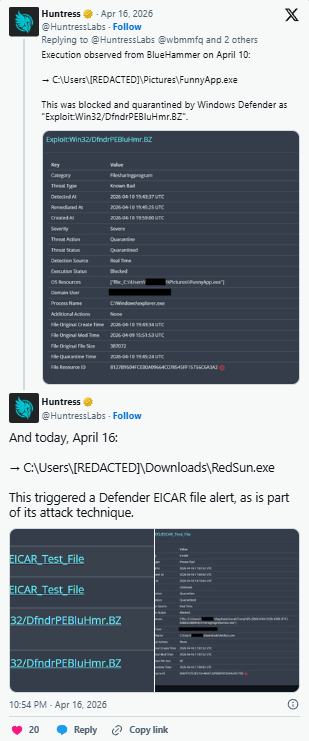
Three zero-day vulnerabilities were disclosed in Microsoft Defender under the names BlueHammer, RedSun, and UnDefend. The issues can allow attackers to elevate privileges and weaken endpoint protection controls; two of the reported flaws remain unpatched.
The vulnerabilities target internal Defender behavior, enabling attackers to bypass or disable protections and execute malicious actions with high privileges.
Technical Specifications
| Attribute | Details |
|---|---|
| BlueHammer | Patched flaw abusing Defender signature update mechanism |
| BlueHammer Impact | Privilege escalation to SYSTEM level |
| RedSun | Unpatched flaw in handling of malicious/flagged files |
| RedSun Impact | Privilege escalation to SYSTEM level |
| UnDefend | Unpatched flaw enabling Defender update/protection interference |
| UnDefend Impact | Security control weakening and persistence enablement |
| Primary Risk Class | Local privilege escalation + endpoint protection tampering |
Affected Products
- Windows endpoints using Microsoft Defender where vulnerable code paths are present
- Enterprise environments relying primarily on Defender as first-line endpoint control
- High-value targets where initial foothold can be converted into SYSTEM-level control
- Systems lacking layered monitoring of Defender service and update integrity
Attack Scenario
-
Initial Access: Attacker gains foothold via phishing, malware delivery, or insider-assisted execution.
-
Privilege Escalation: RedSun or BlueHammer primitives are used to obtain SYSTEM privileges.
-
Defense Degradation: UnDefend behavior is leveraged to disable/interfere with Defender updates and protections.
-
Post-Exploitation: Attacker deploys ransomware, RATs, spyware, or other payloads and establishes persistence.
Impact Assessment
- SYSTEM-level access enables full host control and security policy tampering
- Defender trust boundaries can be altered to conceal malicious activity
- Increased ability to stage follow-on compromise across enterprise environments
- Elevated risk of data theft and endpoint surveillance under high privilege
- Credential and token harvesting opportunities increase with defense evasion
- Sensitive enterprise and user data may be exposed during prolonged dwell time
- Increased ransomware execution success due to weakened endpoint defenses
- Reduced detection response can extend outage and remediation timelines
- Broad operational disruption if compromise propagates laterally
Mitigation Strategies
Immediate Actions
- Apply latest Windows and Defender security updates (including BlueHammer patch).
- Verify Defender services and update channels are operational and untampered.
- Isolate suspected compromised hosts pending forensic review.
Short-term Measures
- Monitor for local privilege-escalation attempts and unusual SYSTEM-context activity.
- Restrict local user/admin rights under least-privilege principles.
- Enable advanced endpoint logging and EDR coverage on all critical assets.
Monitoring & Detection
- Alert on Defender tampering indicators, disabled update paths, or policy drift.
- Hunt for suspicious child-process chains from security service contexts.
- Correlate privilege-escalation, persistence, and C2 signals in SIEM/SOC workflows.
Long-term Solutions
- Implement defense-in-depth layers beyond a single endpoint security product.
- Conduct regular red-team exercises focused on security-control bypass scenarios.
- Maintain continuous patch governance with rapid validation and rollback planning.
Resources and References
Open-Source Reporting
- Microsoft defender under attack as three zero-days, two of them still unpatched, enable elevated access
- Three Microsoft Defender Zero-Days Actively Exploited; Two Still Unpatched
- Over 1 billion Windows users at risk after disgruntled security researcher leaks Defender zero-days | Tom's Guide
- Three Microsoft Defender Zero-Days Actively Exploited; Two Still Unpatched - Cypro
Last Updated: April 19, 2026