Global Campaign Targeting Vulnerable CMS Platforms with Webshell Deployment
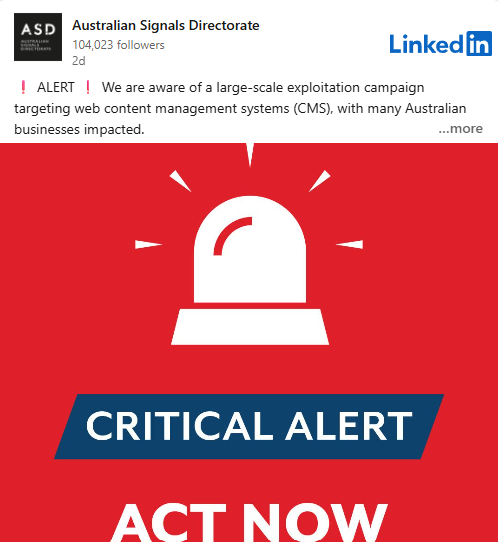
Webshell Deployment Known CVE Exploitation CMS Platforms Persistence ACSC Alert
Overview
The Australian Cyber Security Centre (ACSC) warned of an ongoing global campaign in which threat actors systematically scan the internet for websites running vulnerable CMS platforms and plugins. Instead of relying on new zero-days, attackers are exploiting known but unpatched vulnerabilities to upload webshells, maintain persistence, and enable follow-on operations such as credential theft, data exfiltration, ransomware deployment, and website defacement.
Technical Specifications
| Attribute | Details |
|---|---|
| Campaign Type | Large-scale opportunistic exploitation of unpatched CMS vulnerabilities |
| Primary Objective | Upload webshells for persistent remote access and post-exploitation |
| Targeted Platforms | WordPress plugins, Craft CMS, MaxSite CMS, MetInfo CMS, Joomla JCE Editor |
| Example CVE Context | CVE-2025-32432 (Craft CMS) and multiple 2026 CMS/plugin CVEs |
| Exploitation Method | Automated internet-wide scanning and vulnerability exploitation |
| Post-Compromise Capability | Command execution, file management, malware deployment, privilege escalation, lateral movement |
| Persistence Mechanism | Webshell implantation on compromised web servers |
| Automation Trend | ACSC notes possible AI-assisted reconnaissance and exploitation acceleration |
Affected Products
- Internet-facing websites running unpatched CMS cores, themes, or plugins
- Organizations with delayed patch management for web applications
- Hosting environments with weak file upload controls or limited integrity monitoring
- Multi-site CMS estates where one compromised admin path can impact several services
Attack Scenario
- Attackers continuously scan internet-facing web servers.
- They identify CMS instances with outdated or vulnerable plugins/components.
- A publicly known vulnerability is exploited.
- A webshell is uploaded to the compromised server.
- Persistent remote access is established.
- Attackers execute additional payloads, steal credentials and data, deploy malware, move laterally, or maintain long-term access.
Impact Assessment
- Attackers can alter web content, application code, and server-side files
- Persistent webshell access enables repeated tampering after cleanup attempts
- Compromised sites may be weaponized to host phishing pages or malware
- Administrator credentials and application secrets may be stolen
- Sensitive customer or business data can be exfiltrated from backend systems
- Webshell footholds can expose connected internal services and databases
- Defacement, ransomware deployment, or destructive actions can disrupt services
- Incident response and restoration can cause prolonged downtime
- Compromised servers may be blocked or blacklisted, affecting business operations
Mitigation Strategies
Immediate Actions
- Immediately apply security updates for CMS platforms, plugins, and themes
- Remove unused or unsupported plugins/extensions
- Review administrator accounts, reset high-risk credentials, and tighten privileges
Short-term Measures
- Enable automatic security updates where appropriate
- Deploy and tune a Web Application Firewall (WAF)
- Restrict file upload permissions and executable paths in web directories
Monitoring & Detection
- Monitor web server and application logs for exploitation attempts
- Scan routinely for unauthorized files and known webshell patterns
- Implement File Integrity Monitoring (FIM) on CMS and webroot directories
Long-term Solutions
- Build continuous vulnerability management for CMS assets and plugins
- Segment web tiers from sensitive internal systems to reduce lateral movement risk
- Maintain tested offline backups and incident recovery playbooks for web compromise scenarios
Resources and References
Public Reporting
Last Updated: July 12, 2026