China-Linked GopherWhisper Infects 12 Mongolian Government Systems with Go Backdoors
GopherWhisper China-Linked Espionage Go Malware Toolset Cloud C2 Abuse
Overview
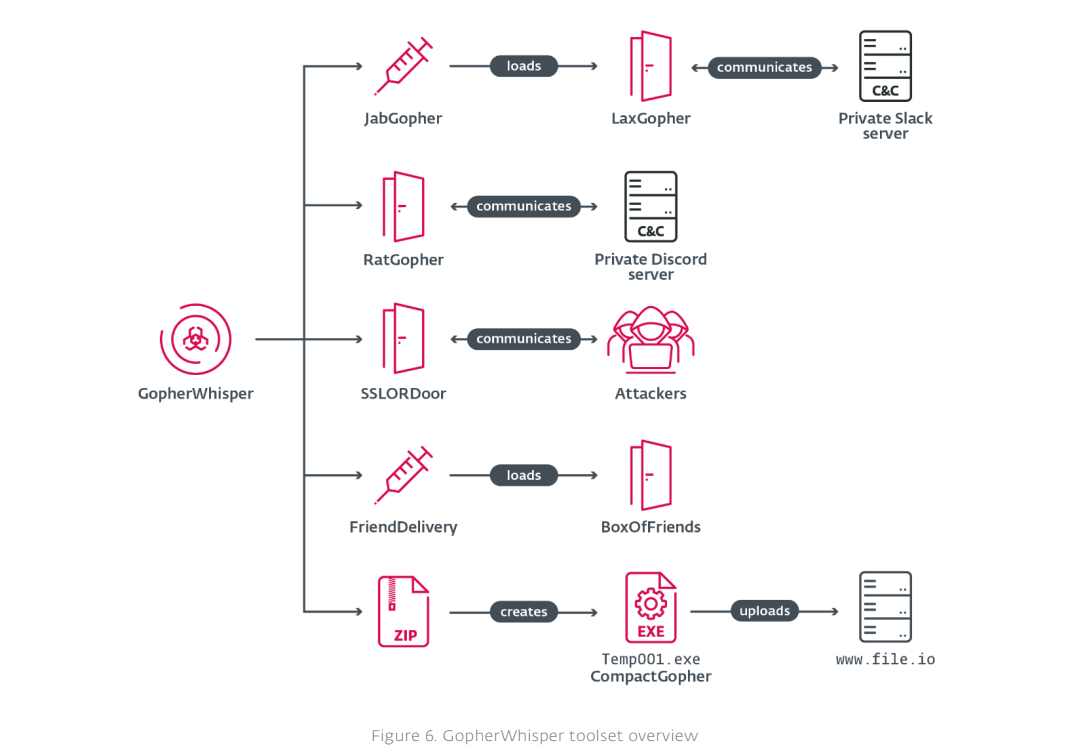
GopherWhisper is a China-linked cyber espionage campaign targeting government entities, with confirmed activity against organizations in Mongolia. Operators deploy a custom malware suite, largely written in Go, to establish persistence, execute commands, and exfiltrate sensitive data.
The campaign stands out for command-and-control (C2) operations over legitimate cloud platforms such as Slack, Discord, and Microsoft Outlook, helping attacker traffic blend into expected enterprise activity.
Technical Specifications
| Attribute | Details |
|---|---|
| Campaign Name | GopherWhisper |
| Primary Victim Set | Government systems in Mongolia (reported at least 12 compromised systems) |
| Malware Family Design | Multi-component toolset (Go-heavy + C++) |
| Core Backdoor | LaxGopher (command execution via cmd) |
| Loader/Injector | JabGopher |
| Remote Access Module | RatGopher (Discord-based channel) |
| Collection/Exfil Module | CompactGopher |
| Additional Backdoor | SSLORDoor (C++ HTTPS channel over port 443) |
| Cloud API C2 Component | BoxOfFriends (Microsoft Graph / Outlook drafts channel) |
| Stealth Technique | DLL injection and trusted SaaS abuse |
| Exfiltration Channel | File-sharing services (for example file.io) |
| Data Protection by Attacker | AES-CFB-128 encryption for stolen data |
| Initial Access | Not confirmed (likely phishing or exploitation) |
Affected Products
- Government endpoints and servers with outbound access to SaaS communication platforms
- Environments allowing unmanaged Slack, Discord, or Microsoft Graph/Outlook traffic paths
- Systems vulnerable to DLL injection and unsigned/untrusted binary execution
- Networks without strict egress control to public file-sharing services
Attack Scenario
-
Initial Compromise: A target government system is compromised through an unknown initial access vector.
-
Loader Deployment: JabGopher is dropped to inject/launch additional payloads.
-
Backdoor Establishment: LaxGopher is installed for persistent command execution.
-
C2 Channel Activation: Attackers use Slack/Discord/Outlook Graph channels for covert command delivery.
-
Modular Expansion: RatGopher, CompactGopher, and other components are deployed as needed.
-
Collection and Exfiltration: Sensitive files (
.doc,.pdf,.xls, etc.) are compressed, AES-encrypted, and exfiltrated via file-sharing channels. -
Long-Term Access: Multiple persistence-capable backdoors maintain sustained intelligence collection.
Impact Assessment
- Persistent unauthorized control over government endpoints
- Increased risk of command execution and configuration tampering
- Difficulty distinguishing malicious from legitimate SaaS-driven operations
- Exposure of confidential government documents and internal communications
- Sustained intelligence theft through covert cloud C2 channels
- Potential expansion to additional victims beyond currently confirmed scope
- Operational degradation from persistent compromise and response activity
- Increased incident-response complexity due to multi-backdoor architecture
- Longer dwell time and delayed containment in permissive outbound environments
Mitigation Strategies
Immediate Actions
- Hunt for suspicious activity tied to Slack, Discord, and Microsoft Graph API usage patterns.
- Isolate suspected systems and collect forensic artifacts before cleanup.
- Revoke compromised credentials and invalidate affected tokens/sessions.
Short-term Measures
- Restrict or tightly audit use of external SaaS communication platforms.
- Deploy and tune EDR detections for DLL injection and unknown Go executables.
- Block or monitor outbound traffic to public file-sharing services such as
file.io.
Monitoring & Detection
- Correlate anomalous SaaS API usage with endpoint process lineage.
- Alert on unusual archive/encryption activity followed by external transfers.
- Track persistence mechanisms and repeated command execution behavior across hosts.
Long-term Solutions
- Apply least privilege and network segmentation across sensitive government systems.
- Strengthen patch and hardening baselines for internet-exposed and high-value assets.
- Build threat-hunting playbooks for cloud-abuse C2 tradecraft in espionage campaigns.
Resources and References
Open-Source Reporting
Last Updated: April 26, 2026