Cisco Secure Email Gateway Arbitrary File Write Vulnerability - CVE-2026-76519
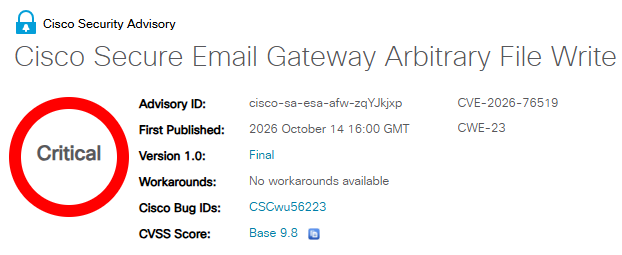
Cisco Secure Email Gateway CVE-2026-76519 CWE-23 CVSS 9.8 Active Exploitation
Overview
Cisco disclosed active exploitation of a critical vulnerability in Cisco Secure Email Gateway appliances.
A remote attacker can send a specially crafted email attachment through a vulnerable gateway without authentication. Successful exploitation may enable arbitrary file writes and subsequent command execution with root privileges.
Technical Details
- CVE: CVE-2026-76519
- CWE: CWE-23 (Relative Path Traversal)
- CVSS: 9.8 (Critical)
- Affected component: Advanced Malware Protection (AMP), specifically attachment-processing logic
Required conditions reported by Cisco advisory context:
- File Reputation is enabled and assigned to a mail policy
- Content Scanner Tools version is earlier than
25.3.0.5525
Affected products:
- Physical and virtual Cisco Secure Email Gateway appliances running vulnerable AsyncOS releases
Technical Specifications
| Attribute | Details |
|---|---|
| CVE | CVE-2026-76519 |
| Weakness | Relative Path Traversal (CWE-23) |
| Severity | CVSS 9.8 (Critical) |
| Attack Prerequisite | Specially crafted email attachment processed by vulnerable AMP path |
| Authentication Requirement | None (remote unauthenticated delivery through email flow) |
| Potential Privilege Outcome | Arbitrary file write with potential root-level command execution |
Affected Products
- Cisco Secure Email Gateway physical appliances on vulnerable AsyncOS and scanner versions.
- Cisco Secure Email Gateway virtual appliances on vulnerable AsyncOS and scanner versions.
- Deployments with File Reputation/AMP attachment processing enabled in active mail policy paths.
Attack Scenario
- Attacker crafts a malicious email attachment targeting vulnerable AMP attachment handling.
- Email is sent through a reachable vulnerable Cisco Secure Email Gateway path.
- Gateway processes attachment using affected scanner/components.
- Path traversal condition enables unauthorized arbitrary file write.
- Follow-on exploitation may execute commands with root privileges.
- Compromised node can be leveraged for persistence, policy tampering, or lateral movement to other cluster members.
Impact Assessment
- Unauthorized access risk to email-security gateway infrastructure
- Arbitrary file-write capability on affected appliances
- Potential root-level command execution on compromised nodes
- Potential disruption of email filtering and security workflows
- Risk of data exposure/manipulation in mail processing context
- Cluster-wide risk if additional members are reachable and similarly vulnerable
- Active exploitation status increases urgency for patching and validation across all cluster members
Mitigation Strategies
- Update Content Scanner Tools to version
25.3.0.5525or later. - Upgrade AsyncOS to fixed releases such as
15.5.5-014or16.5.0-780where applicable. - Run
contentscannerstatusto verify installed scanner version. -
Review system logs with:
grep "System Security" system_logs
-
Investigate suspicious network and appliance behavior across all cluster members.
- Validate consistency of updates and indicators across every node in clustered deployments.
Resources and References
Public Reporting
Last Updated: October 15, 2026