Handala Hack Team Breach Claim Against PSK Wind Technologies
Handala Hacktivist Activity Defense Sector Targeting Data Exfiltration Claim
Overview
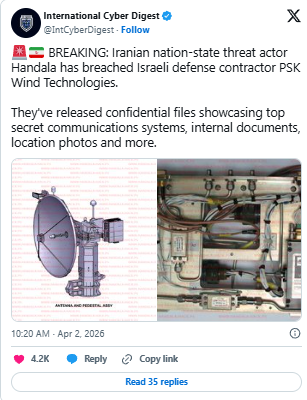
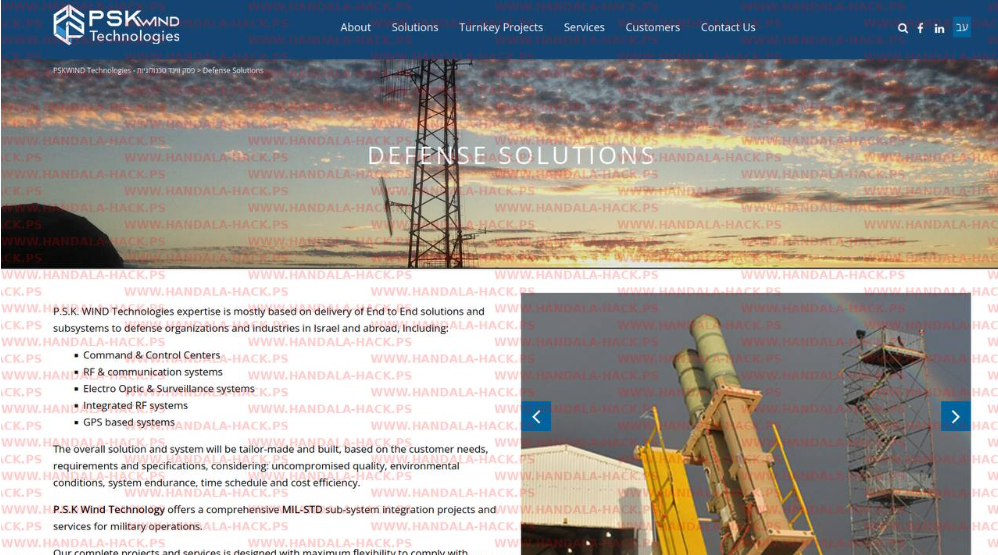
A pro-Iranian hacktivist group, Handala, claimed to have breached Israeli defense contractor PSK Wind Technologies. The group alleged exfiltration of sensitive data related to military command-and-control systems and communications infrastructure, and published partial evidence online.
The breach has not been officially confirmed at the time of reporting.
Technical Specifications
| Attribute | Details |
|---|---|
| Incident Type | Claimed targeted intrusion and information operation |
| Target Sector | Defense contractor ecosystem |
| Initial Access (Reported) | Unknown; likely phishing or credential compromise |
| Observed/Reported TTPs | Spear-phishing, credential harvesting, living-off-the-land activity |
| Data Claimed Exfiltrated | Internal documents, system architecture files, internal environment screenshots |
| Post-Exploitation Risk | Persistence and lateral movement across sensitive systems |
| Verification Status | Public claim with partial evidence; no official confirmation |
Affected Products
- PSK Wind Technologies corporate and technical environments (as claimed)
- Systems associated with command-and-control and communications workflows
- Employee identity/access systems targeted through phishing or credential abuse paths
- Partner and downstream environments that may share trust relationships
Attack Scenario
-
Targeting and Delivery: Attackers target employees through spear-phishing or social engineering.
-
Initial Access: Compromised credentials are used to access internal systems.
-
Lateral Movement: Adversaries traverse internal networks toward high-value command-and-control related assets.
-
Collection: Sensitive documents, architecture information, and screenshots are gathered.
-
Exfiltration: Collected data is transferred to attacker-controlled infrastructure.
-
Information Operation: Samples and threat messaging are published to maximize psychological and media impact.
Impact Assessment
- Trust degradation in internal defense-sector system security posture
- Risk of manipulated or selectively leaked material influencing decisions
- Increased pressure from coordinated cyber and information operations
- Potential exposure of command-and-control and communication architecture details
- Intelligence advantage for adversaries if leaked data is authentic
- Elevated targeting risk for connected suppliers, staff, and critical systems
- Potential disruption from containment and recovery operations
- Increased likelihood of follow-on cyber or physical targeting attempts
- Operational overhead from sustained incident response and threat hunting
Mitigation Strategies
Immediate Actions
- Enforce multi-factor authentication across privileged and remote access paths.
- Harden email security controls and phishing detection.
- Isolate suspicious accounts/endpoints and rotate exposed credentials.
Short-term Measures
- Apply zero-trust access controls and least privilege for sensitive systems.
- Segment networks between user, corporate, and high-value command-related environments.
- Strengthen DLP controls to detect and block unauthorized data movement.
Monitoring & Detection
- Run continuous monitoring with SIEM, EDR, and XDR telemetry correlation.
- Hunt for living-off-the-land activity, unusual VPN/tunneling behavior, and lateral movement indicators.
- Alert on anomalous archive creation, screenshot tooling, and outbound transfer spikes.
Long-term Solutions
- Maintain patching and vulnerability management programs for exposed infrastructure.
- Deliver recurring employee awareness training focused on spear-phishing and social engineering.
Resources and References
Open-Source Reporting
Last Updated: April 5, 2026