Critical U-Boot Secure Boot Vulnerabilities (FIT Image Verification Flaws)
Firmware Security U-Boot FIT Parser Secure Boot Bypass Pre-OS RCE Risk
Overview
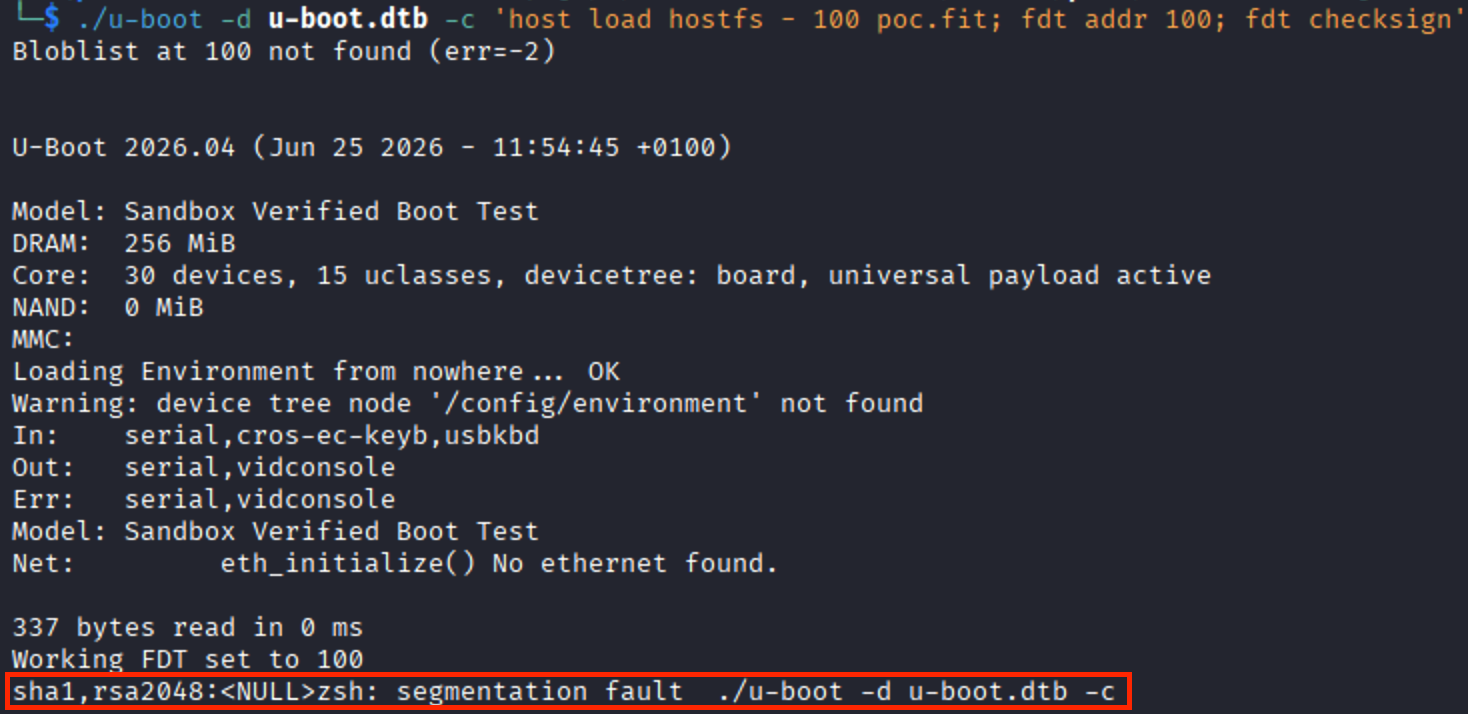
Security researchers at Binarly disclosed six vulnerabilities in the U-Boot bootloader affecting verification of FIT (Flattened Image Tree) images. The flaws can be triggered before Secure Boot completes, allowing attackers to bypass trusted boot protections.
Successful exploitation may lead to arbitrary code execution at the earliest startup stage, enabling compromise before the operating system loads.
Technical Specifications
| Attribute | Details |
|---|---|
| Component | U-Boot FIT image parser and signature verification logic |
| Vulnerability Set | Six disclosed vulnerabilities affecting FIT handling |
| Most Critical Findings | BRLY-2026-037 and BRLY-2026-038 |
| Bug Classes | NULL dereference, out-of-bounds read, stack exhaustion, stack buffer overflow, memory corruption |
| Trust Boundary Impact | Parsing flaws triggered before signature verification completes |
| Security Effect | Potential Secure/Verified Boot bypass and bootloader-context code execution |
| Historical Exposure | Vulnerable code path present since U-Boot v2013.07 |
| Release Scope | More than 50 upstream releases plus vendor-maintained forks |
Affected Products
- Devices and firmware stacks embedding vulnerable U-Boot FIT parsing logic
- Vendor products that rely on U-Boot for Secure/Verified Boot enforcement
- Customized or forked U-Boot deployments without relevant upstream/backported fixes
- Systems with exposed or weakly protected firmware update interfaces
Attack Scenario
- An attacker gains the ability to deliver or replace a firmware/FIT image, via a compromised update server, exposed update interface, physical access, or another privileged path.
- The attacker crafts a malicious FIT image containing malformed metadata.
- During boot, U-Boot parses the malicious image before completing signature verification.
- A parsing flaw is triggered, causing memory corruption or other unsafe behavior.
- The attacker executes code in bootloader context, bypasses Secure Boot protections, and installs persistent malicious firmware before OS startup.
Impact Assessment
- Secure/Verified Boot trust chain can be subverted before OS handoff
- Attackers may modify early boot flow and firmware logic
- Persistent low-level tampering can survive standard OS remediation workflows
- Pre-OS compromise may expose secrets and data paths before endpoint controls start
- Attackers can implant stealth firmware components for long-term collection
- Sensitive workloads on compromised devices may be silently monitored
- Malformed image handling can cause boot failure and device denial of service
- Recovery operations may require complex firmware reflashing procedures
- Fleet-scale update channel compromise can trigger broad operational disruption
Mitigation Strategies
Immediate Actions
- Apply vendor firmware updates containing upstream U-Boot patches
- Backport fixes if using customized or pinned U-Boot versions
- Restrict and strongly authenticate firmware update workflows
Short-term Measures
- Protect management interfaces, including BMC, recovery, and update services
- Require signed and verified update artifacts from trusted distribution channels
- Isolate firmware update infrastructure and enforce strict access controls
Monitoring & Detection
- Monitor for unauthorized firmware changes and update pipeline anomalies
- Alert on unexpected bootloader hash/state deviations where attestation exists
- Track security advisories for impacted U-Boot versions and vendor forks
Resources and References
Public Reporting
- Critical U-Boot Bugs Undermine Secure Boot on Millions of Devices
- New U-Boot flaws could enable stealthy firmware attacks
- Six New U-Boot Flaws Could Let Malicious Images Crash Devices or Run Code at Boot
- Stack buffer underflow in U-Boot during FIT image signature verification in fdt_find_regions | Binarly
Last Updated: July 12, 2026