Unpatched Shark Robot Vacuum AWS IoT Authorization Vulnerability
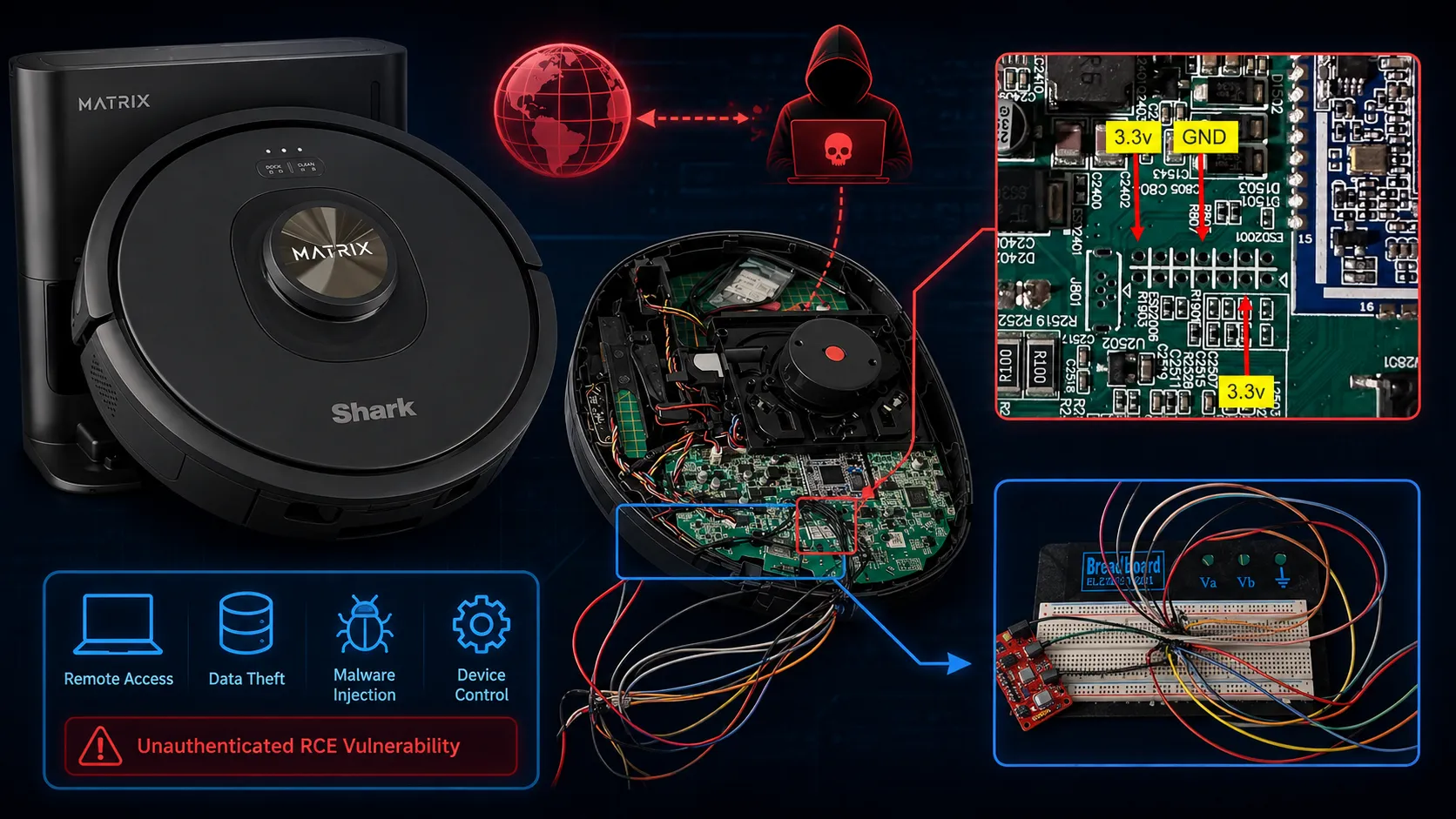
IoT Cloud Misconfiguration AWS IoT Core Certificate Abuse Cross-Device Access Privacy Exposure
Overview
Security researchers disclosed a critical vulnerability affecting Shark Wi-Fi-enabled robot vacuums. The issue is caused by an overly permissive AWS IoT authorization policy, not a firmware exploit. By extracting an AWS IoT client certificate and private key from one Shark vacuum, an attacker can authenticate to Shark cloud infrastructure and interact with many other Shark devices in the same AWS region.
At disclosure time, researchers reported no official patch and observed broad potential impact across hundreds of thousands of accessible devices.
Technical Specifications
| Attribute | Details |
|---|---|
| Affected Platform | Shark cloud-connected robot vacuums |
| Cloud Service | AWS IoT Core |
| Authentication Method | X.509 client certificates |
| Root Cause | Overly permissive AWS IoT authorization policy allowing cross-device resource access |
| Prerequisite | Physical access to one Shark vacuum to extract firmware and recover credentials |
| Credential Material at Risk | AWS IoT client certificate and corresponding private key |
| Abuse Channel | Unauthorized access to MQTT topics for other Shark devices in same AWS region |
| Observed Scale | Researchers reported over 670,000 accessible devices within 24 hours |
| Patch Status at Disclosure | No official patch released |
Affected Products
- Shark Wi-Fi-enabled robot vacuums using vulnerable cloud authorization design
- Associated Shark cloud tenants/devices in shared AWS IoT regional environments
- Users whose devices expose mapping, telemetry, credential, or camera-linked data to cloud channels
Attack Scenario
- An attacker purchases or steals a Shark robot vacuum.
- The attacker extracts device firmware using interfaces such as SPI flash, UART, or JTAG.
- AWS IoT certificates and private keys are recovered from device storage.
- The attacker authenticates to Shark's AWS IoT environment.
- Due to permissive policy design, the attacker accesses MQTT topics tied to other Shark vacuums in the same region.
- The attacker can remotely start/stop cleaning, send devices to dock, retrieve map data, access supported camera feeds, obtain Wi-Fi SSIDs/passwords, collect telemetry, and execute privileged commands where exposed.
Impact Assessment
- Unauthorized command execution can alter device behavior and automation routines
- Cross-device control breaks tenant/device isolation assumptions in cloud IoT design
- Privileged command paths may allow deeper manipulation of affected devices
- Exposure of home mapping/floor-plan information and cleaning history
- Potential access to camera feeds on supported models
- Leakage of Wi-Fi SSIDs, passwords, telemetry, and cloud identifiers
- Remote misuse can disrupt normal cleaning operations and scheduling
- Large-scale abuse can degrade service reliability and trust in cloud control channels
- Recovery actions (credential rotation, cloud policy hardening) may interrupt device availability
Mitigation Strategies
Immediate Actions
- Restrict AWS IoT policies so each certificate can access only its associated device resources
- Apply least-privilege IAM/AWS IoT policy variables for per-device authorization boundaries
- Rotate and revoke exposed or potentially recoverable client certificates
Short-term Measures
- Store private keys in secure hardware when possible (TPM/secure element)
- Encrypt sensitive credentials and reduce plaintext exposure in firmware/device storage
- Protect debug and extraction interfaces on production devices
Monitoring & Detection
- Monitor AWS IoT logs for anomalous cross-device MQTT topic access
- Alert on certificate use patterns inconsistent with expected device identity/behavior
- Perform recurring audits of cloud IAM and MQTT authorization rules
Customer Guidance
- Install firmware and cloud security updates as soon as available
- Place IoT devices on a dedicated VLAN or guest network
- Use strong, unique Wi-Fi credentials and rotate if compromise is suspected
- Disable unnecessary cloud features where practical
- Track Shark advisories for remediation and certificate-related response guidance
Resources and References
Public Reporting
- Unpatched Shark Vacuum Flaw Could Let Attackers Control Other Vacuums Region-Wide
- Robot vacuum flaw lets one stolen certificate run root commands on other Shark robovacs in the same AWS region
- Shark vacuums with flawed Amazon policy can easily expose millions of user data - Neowin
- Millions of Shark Robot Vacuums Vulnerable to Unpatched Remote Code Execution Flaw
Last Updated: July 19, 2026