Cisco SD-WAN 'Make-Me-Root' Bug Under Attack in Catalyst SD-WAN Manager
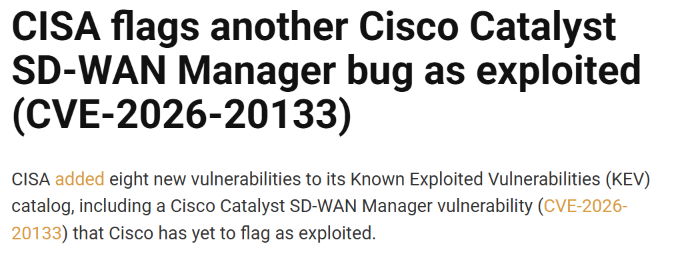
CVE-2026-20127 CVE-2026-20182 CVE-2026-20245 Authentication Bypass Active Exploitation CISA KEV
Overview
Cisco Catalyst SD-WAN Manager (formerly vManage) is affected by a chain of critical vulnerabilities allowing attackers to bypass authentication, obtain administrative access, and ultimately execute commands as root on the SD-WAN control plane. Several flaws have been actively exploited since at least 2023, with CISA issuing emergency directives for U.S. federal agencies. The most severe — CVE-2026-20127 — carries a CVSS score of 10.0. A command-injection "make-me-root" bug (CVE-2026-20245) was exploited as a zero-day until Cisco's June 2026 patch cycle.
Technical Specifications
| Attribute | Details |
|---|---|
| Primary CVEs | CVE-2026-20127 (CVSS 10.0), CVE-2026-20182, CVE-2026-20245 |
| Additional CVEs | CVE-2026-20122, CVE-2026-20126, CVE-2026-20128, CVE-2026-20133 |
| Affected Product | Cisco Catalyst SD-WAN Manager (formerly vManage) and Controller |
| Vulnerability Types | Authentication bypass, command injection, privilege escalation, file overwrite, credential exposure |
| Attack Vector | Network (internet-facing management plane) |
| Authentication Required | None (for auth-bypass CVEs) |
| Exploitation Status | Actively exploited in the wild; multiple CVEs in CISA KEV catalog |
| CISA Action | Emergency directive issued for U.S. federal agencies |
| Fixed Versions | 20.9.8.2, 20.12.5.3, 20.18.2.1 and later; versions 20.18+ immune to key auth-bypass and DCA flaws |
Affected Products
- Cisco Catalyst SD-WAN Manager (all versions prior to fixed releases)
- Cisco Catalyst SD-WAN Controller
- On-premises and Cisco-hosted deployments
- FedRAMP and enterprise/government environments using Catalyst SD-WAN
Attack Scenario
- Attacker scans for internet-exposed Cisco Catalyst SD-WAN Manager or Controller instances.
- Using CVE-2026-20127 or CVE-2026-20182, crafted requests exploit broken peering/API authentication to gain administrative access without credentials.
- With admin or low-privileged access, attacker exploits CVE-2026-20122 (file overwrite) to escalate to full vmanage rights.
- CVE-2026-20128 is abused to dump plaintext passwords from the Data Collection Agent (DCA), enabling lateral movement to other systems.
- CVE-2026-20126 or CVE-2026-20245 command injection is triggered to execute arbitrary commands as root on the SD-WAN Manager OS.
- As root/admin on SD-WAN Manager, attacker adds rogue peers, pushes malicious configurations to branch routers, and hijacks or disrupts WAN traffic across the fabric.
- Attacker may downgrade software, alter logging, or schedule unexpected reboots to persist and erase traces.
Impact
- Full control of the SD-WAN management plane with root access on the controller host
- Ability to push malicious or destructive configurations to all branch routers and gateways
- Addition of rogue peers and manipulation of WAN topology
- Plaintext credential exposure via CVE-2026-20128 DCA flaw enabling lateral movement
- Interception and rerouting of traffic across the corporate WAN
- Exfiltration of sensitive data in transit across all connected sites
- Mass WAN outages possible across corporate infrastructure, branches, and data centers
- Reconfiguration or disabling of branch routers, firewalls, and service-edge nodes
- Critical services disruption across FedRAMP, enterprise, and government SD-WAN environments
Mitigations
Immediate Actions
- Upgrade Cisco Catalyst SD-WAN Manager to fixed versions: 20.9.8.2, 20.12.5.3, 20.18.2.1 or later
- Follow Cisco PSIRT advisories for all listed CVEs: 20127, 20122, 20126, 20128, 20133, 20182, 20245
- Place SD-WAN Controller/Manager behind firewalls — do not expose management interfaces directly to the internet
- Disable unused services (HTTP/FTP) and require VPN or dedicated management networks for access
Short-term Measures
- Isolate the SD-WAN management plane from general IT networks
- Enforce least-privileged accounts and review all admin-level users in SD-WAN Manager
- Engage Cisco TAC if compromise is suspected and collect admin-tech output (
request admin-tech) for analysis - Treat any suspected compromise as both a patching and IR event — assume possibility of malicious configuration changes and credential theft
Monitoring & Detection
- Review
/var/log/auth.logfor suspiciousAccepted publickey for vmanage-adminentries from unknown IPs - Check
/var/log/tmplog/vdebugand/var/volatile/log/sw_script_synccdb.logfor unexpected downgrades, reboots, or unusual script activity - Monitor SD-WAN Manager UI for unknown peers, unexpected configuration changes, and new admin accounts
- Forward SD-WAN logs to a separate SIEM to prevent local evidence erasure by attackers
Long-term Solutions
- Continuously track Cisco advisories and CISA KEV additions related to SD-WAN Manager
- Implement network segmentation ensuring SD-WAN management compromise cannot cascade to broader IT/OT environments
- Enforce zero-trust access for all SD-WAN management plane interactions
Resources
Open-Source Reporting
Last Updated: June 16, 2026