Police National Legal Database (PNLD) Data Breach
Data Breach Law Enforcement Exposure Dark Web Leak Data Extortion Cloud Misconfiguration Risk
Overview
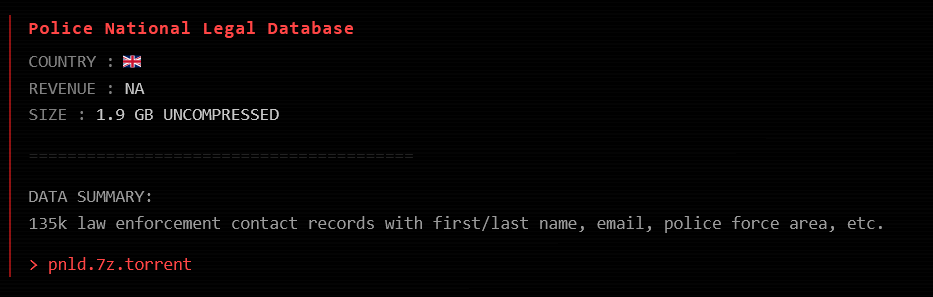
The Police National Legal Database (PNLD), a legal reference platform used by UK police forces and criminal-justice organizations, suffered a cyberattack that resulted in unauthorized access to customer contact information.
The threat actor ExfilSquad later published the stolen dataset on a dark web leak site. While reports indicate no compromise of operational policing systems or classified investigative databases, the exposure of police and government personnel information creates elevated targeting and OPSEC risk.
Technical Specifications
| Attribute | Details |
|---|---|
| Threat Actor | ExfilSquad |
| Reported Record Count | Approximately 135,000 customer records |
| Potentially Affected Personnel | 100,000+ UK police officers and staff (reported) |
| Exposed Data Types | Full names, work email addresses, organization names, police-force affiliations, contact details |
| Confirmed Non-Impacted Data (Reported) | No evidence of criminal case records, operational policing systems, intelligence databases, or classified investigations being accessed |
| Suspected Technical Factor | Ongoing investigation into possible Microsoft Power Platform misconfiguration (not officially confirmed) |
| Extortion Modus Operandi | Publication of stolen data on dark web leak infrastructure |
Affected Products
- PNLD customer/user contact data repositories
- Public-sector and law-enforcement personnel directories linked to PNLD usage
- Organizations relying on exposed contact records for justice-sector communications
- Downstream email and identity ecosystems vulnerable to phishing and impersonation follow-on activity
Attack Scenario
- Threat actors gain unauthorized access to elements of the PNLD environment.
- Customer/user contact databases are identified and enumerated.
- Sensitive personnel contact information is extracted.
- Data is exfiltrated to attacker-controlled infrastructure.
- Stolen records are published on a dark web leak site.
- Exposed details are leveraged for extortion, phishing, social engineering, and impersonation campaigns.
Impact Assessment
- Public trust in justice-sector data stewardship is weakened after unauthorized data access
- Potential impersonation of legitimate police/government personnel can corrupt communication trust chains
- Follow-on fraud campaigns may weaponize exposed identity context for credible deception
- Exposure of names, email addresses, affiliations, and contact details increases targeting precision
- Personnel in sensitive roles may face elevated doxing, spear-phishing, and profiling risk
- Leak-site publication expands long-term accessibility of stolen information to hostile actors
- Incident response, credential checks, and communication-control measures can disrupt normal operations
- Defensive coordination across police and justice organizations may strain staffing and resources
- Sustained phishing waves can create recurring operational burden for affected entities
Mitigation Strategies
Immediate Actions
- Enforce MFA for all user and privileged accounts tied to affected environments
- Rotate credentials and reset sessions when compromise is suspected
- Initiate targeted outreach to potentially affected personnel with actionable security guidance
Short-term Measures
- Review and harden cloud-service configurations, including Power Platform security settings where applicable
- Apply least-privilege controls across platform roles, data connectors, and administrative functions
- Increase monitoring for unusual authentication, permission changes, and data-access patterns
Monitoring & Detection
- Deploy DLP controls to detect and block unauthorized large-scale data extraction attempts
- Monitor dark web leak channels for reposting and secondary data packaging
- Track spear-phishing/BEC indicators using exposed contact data and police/government impersonation themes
Long-term Solutions
- Conduct regular cloud security assessments and penetration testing
- Institutionalize breach-response playbooks for justice-sector data exposure scenarios
- Expand role-specific phishing-awareness and OPSEC training for law-enforcement personnel
Resources and References
Public Reporting
Last Updated: August 4, 2026