React2Shell (CVE-2025-55182)
Remote Code Execution
Unsafe Deserialization
Critical Severity
Overview
CVE-2025-55182 is a severe vulnerability in the server-side part of React, specifically in its React Server Components (RSC) / "Flight" protocol. The bug lies in unsafe deserialization — the mechanism by which React reconstructs objects sent from client to server. An attacker can craft a malicious HTTP request whose payload, when deserialized by React on the server, executes arbitrary code.
Affected libraries include:
- `react-server-dom-webpack`
- `react-server-dom-parcel`
- `react-server-dom-turbopack` (versions 19.0, 19.1.0, 19.1.1, 19.2.0)
Frameworks / tools built on React that bundle or embed those packages, most notably Next.js.
Even applications that don't explicitly leverage "Server Functions" endpoints may still be vulnerable, if they support React Server Components.
Technical Specifications
| Attribute | Details |
|---|---|
| CVE ID | CVE-2025-55182 |
| Also Known As | React2Shell |
| Vulnerability Type | Unsafe Deserialization → Remote Code Execution (RCE) |
| Affected Libraries | react-server-dom-webpack, react-server-dom-parcel, react-server-dom-turbopack |
| Affected Versions | 19.0, 19.1.0, 19.1.1, 19.2.0 |
| Affected Frameworks | Next.js (multiple versions) |
| Attack Vector | Network (single HTTP request) |
| Authentication | None required (unauthenticated RCE) |
| Exploitability | Public PoC available, active exploitation confirmed |
| Success Rate | Near 100% (high-fidelity exploitation reported) |
| Exposed Attack Surface | ~39% of cloud environments (per Wiz study) |
Technical Details
Vulnerability Root Cause
- Unsafe deserialization of attacker-controlled payloads in React's "Flight" protocol
- Internal mechanism for serializing/deserializing data sent between client and server in RSC
Trigger Mechanism
- A single HTTP request with malicious payload can trigger remote code execution on the server
- Without authentication or privileges
Affected Components/Libraries
react-server-dom-webpackreact-server-dom-parcelreact-server-dom-turbopack- Frameworks bundling them (e.g., Next.js)
Patched Versions
React Packages
Fixed in:
- 19.0.1
- 19.1.2
- 19.2.1
Next.js
Fixed in several versions depending on series:
- 15.0.5
- 15.1.9
- 15.2.6
- 15.3.6
- 15.4.8
- 15.5.7
- 16.0.7
Exploitability Status
- Public proof-of-concept (PoC) code is now circulating
- Multiple security firms report high-fidelity exploitation with near 100% success rate
- Active exploitation confirmed in the wild
Attack Scenario
-
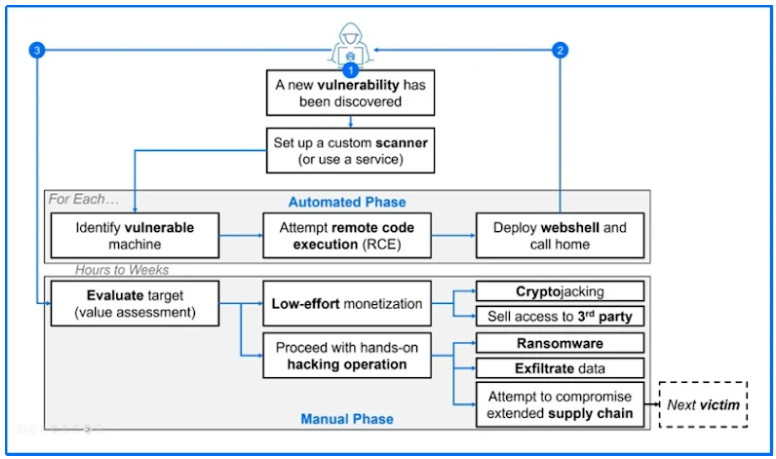
Target Identification: Attacker scans the internet for publicly exposed web servers running vulnerable versions of React/Next.js (or other impacted frameworks). According to initial telemetry, ~39% of cloud environments are vulnerable.
-
Malicious Request: Once a target is found, attacker sends a specially crafted HTTP request (malformed payload designed to exploit deserialization bug) to a server endpoint that handles React Server Components / Server Functions.
-
Code Execution: Because of unsafe deserialization, the payload triggers execution of arbitrary code on the server. The attacker gains remote code execution (RCE), potentially at the server's privilege level.
-
Post-Exploitation: With RCE, attacker can perform malicious actions:
- Install web shells
- Steal environment variables/credentials
- Exfiltrate data
- Pivot within networks
- Deploy malware
Early reports show:
- Theft of cloud credentials
- Filesystem access
- Attempts to install malicious implants
-
Scalability: Because exploitation requires only internet access and no authentication, this scenario is highly scalable and "low bar" for attackers.
Impact Assessment
- Potentially massive: given the ubiquity of React and related frameworks (including Next.js)
- A huge portion of web applications globally are affected
- ~39% of cloud environments contain vulnerable React/Next.js instances (per Wiz estimate)
- Remote, unauthenticated takeover
- Attacker can gain full server-side code execution
- Access to environment, credentials
- Leading to:
- Data breach
- Persistent backdoors
- Lateral movement
- Cloud resource abuse
- Widespread scanning / active exploitation
- Security intelligence shows that multiple threat actor groups (including alleged state-linked actors) have already begun exploiting the vulnerability
- Targeting a variety of sectors:
- Cloud services
- Corporate
- Government
- Across multiple regions
- Large exposed attack surface
- Single HTTP request can compromise server
- No authentication required
- High success rate exploitation
Mitigations
🔄 Patch Immediately
Upgrade affected React Server Component packages to fixed versions:
- react-server-dom-webpack/parcel/turbopack → 19.0.1, 19.1.2, 19.2.1
Update Next.js to the patched fixed versions: - 15.0.5, 15.1.9, 15.2.6, 15.3.6, 15.4.8, 15.5.7, 16.0.7
🛡️ Web Application Firewall (WAF)
- Use WAFs as a stop-gap defense while patching
- Major cloud providers and WAF vendors have already rolled out rules to block exploit attempts
🔍 Audit and Monitor
- Scan all applications (especially internet-facing) for vulnerable dependencies
- Review server logs for suspicious requests
- Watch for:
- Unexpected process spawning
- Web shells
- Anomalous outbound connections
- Credential access
🏗️ Defense-in-Depth
- Restrict access to services
- Minimize exposure of server-side React usage
- Limit privileges
- Enforce least-privilege on secrets/credentials
- Separate sensitive services
📊 Vulnerability Scanning
- Use vulnerability-scanning tools that detect presence of React2Shell-vulnerable packages or Next.js versions
- Many vendors (cloud or security-tool providers) have released detection plugins
🚨 Incident Response
- If compromise is suspected:
- Isolate affected systems
- Review logs for evidence of exploitation
- Reset credentials and secrets
- Conduct forensic analysis
Resources & References
Official Advisories & Analysis
- Critical Security Vulnerability in React Server Components – React
- CVE-2025-55182 (React2Shell): Remote code execution in React Server Components and Next.js | Datadog Security Labs
- React2Shell RCE (CVE-2025-55182) Next.js (CVE-2025-66478) | Tenable®
- CVE-2025-55182 vulnerability in React and Next.js | Kaspersky official blog
Active Exploitation & Threat Intelligence
- Critical React2Shell Flaw Added to CISA KEV After Confirmed Active Exploitation
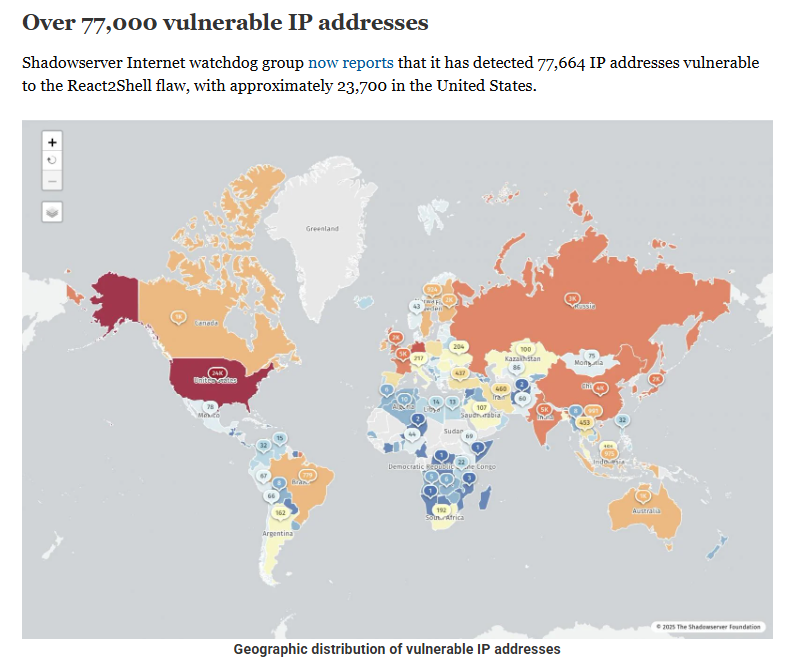
- React2Shell flaw exploited to breach 30 orgs, 77k IP addresses vulnerable
- Chinese Hackers Have Started Exploiting the Newly Disclosed React2Shell Vulnerability
- React2Shell: In-the-Wild Exploitation Expected for Critical React Vulnerability - SecurityWeek
- React.js Hit by Maximum-Severity 'React2Shell' Vulnerability - Infosecurity Magazine
- Experts warn this 'worst case scenario' React vulnerability could soon be exploited - so patch now | TechRadar
Critical Priority
This vulnerability is being actively exploited in the wild by multiple threat actors, including state-linked groups. Immediate patching is critical for all React/Next.js deployments.