ClickFix Hospitality Phishing Campaign (a.k.a. “I Paid Twice” campaign)
Hospitality Phishing / Booking Impersonation Infostealer / RAT Delivery Credential & Booking Data Theft
Overview
The ClickFix campaign targets hotels and accommodation providers via phishing emails impersonating booking platforms (notably Booking.com). Hotel staff who follow the lure run a clipboard/PowerShell payload that installs infostealers and PureRAT variants, enabling theft of booking and guest data and follow‑on phishing or financial fraud against customers.
Technical Specifications
| Attribute | Details |
|---|---|
| Campaign Name | ClickFix / "I Paid Twice" |
| Target | Hotels, lodging providers, reservation staff |
| Attack Vector | Spear‑phishing emails with links to fake Booking.com pages (CAPTCHA / "Click to fix" lures) |
| Initial Vector | Compromised/spoofed emails or targeted phishing |
| Payloads | PowerShell downloader, infostealer (credentials, browser data), PureRAT (PureHVNC/ResolverRAT) |
| Infrastructure | Hundreds of lookalike domains (fast‑flux / bulletproof hosting) |
| User Interaction | Low — user must follow link and execute copied payload (Win+R, Ctrl+V, Enter) |
| Impact | Account compromise, data theft, secondary phishing, financial fraud |
| Regions Observed | Global (hotel ecosystems relying on third‑party booking platforms) |
Technical Details
- Initial vectors:
- Compromised or spoofed sender addresses impersonating Booking.com or similar services.
- Malicious landing pages that present a fake CAPTCHA or "ClickFix" verification flow.
- Delivery & execution:
- Pages instruct victims to copy a command/payload to clipboard and run via Windows Run (Win+R → Ctrl+V → Enter).
- PowerShell fetches and executes additional payloads from attacker infrastructure.
- Payload & capabilities:
- Infostealer modules harvest email, booking system credentials, browser cookies, and local files.
- Remote Access Trojans (PureRAT / PureHVNC / ResolverRAT) provide persistence and remote control.
- Infrastructure:
- Domain clusters mimic legitimate booking and hotel domains (e.g., booking-com-secure[.]com).
- Use of fast‑flux/bulletproof providers to rotate domains and evade takedown.
Attack Scenario
- Adversary identifies hotels using popular booking platforms and crafts spear‑phish messages (urgent payment/update, negative review).
- Email directs staff to a spoofed Booking.com page with a verification/CAPTCHA prompt (ClickFix lure).
- Page instructs victim to copy a command and run it, causing a PowerShell download/execution.
- Malware installs infostealer and PureRAT, exfiltrating credentials and system data.
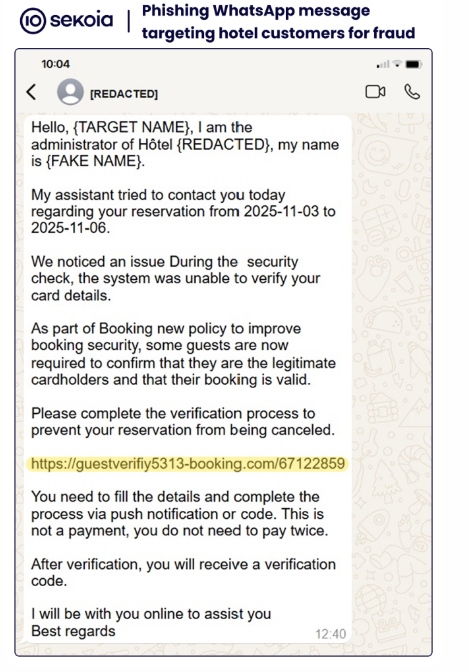
- Compromised hotel accounts are used to alter bookings, send fraudulent emails to guests, or harvest payment data.
- Stolen guest data fuels secondary phishing or payment fraud campaigns against customers.
Impact
- Hotels / Lodging Providers:
- Email and booking system account compromise
- Operational disruption, financial loss, reputational damage
- Potential regulatory exposures (GDPR, local data‑protection laws)
- Customers / Guests:
- Exposure of PII and payment details
- Increased risk of payment fraud and identity theft
- Targeted follow‑on phishing using stolen booking data
Mitigations
- For Organizations (Hotels, Booking Platforms):
- Enforce MFA on email and booking accounts.
- Deploy email authentication (SPF/DKIM/DMARC) and advanced phishing detection.
- Implement EDR to detect PowerShell abuse and RAT behavior.
- Train staff to never run clipboard commands or follow verification flows from unsolicited messages.
- Maintain segmented networks, offline backups, and rapid incident response playbooks.
- For Customers:
- Always access booking platforms directly (not via message links).
- Verify suspicious "payment verification" notices through the official booking dashboard.
- Use strong, unique passwords and enable MFA.
Indicators & IOCs
- Example domain patterns: booking-com-secure[.]com, extrntbooking[.]xyz
- Lures: fake CAPTCHA / "Click to fix" verification pages instructing clipboard command execution
- Behavioral IOCs: unusual PowerShell downloads, new Remote Access service installs, outbound beaconing to unfamiliar domains
Resources and References
Official Documentation
- Dark Reading: ClickFix Scam Targets Hotels, Spurs Customer Attacks
- Industry report: ClickFix phishing links increased nearly 400% in 12 months
- Sekoia: Booking.com Phishing Campaign Targeting Hotels
Risk Level: High
The campaign enables credential theft and persistent remote access to hotel systems; prioritise MFA, EDR, user training, and swift containment for suspected incidents.