TA419 - China-Aligned Targeted Phishing
TA419 AitM Phishing Frameless BitB Microsoft 365 AI Policy Targeting
Overview
China-aligned threat actor TA419 targeted U.S. AI-policy experts through tailored relationship-based phishing.
Attackers impersonated real AI-policy figures and other prominent professionals, using credible invitations tied to AI policy, advisory committees, export controls, and supply-chain topics.
Reporting indicates the objective was intelligence collection on U.S. AI policy and regulation rather than broad indiscriminate credential theft.
Technical Details
- Initial access: targeted spear-phishing and social engineering.
- Impersonation themes reportedly included former White House OSTP personnel, economists/foreign-policy experts, and an Anthropic employee.
- URL shorteners were used to redirect victims through attacker-controlled infrastructure.
- Cloudflare Turnstile appeared in the redirection/filtering flow.
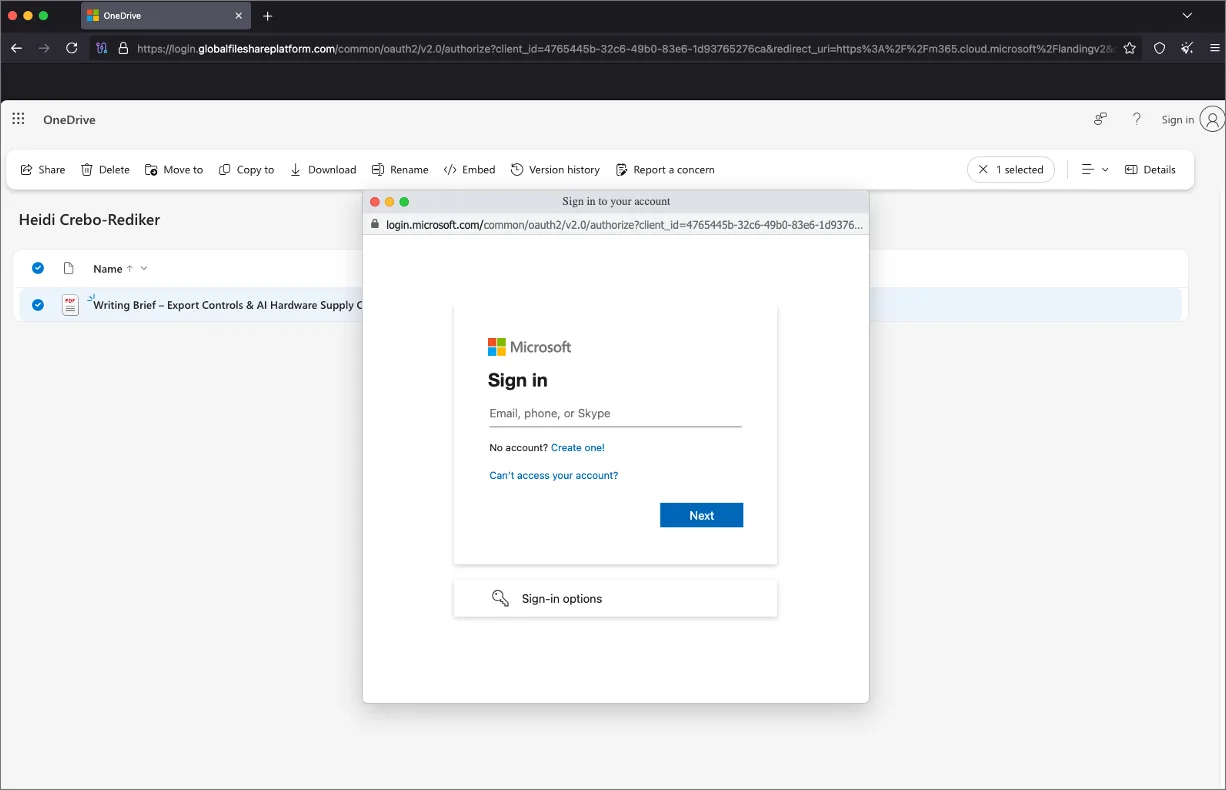
- Fake OneDrive pages were used as lures.
- Adversary-in-the-middle (AitM) infrastructure proxied Microsoft authentication traffic.
- Primary identity target: Microsoft 365 and Microsoft Entra ID users.
- Frameless BitB (Browser-in-the-Browser) was used to present convincing fake Microsoft sign-in interfaces.
- Credential and MFA information could be captured.
- Authentication session cookies were captured post-login for potential session hijacking.
- Attacker-controlled scripts monitored victim authentication progress and automated portions of the workflow.
Technical Specifications
| Attribute | Details |
|---|---|
| Threat Actor | TA419 (China-aligned in reporting context) |
| Initial Vector | Highly targeted spear-phishing/social engineering |
| Impersonation Strategy | Trusted policy and professional persona abuse |
| Phishing Infrastructure | URL shorteners, fake OneDrive, Turnstile-gated redirect chain |
| Credential Capture Method | AitM proxy plus Frameless BitB login simulation |
| Post-Auth Objective | Session-cookie theft and cloud-account access for intelligence collection |
Affected Products
- Microsoft 365 user accounts and related cloud resources.
- Microsoft Entra ID authentication and session workflows.
- Organizations involved in AI policy, export-control analysis, and strategic technology research.
Attack Scenario
- TA419 selects an AI-policy expert target.
- Attacker sends a tailored message impersonating a trusted policy professional.
- Victim receives realistic collaboration/invitation content.
- Victim engages, increasing trust.
- TA419 sends shortened URL infrastructure.
- Victim is redirected through attacker-controlled chain.
- Fake OneDrive content is shown.
- Cloudflare Turnstile appears in flow.
- Victim reaches AitM phishing stack.
- Frameless BitB fake Microsoft login interface is displayed.
- Authentication is relayed to legitimate Microsoft infrastructure.
- Victim credentials/MFA succeed.
- TA419 captures credentials and session material for potential account access.
Impact Assessment
- Compromise risk for Microsoft 365 and Entra ID accounts
- Theft of credentials, MFA artifacts, and session information
- Potential unauthorized access to email and cloud-hosted data
- Possible exposure of sensitive AI-policy research and communications
- Intelligence value tied to U.S. AI regulation, export controls, supply chains, military AI applications, and U.S.-China technology competition
- Session hijacking can enable persistent cloud access after initial phishing success
- Elevated exposure for organizations active in strategic AI research and policymaking
Mitigation Strategies
- Deploy phishing-resistant MFA, preferably FIDO2/WebAuthn/passkeys.
- Do not rely only on SMS or traditional OTP MFA for high-value accounts.
- Verify unexpected professional invitations through independent channels.
- Provide relationship-based phishing awareness training for high-value personnel.
- Monitor Microsoft 365/Entra ID for unusual sign-ins, impossible travel, unfamiliar sessions/devices, suspicious token activity, and anomalous OAuth/application behavior.
- Block or investigate suspicious URL-shortening services.
- Monitor newly registered domains resembling Microsoft, OneDrive, or internal organization brands.
- Apply Conditional Access and device-compliance enforcement.
- Revoke active sessions/tokens immediately after suspected compromise.
- Centralize identity/cloud logging for rapid detection and response.
- Conduct targeted awareness programs for executives, researchers, policy experts, and administrators.
Resources and References
Public Reporting
Last Updated: October 6, 2026