OpenPLC ScadaBR CVE-2021-26829 Active Exploitation

Stored XSS
SCADA/HMI Compromise
Active Exploitation
Overview
CVE-2021-26829 is a stored XSS vulnerability in OpenPLC ScadaBR's system_settings.shtm page. Affected versions are up to 1.12.4 on Windows, and up to 0.9.1 on Linux.
The flaw allows an attacker who can reach the interface (e.g., via default or weak credentials) to inject malicious JavaScript that will be stored. Anytime an operator/admin visits that page, the script executes in their browser context, potentially manipulating the HMI interface, stealing credentials/sessions, or altering configuration.
Technical Specifications
| Attribute | Details |
|---|---|
| CVE ID | CVE-2021-26829 |
| Vulnerability Type | Stored Cross-Site Scripting (CWE-79) |
| Affected Component | system_settings.shtm page in OpenPLC ScadaBR |
| Affected Versions | Up to 1.12.4 (Windows), up to 0.9.1 (Linux) |
| Attack Vector | Network (Web Interface) |
| Authentication | Required (often default/weak credentials) |
| Target Environment | SCADA/HMI systems in critical infrastructure |
Technical Details
Vulnerability Mechanism
- Trigger: User-supplied input not properly sanitized or filtered before persistent storage/rendering, leading to script injection in the backend content.
- Storage: Malicious JavaScript is stored in the application and executed whenever an authenticated user visits the vulnerable page.
Attack Capabilities
When malicious script executes in the context of an authenticated user (e.g., HMI operator/admin), possibilities include: - Session hijacking - Credential theft - Unauthorized UI changes (e.g., hiding or modifying panels or parameters) - Disabling logs/alarms - Redirecting to attacker servers - Control over the SCADA interface / HMI elements
All without needing OS-level exploits or host-level privilege escalation.
Attack Scenario
Reported Case: TwoNet Attack (September 2025)
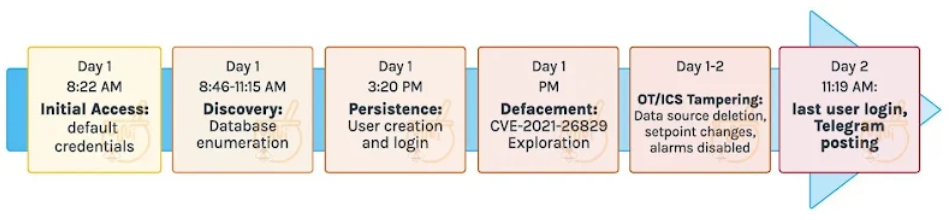
In September 2025, TwoNet attacked a honeypot configured to mimic a water-treatment facility running ScadaBR. The chain observed by security researchers went as follows:
- Initial Access: Use of default credentials to log in.
- Persistence: Creation of a new user account named "BARLATI" for persistence.
- Exploitation: Exploitation of CVE-2021-26829 to inject malicious script.
- Impact:
- Defacement of the HMI login page (e.g., a pop-up "Hacked by Barlati")
- Modification of system settings to disable HMI logs and alarms
- Scope: According to the report, they did not escalate privileges to the underlying host: all abuse stayed at the web-application layer (HMI).
Because the target was a honeypot (a decoy), it's unclear whether a real industrial facility has been compromised — but the behavior demonstrates that even "just" XSS can lead to meaningful OT impact if exploited.
Impact Assessment
- Potential compromise of SCADA HMI interface
- Attackers can manipulate what operators see (e.g., sensor values, alarms)
- Possibly causing incorrect operator decisions
- Disabling of logs/alarms: making malicious changes stealthy
- Impeding detection or forensic audit
- Session hijacking, credential theft or persistence (e.g., backdoor accounts)
- Leading to long-term unauthorized access
- In a real deployment, could lead to disruption of industrial processes
- Safety hazards, loss of availability or integrity of control systems
- SCADA systems often control critical infrastructure (water, utilities, power)
- Potential real-world impact could be severe
- Even though publicly documented exploitation is only for a honeypot
- The fact that the flaw is in the wild, combined with scanning and detection efforts (by actors like TwoNet)
- Suggests a real risk to any unpatched ScadaBR instance exposed or reachable
Mitigations
🔄 Patching
- Apply the vendor-provided patch / fix
- Upgrade ScadaBR beyond the vulnerable versions (i.e., versions later than 1.12.4 on Windows, or later than 0.9.1 on Linux)
🛡️ If Patching is Not Immediately Possible
- Restrict or limit access to the web interface (HMI)
- Limit who can reach the web UI (network segmentation, VPNs, firewall rules, internal-only access)
🔒 Strong Authentication
- Implement strong credentials (no default credentials)
- Enforce unique and strong passwords for administrators/accounts
🛠️ Compensating Controls
- Use Web Application Firewalls (WAFs) or input-validation/sanitization proxies
- Filter or block malicious script payloads if the interface must remain exposed
📊 Monitoring & Detection
- Monitor network logs, HMI interface access logs, and audit configuration changes
- Hunt for anomalous behavior:
- Unexpected user creations
- Disabling of logs/alarms
- Unusual page modifications
🗑️ Decommissioning
- If possible, decommission or replace ScadaBR installations
- Especially if there is no longer vendor support or ability to patch