Chinese Hackers Use AI Agents in Multi-Country Cyber Campaign
AI-Enabled Threat Activity Cyber Espionage SecFlow GLUTTON Webshell Credential Theft Data Exfiltration
Overview
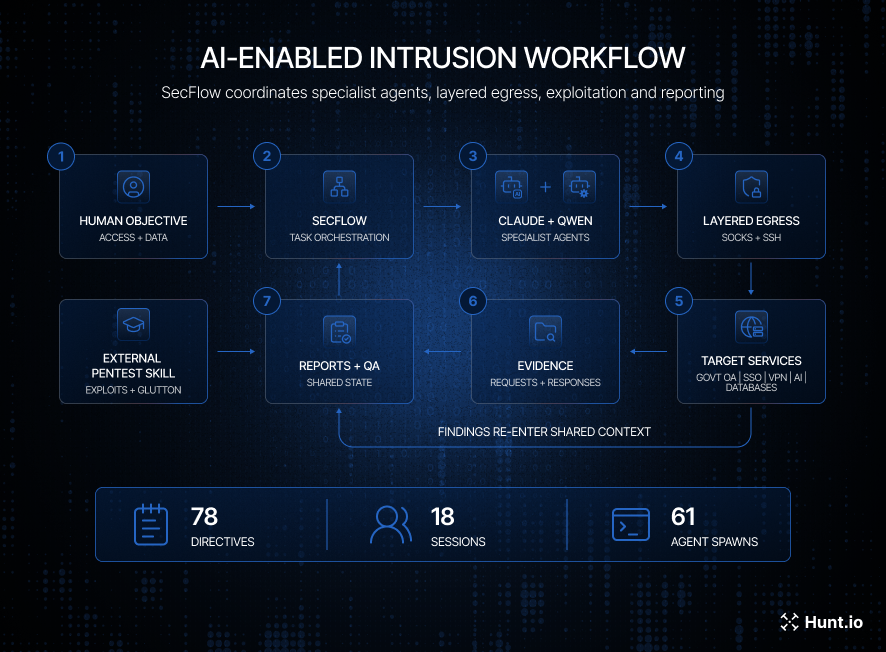
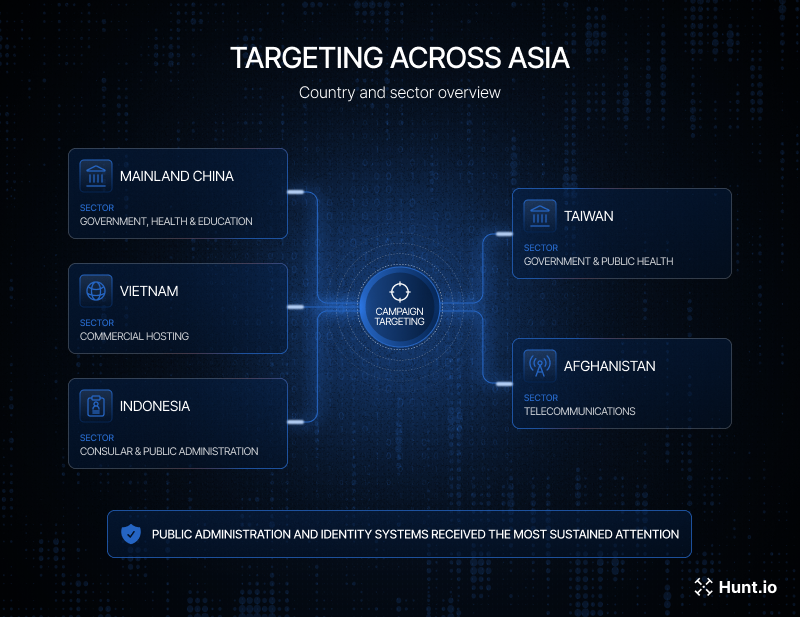
Hunt.io documented a Chinese-speaking threat actor using an AI-agent orchestration framework called SecFlow to automate and coordinate cyber-espionage operations. The framework reportedly used commercial AI models as specialized workers for reconnaissance, exploitation, data collection, and reporting.
The campaign combined AI-assisted tasking with conventional intrusion tradecraft, including exposed attack infrastructure, webshell deployment, credential access, and staged data theft from targeted organizations.
Technical Specifications
| Attribute | Details |
|---|---|
| Primary Framework | SecFlow AI-agent orchestration platform |
| Model Profiles Observed | Claude, Qwen, and DeepSeek profiles with switching support |
| Routing Infrastructure | Private proxy infrastructure associated with niestools.com |
| Exposed Components | AI orchestration host, Java/CAS exploitation tooling, fake MySQL deserialization service, Shellshock and credential-testing infrastructure, payload repository |
| Custom Malware/Tooling | GLUTTON webshell framework |
| Stealth Technique | Steganographic payload concealment in PNG files with in-memory decode/execute flow |
| Post-Exploitation Actions | Command execution, ASPX webshell deployment, LSASS and SAM/SYSTEM hive collection, credential extraction, privileged account creation, file exfiltration |
| Known Confirmed Data Loss | 822 OA user account records; 949 attachments (~1.28 GB), including sensitive health-related information |
| Secondary Exposure | AI education platform with 23 agent configurations, 14 API-secret fields, and 104 chatbot conversations |
Affected Products
- Internet-facing Office Automation (OA) platforms
- Java/CAS-based web applications and related middleware
- Apache, Grafana, and other publicly exposed enterprise services with unpatched weaknesses
- Windows servers hosting vulnerable web applications
- AI-agent backends and management interfaces with weak access controls
Attack Scenario
- Operators perform reconnaissance and scanning against internet-facing applications across multiple targets.
- The threat actor tests credentials and probes vulnerable services, including Java/CAS-related paths and auxiliary infrastructure.
- Once access is established, attackers obtain Windows command execution and deploy ASPX webshells.
- Attackers collect credential material from LSASS memory and SAM/SYSTEM registry hives.
- A privileged account is created for persistent access and post-compromise control.
- Files are staged and exfiltrated from compromised environments.
- In parallel, fake MySQL deserialization services are used to target vulnerable Java applications.
- GLUTTON tooling may embed payloads in PNG files and execute decoded code in memory to reduce static detection.
Impact Assessment
- Unauthorized command execution and webshell persistence on compromised systems
- Privileged account creation enables continued attacker control
- System configuration and trust boundaries may be altered during post-exploitation
- Confirmed theft of account records and attachment data, including sensitive health information
- Credential material extraction increases risk of lateral movement and follow-on compromise
- Exposure of AI-agent secrets and chatbot conversations increases privacy and security risk
- Operational disruption may occur during containment, credential resets, and forensic response
- Compromised enterprise services may require temporary isolation or rebuilds
- Broad campaign activity increases cumulative risk across multiple organizations
Mitigation Strategies
Immediate Actions
- Secure internet-facing applications and Office Automation systems.
- Patch vulnerable Java/CAS, Apache, Grafana, and other exposed software.
- Isolate suspected hosts and preserve forensic evidence before cleanup.
- Revoke compromised sessions and rotate exposed credentials, tokens, and API secrets.
Short-term Measures
- Monitor for webshell activity and unusual command execution patterns.
- Protect and monitor access to LSASS memory and SAM/SYSTEM registry hives.
- Enforce MFA and least-privilege controls for administrative and remote access paths.
- Require strong authentication on AI-agent platforms and management backends.
Monitoring & Detection
- Detect suspicious proxy-mediated and automated AI-agent activity.
- Inspect uploaded image files for hidden payload indicators and anomalous server-side decoding behavior.
- Correlate reconnaissance, credential testing, exploitation, and exfiltration as a single kill chain.
- Hunt for unauthorized privileged-account creation and anomalous outbound transfer activity.
Long-term Solutions
- Build behavioral detections for end-to-end attack-chain activity rather than model-name indicators only.
- Establish hardening baselines for AI orchestration infrastructure and secret-management workflows.
- Conduct recurring adversary emulation for webshell, credential-theft, and data-exfiltration scenarios.
- Implement continuous external exposure management for internet-facing assets.
Resources and References
Last Updated: September 6, 2026