Zara Data Breach: 197,000 Customers Exposed in Third-Party Security Incident

Data Breach Third-Party Risk ShinyHunters Supply Chain
Overview
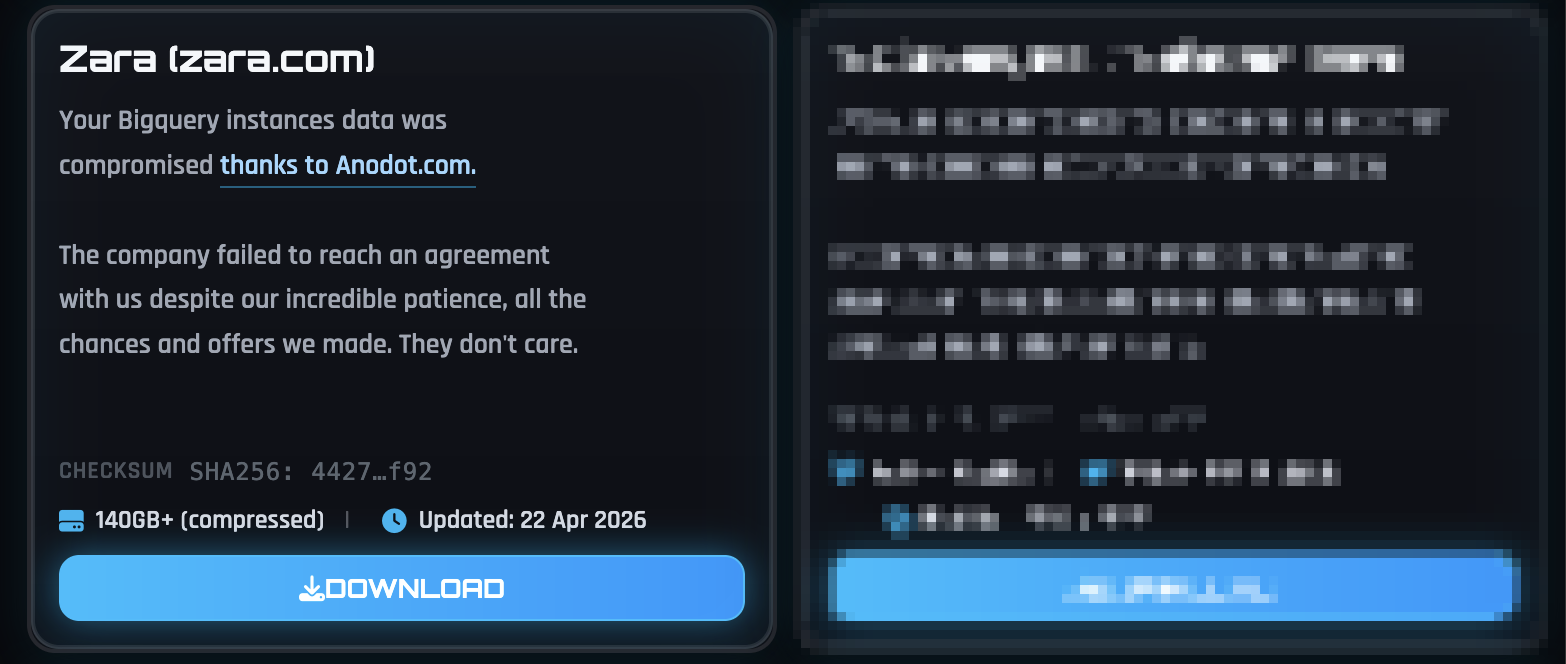
A third-party security incident exposed personal data belonging to approximately 197,000 Zara customers. The breach reportedly originated from a compromised external vendor connected to Inditex infrastructure. Threat actors — linked in reports to the cybercrime group ShinyHunters — accessed customer-related records held by a third-party analytics or cloud service provider, then allegedly attempted extortion. No payment card data or account passwords were reported to have been exposed.
Technical Specifications
| Attribute | Details |
|---|---|
| Target Organization | Inditex / Zara |
| Breach Origin | Compromised third-party analytics or cloud service provider |
| Records Exposed | ~197,000 customers |
| Data Exposed | Email addresses, customer support records, geographic transaction data, purchase-related data |
| Data Not Exposed | Payment card data, account passwords |
| Threat Actor | ShinyHunters (reported attribution) |
| Method | Third-party vendor compromise → connected cloud database access → data extraction |
| Post-Breach Activity | Extortion / leak threats |
| CVE | None |
Affected Products
- Inditex / Zara third-party vendor infrastructure (analytics or cloud service)
- Connected customer data systems accessible to the compromised vendor
Attack Scenario
- Threat actors compromise a third-party analytics or cloud service provider with access to Inditex/Zara customer data
- Attackers leverage the vendor's existing access to connected cloud databases within Inditex infrastructure
- Customer information — including email addresses, support records, transaction geography, and purchase history — is extracted from vendor systems
- Stolen data is weaponized for extortion or public leak threats against the affected organization
- Inditex and Zara investigate the incident, notify impacted customers, and report unauthorized access to transaction databases
Impact
- Personal information of ~197,000 Zara customers exposed, including email addresses, support records, and purchase-related data
- Increased risk of targeted phishing, fraud, and social-engineering campaigns directed at affected customers
- Potential privacy violations triggering regulatory obligations under GDPR and equivalent frameworks
- Reputational damage to Zara and the wider Inditex brand stemming from an incident in the vendor supply chain rather than a direct internal failure
- Regulatory and compliance scrutiny under GDPR and other applicable data protection laws
- Customer trust erosion, particularly given the sensitivity of purchase behavior and support correspondence
- Demonstrates how a single third-party provider with broad access to customer data can become the weakest link in an enterprise security posture
- Extortion follow-on underscores that third-party breaches carry post-incident operational and financial consequences beyond the initial data loss
Mitigations
Third-Party Risk Management
- Conduct regular third-party security audits — assess the security posture of all vendors with access to customer data before onboarding and on a recurring schedule; require evidence of controls such as SOC 2 Type II or ISO 27001 certification
- Perform supply-chain risk assessments — map all vendors with connectivity to internal systems or access to customer datasets; prioritize reviews for analytics, cloud, and marketing providers
- Limit vendor access to sensitive customer data — enforce data minimization: vendors should only receive the data strictly necessary for their contracted service, and access should be scoped, time-limited, and reviewed periodically
- Enforce Zero Trust access controls — treat vendor accounts as untrusted by default; require strong authentication and enforce least-privilege access to internal systems and databases
Technical Controls
- Enable MFA for all vendor accounts with access to internal environments or cloud databases
- Encrypt sensitive stored data at rest and in transit so that extraction without decryption keys yields limited usable data
- Implement continuous monitoring and logging across vendor-connected access paths; alert on anomalous query volumes, bulk data exports, or access from unexpected locations
Incident Response
- Notify affected users promptly and provide clear guidance on phishing risk; advise customers to be vigilant about emails referencing their Zara order history or support interactions
- Monitor for downstream phishing campaigns targeting affected customers using the exposed email addresses and purchase data
- Engage regulatory authorities as required under GDPR (72-hour notification obligation) and equivalent frameworks
Resources
Open-Source Reporting
Last Updated: May 10, 2026