Mirai Botnet Targeting CVE-2025-29635 in D-Link DIR-823X Routers

CVE-2025-29635 Mirai Botnet Command Injection End-of-Life Device
Overview
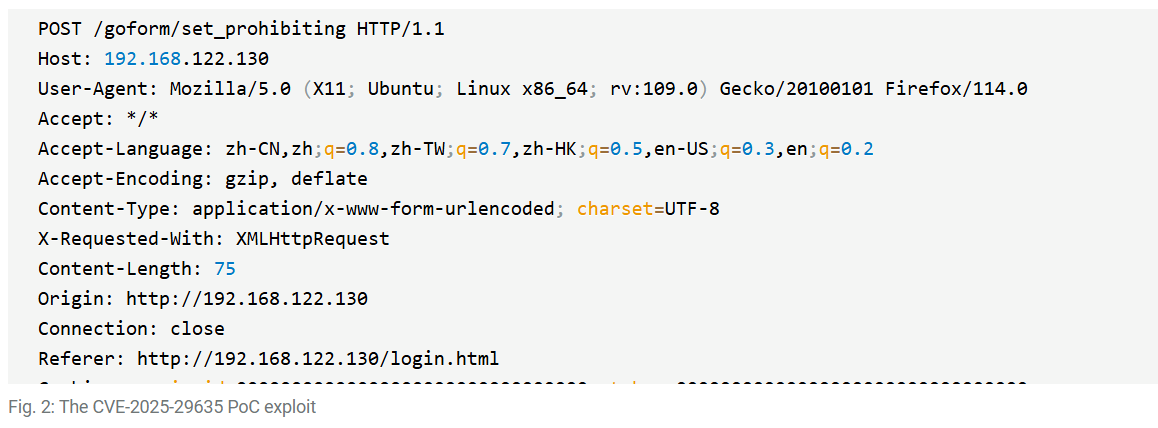
A Mirai-based botnet campaign is actively exploiting CVE-2025-29635, a command injection vulnerability in discontinued D-Link DIR-823X routers. Attackers scan for internet-exposed devices, send a crafted HTTP POST request to achieve remote code execution, then download and execute a Mirai payload that enrolls the device into botnet infrastructure used for DDoS attacks and other malicious operations. As the affected devices are end-of-life, no vendor patch will be issued.
Technical Specifications
| Attribute | Details |
|---|---|
| CVE | CVE-2025-29635 |
| Vulnerability Type | Command Injection → Remote Code Execution |
| Affected Device | D-Link DIR-823X router (discontinued / EoL) |
| Attack Vector | Crafted HTTP POST request (network-accessible management interface) |
| Payload | Mirai variant — XOR-obfuscated binary |
| Post-Exploitation | Shell command execution, malware download, C2 enrollment |
| Botnet Use | DDoS attacks; potential traffic interception |
| Patch Available | No — device is end-of-life |
Affected Products
- D-Link DIR-823X routers — all firmware versions (end-of-life, no patch forthcoming)
Attack Scenario
- Attacker mass-scans the internet for devices exposing the DIR-823X management interface
- Vulnerable devices are identified and targeted with a crafted HTTP POST request exploiting CVE-2025-29635
- Command injection triggers remote code execution on the router's underlying OS
- Shell commands download the Mirai payload (XOR-encoded) from an attacker-controlled server
- Payload is decoded and executed on the device
- Device connects to C2 infrastructure and joins the Mirai botnet
- Compromised router participates in DDoS campaigns and awaits further attacker commands
Impact
- Full remote compromise of vulnerable DIR-823X routers
- Device enrolled into Mirai botnet for DDoS and other operations
- Risk of network traffic interception on the affected segment
- Potential pivot point for lateral movement into connected internal networks
- Botnet scale amplified by the large installed base of EoL routers that will never receive patches
- Coordinated DDoS capacity usable against any downstream target
- Owners unlikely to detect compromise — no visible symptoms on consumer routers
Mitigations
- Replace affected routers — DIR-823X is end-of-life; replacement with a supported device is the only full remediation
- Avoid continued use of EoL network devices, particularly those exposed to the internet
- Disable remote/WAN-side administration interfaces on all routers where not required
- Apply firewall rules to restrict external access to router management ports
- Monitor network traffic for anomalous outbound connections indicative of C2 activity
- Ensure all other network devices run current, vendor-supported firmware
Resources
Open-Source Reporting
- Mirai Botnet Targets Flaw in Discontinued D-Link Routers — SecurityWeek
- Mirai Botnet exploits CVE-2025-29635 to target legacy D-Link routers
- New Mirai campaign exploits RCE flaw in EoL D-Link routers
- CVE-2025-29635: Mirai Campaign Targets D-Link Devices | Akamai
- New Mirai variants target routers and DVRs in parallel campaigns — Help Net Security
- NVD — CVE-2025-29635
Last Updated: April 23, 2026