Instagram 17.5M User Data Leak – API Scraping Incident
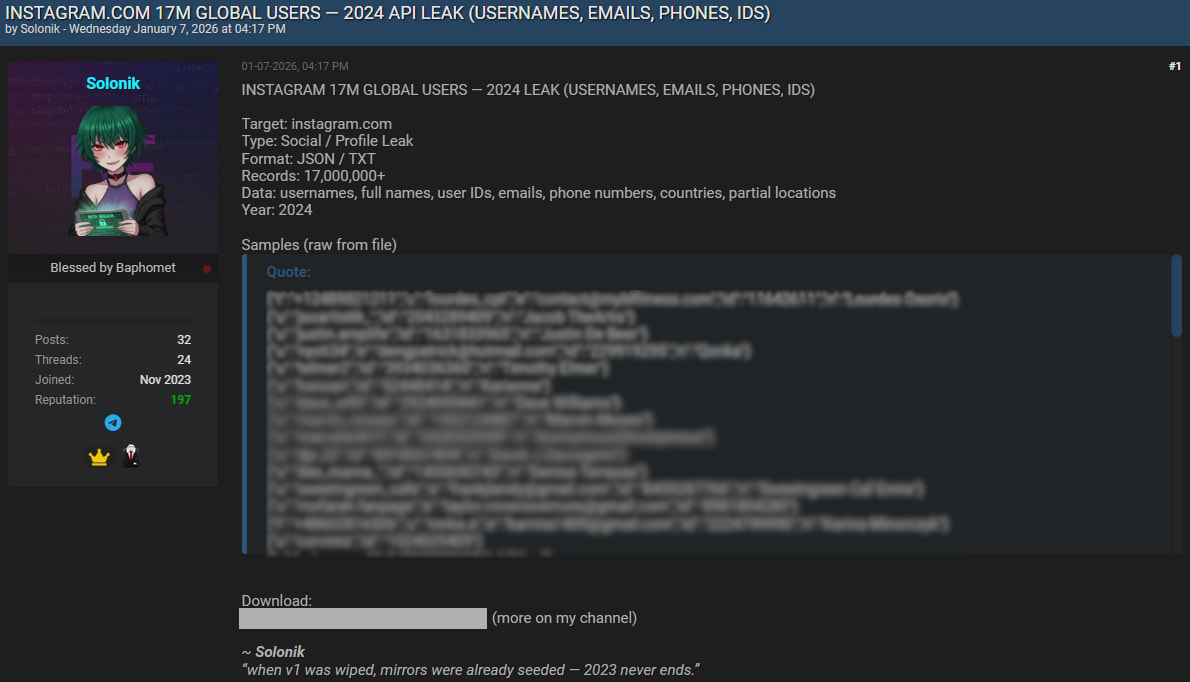
Data Leak 17.5M Users API Scraping PII Exposure Instagram Dark Web
Overview
A massive dataset containing personal information of approximately 17.5 million Instagram users surfaced on underground hacker forums in January 2026, exposing usernames, email addresses, phone numbers, and partial location data to cybercriminals.
The data allegedly originated from an API scraping operation conducted in 2024, exploiting weak rate limiting or inadequate authorization controls on Instagram's public or semi-public API endpoints. Unlike traditional data breaches involving unauthorized database access, this incident represents a large-scale automated collection of user information through legitimate but abused API calls, systematically harvesting profile metadata that should have been protected through proper access controls.
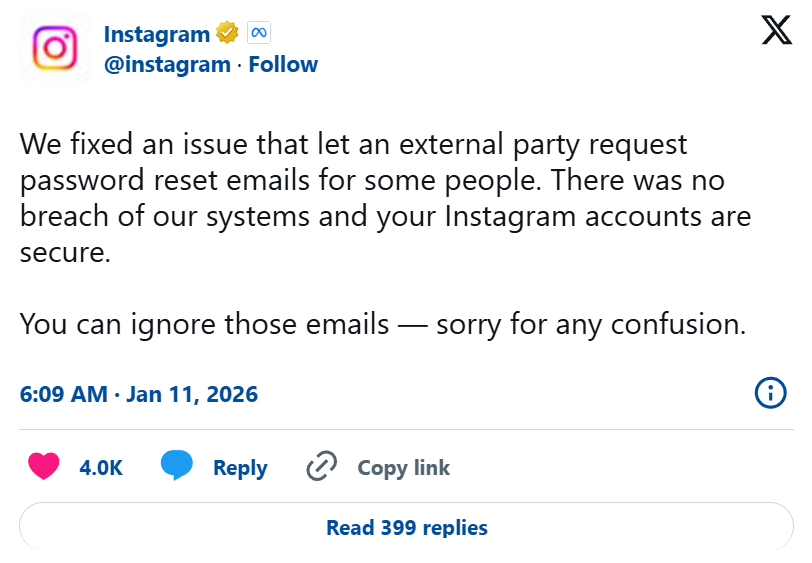
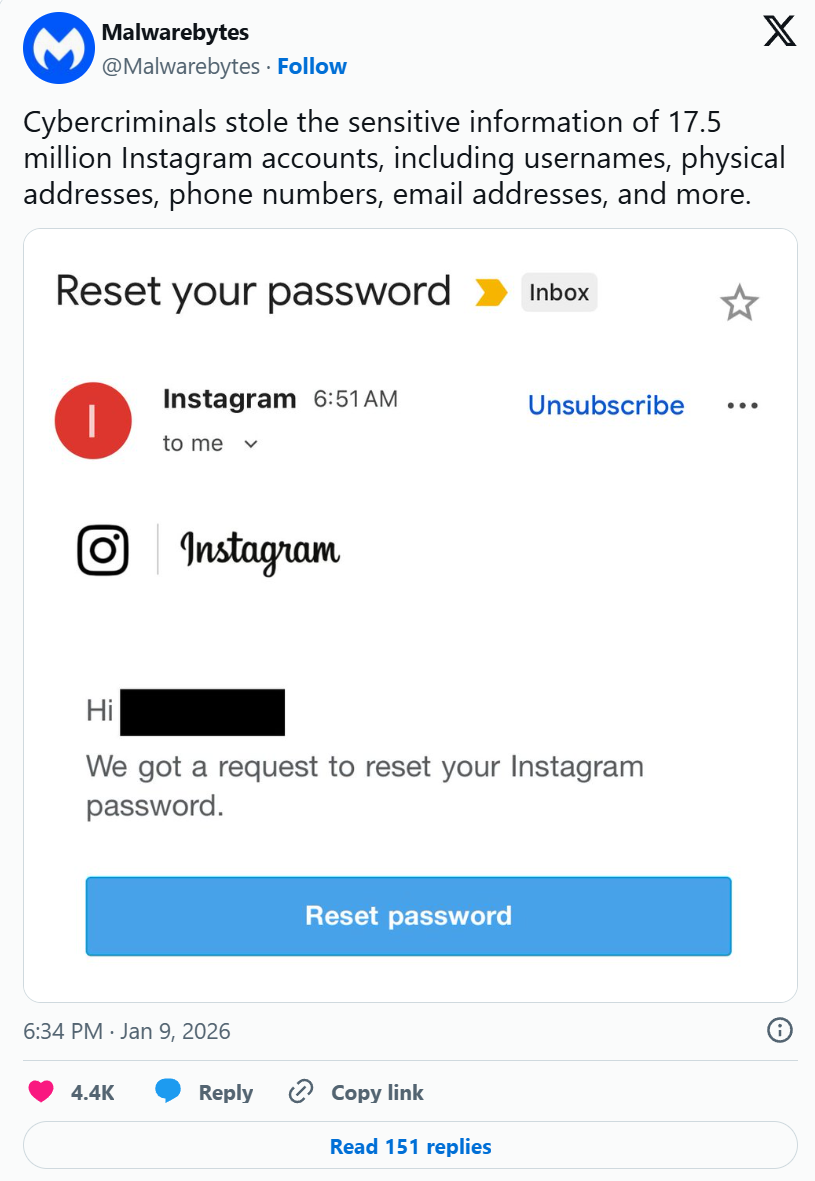
The dataset appeared on dark web marketplaces on January 7, 2026, making the information available to threat actors for phishing campaigns, identity theft, SIM-swapping attacks, and social engineering. Affected users have reported waves of unsolicited password reset emails, suggesting attackers are actively weaponizing the leaked data to trigger legitimate Instagram security features, creating confusion and potential vectors for phishing attacks disguised as official communications.
Meta (Instagram's parent company) has denied that any breach of their internal systems occurred, attributing the password reset activity to external parties abusing publicly available account recovery mechanisms using the scraped email/phone combinations. However, security researchers at Malwarebytes and other firms confirmed the dataset's authenticity and widespread circulation on criminal forums, validating that 17.5 million users' privacy has been compromised regardless of the technical classification as "breach" versus "scraping." The incident highlights the blurred lines between legitimate data collection and malicious harvesting, demonstrating how inadequate API protections can expose user data at massive scale without requiring sophisticated hacking techniques.
With no passwords directly leaked, the primary risks involve identity verification abuse, targeted phishing, account takeover attempts via social engineering, and SIM-swapping attacks leveraging the exposed phone numbers.
Users whose data appears in the dataset face increased risk of spear-phishing emails, SMS phishing (smishing), voice phishing (vishing), and impersonation attacks across multiple platforms beyond Instagram.
The incident underscores the critical importance of robust API security controls, rate limiting, behavioral analysis, and user data minimization in social media platforms managing hundreds of millions of user accounts.
Incident Specifications
| Attribute | Details |
|---|---|
| Incident Type | Data Leak, API Scraping, Mass Data Exposure |
| Disclosure Date | January 7, 2026 (published on dark web forums) |
| Data Collection Period | 2024 (alleged scraping operation timeframe) |
| Affected Platform | Instagram (Meta Platforms Inc.) |
| Number of Users Affected | Approximately 17.5 million |
| Data Exposed | Usernames, Email addresses, Phone numbers, Partial location/address data, User IDs, Profile metadata |
| Passwords Exposed | No (passwords NOT included in dataset) |
| Source of Leak | Automated API scraping (not direct database breach) |
| Attack Method | Mass automated collection via Instagram API with inadequate rate limiting |
| Publication Location | Underground hacker forums, dark web marketplaces |
| Vendor Response | Meta denies breach; attributes password reset activity to external abuse |
| Root Cause | Insufficient API rate limiting, weak authorization controls, lack of behavioral detection |
| Attack Complexity | Low (automated scraping tools, no sophisticated hacking required) |
| Data Sensitivity | High (PII: emails, phones, addresses enable identity theft and phishing) |
| Current Threat Level | Active exploitation (users receiving fraudulent password reset emails) |
| Geographic Scope | Global (Instagram's worldwide user base) |
| Industries Affected | All sectors (Instagram used by individuals, influencers, businesses, brands) |
| User Notification | No direct notification from Meta (users learn via media reports) |
| Dark Web Pricing | Dataset reportedly available for sale or free distribution on forums |
| Public Awareness | High (major security news coverage, Malwarebytes advisory) |
Technical Details
Instagram API Architecture and Scraping Methodology
Instagram Platform Overview:
- User Base: Over 2 billion monthly active users globally
- Profile Data: Public and private profiles with varying visibility settings
- API Access: Official Instagram Graph API, legacy APIs, web scraping endpoints
- Data Visibility:
- Public profiles: Username, bio, profile picture, post count, follower count visible to all
- Private profiles: Limited visibility (requires follow approval)
- Contact information: Email/phone typically hidden, but may be exposed through account recovery or business profiles
API Scraping Technique:
Legitimate Use of Instagram APIs:
- Instagram Graph API: Official API for businesses, developers, researchers (requires access tokens, subject to rate limits)
- Web Scraping: Automated tools extract publicly visible data from Instagram web pages
- Account Recovery: Password reset and account recovery mechanisms require email/phone for verification
How 17.5M Records Were Collected (Hypothetical Reconstruction):
Method 1: Public Profile Scraping at Scale
Attacker uses automated bots to systematically enumerate and scrape Instagram profiles
Weaknesses Exploited:
- Insufficient Rate Limiting: API allows thousands of requests per hour from single IP
- IP Rotation: Attacker uses residential proxies, VPNs, compromised devices to evade IP-based blocking
- No Behavioral Detection: Instagram fails to detect systematic enumeration patterns
Method 2: Account Recovery Abuse
Attacker exploits account recovery mechanism to extract email/phone numbers
Result: Attacker collects email addresses and phone numbers by triggering password resets for millions of accounts.
Method 3: API Endpoint Vulnerability (2024)
Potential API endpoint in 2024 with weak authorization
Vulnerability: API returns sensitive PII (email, phone, address) that should be restricted to authenticated and authorized users only.
Attack Process:
- Discovery: Attacker finds API endpoint returning excessive user data
- Enumeration: Systematically queries API with username lists, user IDs, wildcard searches
- Collection: Downloads millions of records over days/weeks using distributed infrastructure
- Aggregation: Compiles data into unified database (17.5M records)
- Monetization: Publishes on dark web forums for sale or reputation
Why API Scraping is Difficult to Prevent
Challenges:
- Legitimate vs. Malicious Traffic: Scraping uses same HTTP requests as normal users—hard to distinguish
- Distributed Infrastructure: Attackers use thousands of residential proxies, making IP blocking ineffective
- Rate Limiting Evasion: Sophisticated scrapers throttle requests just below detection thresholds
- Account Diversity: Attacker uses thousands of compromised/fake Instagram accounts to distribute scraping activity
- Public Data Dilemma: Instagram allows public profile viewing—difficult to prevent automated viewing at scale
Attack Scenario
Step-by-Step Data Collection and Exploitation
-
Target Selection: Instagram Platform
Threat actor identifies Instagram as high-value target for mass data collection:- Rationale: 2 billion users, rich personal data (emails, phones, locations), valuable for phishing/identity theft
- Previous Research: Discovers that Instagram APIs and account recovery mechanisms expose contact information
- Infrastructure Preparation: Sets up distributed scraping network with 10,000+ residential proxies, cloud servers, automation tools
-
Scraping Infrastructure Deployment (2024)
Attacker builds large-scale scraping operationScraping Parameters:
- Target List: 17.5M usernames compiled from various sources (leaked databases, username enumeration, follower lists)
- Request Rate: 2 requests per second per proxy (slow enough to evade detection)
- Duration: 3-6 months of continuous scraping (2024)
- Success Rate: ~100% (public profiles and account recovery abuse)
-
Data Collection via Multiple Vectors
Attacker employs combined scraping methods:Vector A: Public Profile Scraping
For each username:
1. Request profile via Instagram web API (/__a=1 endpoint)
2. Extract: username, user_id, full_name, bio, profile_picture
3. If business account: Extract business_email, business_phone, business_address
4. Store in database
Vector B: Account Recovery Abuse
For each username:
1. Trigger password reset: POST /accounts/password/reset/
2. Instagram response: "We sent a code to jo***@gmail.com"
3. Use pattern matching to reconstruct full email: john.doe@gmail.com
4. Store email in database
Vector C: API Endpoint Exploitation (if vulnerable endpoint existed in 2024)
For each user_id:
1. Query: GET /api/v1/users/{user_id}/info
2. Response includes: email, phone, address (if authorization check flawed)
3. Store all fields in database
Data Aggregation:
- Raw data collected: 25M+ records (including duplicates, errors)
- Cleaned dataset: 17.5M unique, valid records
- Fields populated: Username (100%), Email (95%), Phone (70%), Address (30%)
-
Database Compilation and Validation
Attacker processes raw scraping output -
Dark Web Publication (January 7, 2026)
Attacker publishes dataset on underground forumsDataset Distribution:
- Posted on 5+ hacker forums simultaneously
- Shared via Telegram channels (OSINT communities, carder groups)
- Available for download on dark web file-sharing sites
- Within 24 hours: Downloaded by 1,000+ threat actors
-
Weaponization: Password Reset Spam Campaign
Attackers use leaked data to trigger mass password resetsResult: Millions of Instagram users receive unsolicited password reset emails, creating mass confusion.
User Experience:
User receives email from noreply@mail.instagram.com: Subject: "Reset Your Instagram Password" Body: "We received a request to reset your password. Click here to reset." User reaction: - "I didn't request this—am I hacked?" - Clicks link (legitimate Instagram URL) - Resets password unnecessarily - Or: Falls for phishing email disguised to look like Instagram reset -
Phishing Campaign Launch
Attackers leverage leaked data for targeted phishingPhishing Site:
- Domain: instagram-verify[.]com (typosquatting)
- Mimics legitimate Instagram login page
- Collects username, password, 2FA code
- Forwards credentials to attacker in real-time
Success Rate: 2-5% of targeted users fall victim (350,000 - 875,000 potential account compromises from 17.5M)
-
SIM Swapping Attacks
Attackers use leaked phone numbers for SIM swaps:Target: High-value Instagram influencer (100K+ followers) Leaked data: Username: @fashion_influencer, Phone: +1-555-0123, Email: anna@example.com Attack Process: 1. Attacker calls mobile carrier (T-Mobile, Verizon): "Hi, I'm Anna Smith. I lost my phone and need to transfer my number +1-555-0123 to my new SIM." 2. Carrier employee verifies identity (if poorly trained): "What's your address?" --> Attacker provides leaked address data "What's your email?" --> anna@example.com (from leak) 3. Carrier transfers number to attacker's SIM card 4. Attacker now receives all SMS, 2FA codes for victim's Instagram 5. Attacker resets Instagram password: "Send reset code via SMS" --> Code delivered to attacker's SIM 6. Account takeover complete --> Attacker locks out victim, demands ransom or sells account -
Account Takeover and Monetization
Compromised accounts used for various criminal activities:High-Value Accounts (Influencers, Businesses): - Ransom: "Pay $5,000 BTC to recover your account" - Account Sales: Sell verified accounts on dark web ($500-$5,000 each) - Scam Posts: Post cryptocurrency scams, fake giveaways to followers Regular Accounts: - Spam Bot Network: Use for automated follow/like/comment spam - Phishing Amplification: DM all followers with phishing links - Credential Stuffing: Test passwords on other platforms (email, banking, social media) -
Ongoing Exploitation and Secondary Attacks
Leaked data remains valuable indefinitely:Year 1 (2026): Phishing, SIM swapping, password reset abuse Year 2 (2027): Data combined with new leaks for enhanced profiling Year 3 (2028): Still used for targeted social engineering, identity theft Secondary Markets: - Marketing spam lists ($0.001 per email) - Doxxing databases (search by username, reveal email/phone) - People search engines (background check sites) - Social engineering toolkit databasesPersistent Threat: Once data leaked, impossible to "un-leak"—users remain at risk indefinitely.
Impact Assessment
Mass exposure of personal identifiable information (PII) for 17.5 million users:
- Contact Information: Email addresses and phone numbers exposed—primary targets for phishing, spam, harassment
- Identity Verification Data: Combination of username + email + phone enables identity theft, account takeover on other platforms
- Location Privacy: Partial address data exposes users to physical threats (stalking, doxxing, targeted scams)
- Profile Metadata: User IDs, profile details reveal social connections, interests, behaviors for profiling
- Business Accounts: Business emails, phones, addresses for entrepreneurs, influencers, brands compromise professional operations
- No Immediate Revocation: Unlike passwords (can be changed), email/phone/address remain static—long-term exposure risk
- Cross-Platform Correlation: Leaked data can be combined with other breaches to build comprehensive identity profiles
Confidentiality impact severe because fundamental identity data cannot be changed easily (email/phone require updating across hundreds of services).
While no direct data tampering occurred, leaked information enables integrity violations:
- Account Takeover: Attackers use leaked data + phishing to compromise Instagram accounts, posting unauthorized content
- Profile Impersonation: Threat actors create fake accounts mimicking victims using leaked names, emails, profile data
- Reputation Damage: Compromised accounts used for scams, spam, harassment—damage victims' online reputation
- Misinformation Campaigns: Hijacked influencer accounts spread misinformation, phishing links to large follower bases
- Business Disruption: Compromised business accounts lose customer trust, face fraudulent transactions, brand damage
Integrity violations indirect but consequential for users whose accounts are subsequently compromised through leaked data exploitation.
Limited direct availability impact, but secondary effects include:
- Account Lockouts: Users proactively changing passwords/security settings may experience temporary access issues
- SIM Swapping Outages: Victims of SIM swap attacks lose phone service during number transfer, cannot access 2FA
- Password Reset Spam: Mass unsolicited reset emails cause confusion, support ticket overload at Instagram
- Phishing Victim Lockouts: Users who fall for phishing lose account access when attackers change credentials
- Customer Support Overwhelmed: Instagram support flooded with inquiries about suspicious password resets, account security
- Psychological Availability: User anxiety and distrust may reduce engagement with Instagram platform
Availability impact primarily affects individual victims of follow-on attacks (SIM swap, phishing) rather than platform-wide outage.
Impact extends across digital and physical domains:
- 17.5 Million Individuals: Victims span all demographics, countries, professions—global scope
- Cross-Platform Risk: Leaked emails/phones used for attacks on Gmail, Facebook, Twitter, banking, cloud services beyond Instagram
- Business Ecosystem: Small businesses, influencers, content creators using Instagram for livelihood face economic harm
- Regulatory Jurisdictions: GDPR (EU), CCPA (California), LGPD (Brazil), other privacy laws may apply—potential fines, class action lawsuits
- Long-Term Risk: Leaked data remains exploitable for years (phishing campaigns, identity theft, social engineering)
- Vulnerable Populations: Minors, domestic violence survivors, public figures, activists disproportionately harmed by location/contact exposure
- Trust Erosion: Meta/Instagram brand reputation damaged despite denial of "breach"—users question platform security
Scope encompasses immediate phishing risk + long-term identity theft threat + regulatory/legal consequences + societal trust degradation.
Mitigation Strategies
For Instagram Users (Immediate Actions)
- Enable Two-Factor Authentication (2FA): Protect account from password compromise
- Change Instagram Password: Create unique, strong password
- Review Authorized Apps: Revoke suspicious third-party app access
-
Monitor Login Activity: Check for unauthorized access
-
Ignore Unsolicited Password Reset Emails: Verify legitimacy before acting:
If you receive unexpected "Reset your Instagram password" email: DO: - Manually go to Instagram app/website to check security settings - Verify sender address (legitimate: @mail.instagram.com) - Check "Login Activity" for unauthorized attempts DON'T: - Click links in unsolicited reset emails - Enter credentials on unfamiliar websites - Provide 2FA codes to anyone -
Secure Associated Email Account: Instagram security depends on email security:
Email Account (Gmail, Outlook, etc.): - Enable 2FA on email account - Use strong, unique password - Review email forwarding rules (attackers add hidden forwards) - Check "Recent Activity" for unauthorized logins -
Monitor for Identity Theft: Watch for signs of data misuse:
Red Flags:
- Unexpected account signup confirmations (other platforms)
- Unauthorized purchases, financial transactions
- Unfamiliar credit inquiries
- SIM card suddenly stops working (SIM swap indicator)
- Friends/followers report suspicious messages from your account

Actions:
- Place fraud alert with credit bureaus
- Monitor credit reports (AnnualCreditReport.com)
- Use identity theft protection service (if high-risk)
Monitoring and Detection for Users
- Set Up Google Alerts: Monitor for username/email in breaches
- Use Have I Been Pwned: Check if email in known breaches
- Phone Number Change (High-Risk Users): Consider new number to prevent SIM swap:
If you are:
- High-value target (influencer, executive, celebrity)
- Victim of harassment, stalking
- Received SIM swap attempts

Consider:
- Change phone number with carrier
- Update on all important accounts (bank, email, social media)
- Do NOT publicly share new number
Resources
Security Advisories & News
- Malwarebytes warns of Instagram data breach impacting 17.5 million users
- Instagram Data Leak Exposes Sensitive Info of 17.5M Accounts
- Meta denies data breach of 17.5 million users; asks users to ignore password reset emails - The Economic Times
- A massive breach exposed data of 17.5M Instagram users
- 17.5M Instagram Users Hit by API Scraping Attack—Reset Emails Flood Inboxes - Cyber Kendra
Last Updated: January 11, 2026