WhatsApp-Based Malware Campaign by Water Saci

Banking Trojan
WhatsApp Worm
Brazil-Targeted
Overview
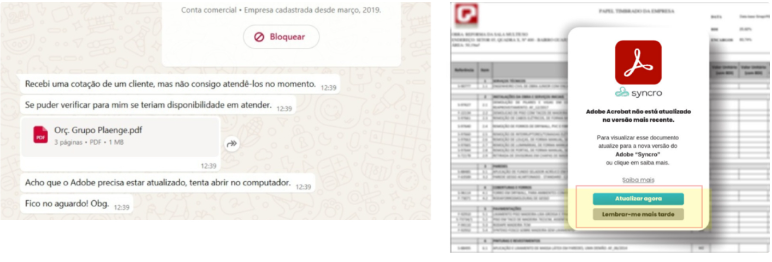
The campaign uses a sophisticated, multi-stage infection chain: attackers send malicious PDF or HTA attachments via WhatsApp appearing to come from trusted contacts. If opened, these trigger download of further payloads (an MSI installer + a Python script) that install a banking trojan and then propagate automatically to the victim's contacts via WhatsApp Web.
This worm-like propagation mechanism allows the malware to spread rapidly through WhatsApp contact lists, creating a large-scale compromise of Windows PCs belonging to WhatsApp-using Brazilians.
Technical Specifications
| Attribute | Details |
|---|---|
| Threat Actor | Water Saci |
| Target Region | Brazil (Portuguese-language systems) |
| Target Platform | Windows PCs with WhatsApp Desktop/Web |
| Delivery Method | WhatsApp messages with malicious PDF or HTA attachments |
| Malware Type | Banking Trojan with worm capabilities |
| Propagation | Automated via WhatsApp Web (Python script with Selenium) |
| Target Sectors | Banking, cryptocurrency, payment platforms |
Technical Details
Initial Payload
- PDF: Lure to "update Adobe Reader"
- HTA: Runs VBScript
Infection Chain
- VBScript triggers PowerShell to fetch next-stage payloads:
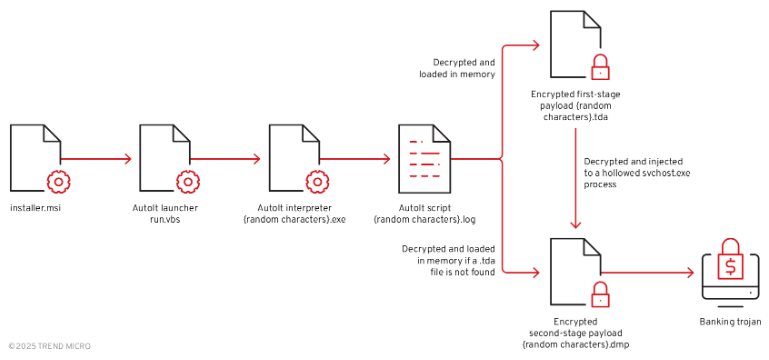
- An MSI installer (with AutoIt script)
- A Python script for propagation
AutoIt Installer Behavior
- Verifies one instance (checks for marker file
executed.dat) - Optionally contacts attacker-controlled server
- Checks OS language is Portuguese (Brazil) before proceeding
- Scans for banking-app related folders
Trojan Capabilities
Monitoring & Targeting
- Monitors active windows/browser tabs
- Looking for banking or crypto-related sites (hard-coded lists including major Brazilian banks and crypto/payment platforms)
- On match, decrypts and injects payload via:
- Process hollowing into
svchost.exe - Direct injection, depending on presence of loader file (TDA) or DMP
- Process hollowing into
Core Functions
- Send system info
- Keylogging
- Screen capture
- Mouse/keyboard simulation
- File operations
- Create fake banking overlays to harvest credentials
- Forcibly terminate browsers to force victims to reopen under attacker-controlled conditions
Persistence & Stealth
- Anti-virtualization checks
- WMI queries for host data
- Registry modifications for persistence
- Fallback C2 via IMAP
- Checks for security software and avoids execution if environment not suitable
Propagation Mechanism
- Python-based script uses browser automation (Selenium / WhatsApp Web)
- Sends malicious attachments/links to all contacts
- Making infection worm-like and scalable
Attack Scenario
-
Initial Contact: User receives a message on WhatsApp from a contact (likely already compromised), containing a malicious PDF or HTA.
-
User Interaction: User opens the attachment (perhaps thinking it's a legitimate document/update).
-
Execution Chain:
- HTA executes VBScript
- Launches PowerShell
- Downloads MSI installer + Python propagation script
-
Installation: AutoIt installs the banking trojan, performs checks:
- Language verification
- Prior infection check
- Environment validation
- If passing, drops & loads the trojan (via process injection or direct memory)
-
Trojan Activation:
- Trojan stays persistent
- Monitors for banking app/browser use
-
Worm Propagation: Simultaneously the Python worm script:
- Hijacks WhatsApp Web sessions (if logged in)
- Sends malicious messages/files to all contacts
- Spreading to new victims
-
Chain Reaction: Once new victims open the file, the chain repeats.
Impact Assessment
- Potential large-scale compromise of Windows PCs belonging to WhatsApp-using Brazilians
- Worm-like propagation — one infection can lead to many more via victims' contact lists
- Enabling a fast, broad spread
- Theft of banking credentials
- Crypto wallet credentials/payment credentials
- Risk to banking sector trust
- Increase in fraudulent transactions
- Account takeovers
- Money theft
- Remote-control of infected machines
- Attackers can:
- Capture keystrokes
- Capture screen
- Exfiltrate files
- Manipulate browser behavior
- Execute transactions
- Difficulty of detection and removal due to:
- Stealth techniques
- Anti-analysis mechanisms
- In-memory loading
- Persistence mechanisms
Mitigations
👤 User Awareness
- Avoid opening unsolicited attachments even if they appear to come from trusted contacts on WhatsApp (especially PDFs, ZIPs, HTA)
- Do not use WhatsApp Web / desktop when logged in on a PC that might be risky
- At least avoid downloading/executing attachments from it
🛡️ Endpoint Security
- Use robust endpoint security with behavioral detection (not just signature-based)
- Able to catch:
- Script-based execution
- Process injection
- Unusual child processes (
mshta.exe→ PowerShell/Python → unusual executables)
🔄 System Hardening
- Keep OS and applications up-to-date
- Disable or restrict execution of HTA/AutoIt/PowerShell from untrusted sources
- Restrict use of scripting or automation tools if not needed
📚 Security Awareness
- Educate users about phishing/social engineering risks, especially via messaging platforms
- Promote security awareness before opening files
🏦 For Financial Institutions
- Monitor unusual login patterns
- Prompt for two-factor authentication
- Detect anomalous transactions
- Encourage customers to use trusted devices
📱 For WhatsApp/Meta
- Restrict or block the propagation of executable or archive attachments via WhatsApp Web
- Warn users about risks
Resources & References
Research & Analysis
Target Region
This campaign specifically targets Portuguese-language Windows systems in Brazil. The malware checks for Portuguese (Brazil) OS language before proceeding with infection.