UDPGangster Campaigns Target Multiple Countries
Windows Backdoor
UDP-Based C2
MuddyWater Campaign
Overview
UDPGangster is a Windows backdoor that communicates with attacker C2 servers over UDP — unusual, since many backdoors use TCP/HTTP(S). The campaign uses spear-phishing emails that deliver a malicious Word document (or ZIP containing it). Once the victim enables macros, a VBA macro drops and executes a payload, which installs the backdoor.
This campaign has been attributed to MuddyWater (Iran-aligned APT) and targets multiple countries including Turkey, Israel, and Azerbaijan.
Technical Specifications
| Attribute | Details |
|---|---|
| Threat Actor | MuddyWater (Iran-aligned APT) |
| Target Countries | Turkey, Israel, Azerbaijan |
| Malware Name | UDPGangster |
| Platform | Windows |
| C2 Protocol | UDP (port 1269) |
| C2 IP Observed | 157.20.182.75 |
| Initial Access | Spear-phishing with malicious Word documents |
| Delivery Method | Macro-enabled Word documents or ZIP files |
| Persistence Location | %AppData%\RoamingLow\SystemProc.exe |
| Mutex Name | xhxhxhxhxhxpp |
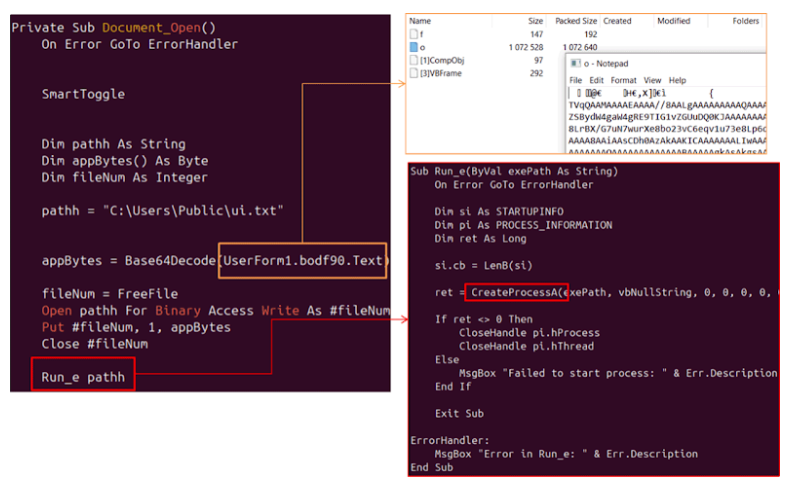
VBA executing the encoded payload
Technical Details
Initial Infection Vector
Malicious Document
- The malicious document uses a VBA macro triggered via the
Document_Open()event - The macro decodes a Base64-encoded payload (stored in a hidden form field)
- Writes it to a file, e.g.,
C:\Users\Public\ui.txt - Then uses the Windows API (
CreateProcessA) to execute it — launching UDPGangster
Persistence Mechanism
After execution, UDPGangster:
- Copies itself to
%AppData%\RoamingLow\SystemProc.exe - Creates a registry startup entry under
HKCU\SOFTWARE\Microsoft\Windows\CurrentVersion\Explorer\User Shell - Creates a mutex (named
xhxhxhxhxhxpp) to prevent multiple instances
Anti-Analysis / Sandbox/VM Detection
UDPGangster performs extensive checks:
Environment Checks
- Checks for debugger presence
- Checks if CPU cores < 2
- Checks if RAM < 2048 MB
- Checks if running under workgroup vs domain
Virtualization Detection
- Checks network adapter MAC prefixes for known virtualized NIC vendors:
- VMware
- VirtualBox
- Xen
- Others
- Scans WMI, registry, running processes/services for VM/sandbox artifacts
Sandbox Detection
- Inspects for known sandboxing/debugging DLLs:
sbiedll.dlldbghelp.dlldir_watch.dll- Others
If it detects such an environment, it aborts payload — to avoid sandbox or analysis detection.
Command & Control (C2)
- The backdoor contacts a C2 server (IP seen: 157.20.182.75) over UDP port 1269
- Unusual use of UDP instead of typical TCP/HTTP(S)
Supported Commands
- Heartbeat (keep-alive)
- Remote command execution via
cmd.exe - File extraction/exfiltration
- Dropping and executing additional payloads
- Updating the C2 address
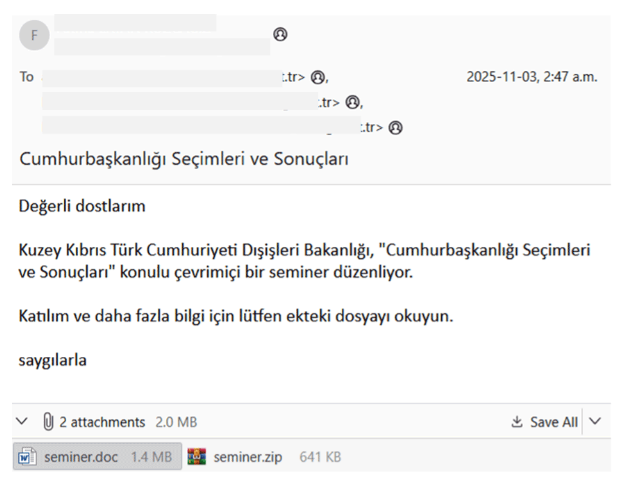
Phishing mail
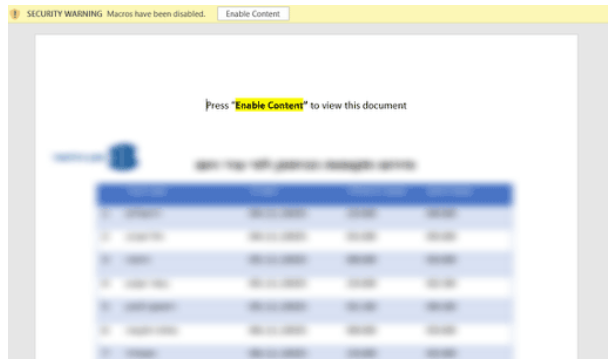
Document with VBA script
Attack Scenario
-
Spear-Phishing Email: The attacker sends a spear-phishing email impersonating a legitimate government entity (in the documented case: the Turkish Republic of Northern Cyprus Ministry of Foreign Affairs), inviting the target to a fake "online seminar." The email includes a malicious Word document (or ZIP) asking to "Enable Content" (macros).
-
Macro Execution: If the user enables macros, the embedded VBA script runs:
- Decodes the hidden payload and writes to disk
- Executes it — installing UDPGangster silently
- The document may show a benign-looking decoy image (e.g., about service outages) to distract the user while the malware executes
-
Anti-Analysis & Installation: UDPGangster carries out its anti-analysis checks to evade sandbox detection:
- If environment passes, proceeds to collect system info
- Opens a UDP-based C2 connection for remote control, exfiltration, and possibly further payloads or lateral movement
Impact Assessment
- Full remote control of infected Windows systems by attackers
- Ability to execute arbitrary commands via
cmd.exe - Deploy additional payloads
- Ability to exfiltrate files and sensitive data
- Access to system information
- Potential for long-term data collection
- Potential for long-term stealthy presence on networks
- Persistence mechanisms ensure survival across reboots
- UDP C2 that evades many detection tools (since most focus on TCP/HTTP traffic)
- Because of the use of social engineering (phishing) and custom malware
- This represents a serious espionage risk to organizations
- Especially government, critical infrastructure, or those with sensitive data
- Targeted countries: Turkey, Israel, Azerbaijan
Mitigations
👥 User Awareness & Training
- Be extremely cautious about unsolicited emails, especially those with attachments requesting to "Enable Content" (macros)
- Treat macro-enabled documents with suspicion unless expected
- Verify sender authenticity through alternative channels
📧 Email Filtering & Gateway Protections
- Use phishing protection, sandboxing, and macro-blocking on email gateways
- Stop malicious macro-laden documents before they reach users
🛡️ Endpoint Protection & Content Disarm/Reconstruction
- Solutions that strip or disable macros or sandbox suspicious documents can stop the initial malware dropper
- Use content-disarm/reconstruction services
🌐 Network Monitoring & Anomaly Detection
- Pay attention to unusual outbound UDP traffic (especially to unknown external IPs or on unusual ports, e.g., port 1269)
- Since using UDP for C2 is atypical and may bypass traditional monitoring
🔄 Keep AV/EDR Signatures Updated
- The report indicates that Fortinet's AV detects UDPGangster with signatures such as:
VBA/Agent.NFYP!trW64/Agent.ALD!tr
- Ensure all security tools are up-to-date
🏗️ Harden Security Posture
Use layered defenses:
- Email gateways
- Endpoint security
- Network-based content disarm + sandboxing
- Strong egress filtering
- Least-privilege principle
- Multi-factor authentication (MFA)
- Network segmentation
(Even though MFA or segmentation won't by itself block a macro-based infection, they help limit lateral movement or impact)
🔍 Detection & Response
- Monitor for:
- Unexpected UDP traffic on port 1269
- Registry modifications in User Shell Folders
- Files appearing in
%AppData%\RoamingLow\ - Mutex creation:
xhxhxhxhxhxpp - VBA macro execution
- Suspicious
cmd.exespawning
Resources & References
Research & Analysis
- UDPGangster Campaigns Target Multiple Countries | FortiGuard Labs
- MuddyWater Deploys UDPGangster Backdoor in Targeted Turkey-Israel-Azerbaijan Campaign
- Iran-Linked MuddyWater Deploys UDPGangster Backdoor, Using UDP Protocol for Covert C2
- MuddyWater Hackers Use UDPGangster Backdoor to Bypass Network Defenses on Windows
- MuddyWater Hackers Using UDPGangster Backdoor to Attack Windows Systems Evading Network Defenses
- Windows Systems Under Attack as MuddyWater Hackers Use UDPGangster Backdoor to Bypass Defenses
Attribution
This campaign has been attributed to MuddyWater, an Iran-aligned APT group. The use of government impersonation and targeted countries suggests state-sponsored espionage objectives.