Realtek Jungle SDK Exploitation - Cling IoT Botnet
Realtek Jungle SDK CVE-2021-35394 Cling Botnet IoT Exploitation STUN-based C2
Overview
Threat actors are actively exploiting CVE-2021-35394 in the Realtek Jungle SDK to compromise internet-exposed IoT devices.
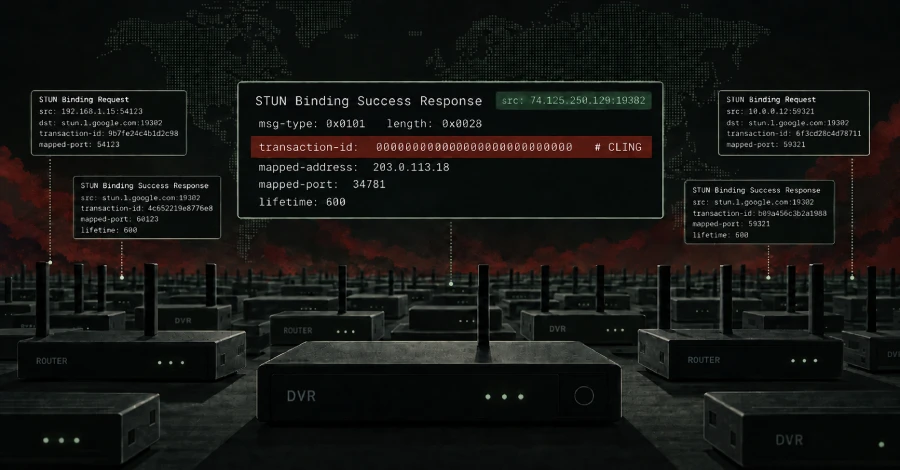
A subset of observed activity deploys the Cling botnet, which establishes persistence, propagates to additional vulnerable devices, and communicates with operators using a STUN-based command-and-control mechanism.
By leveraging STUN-like traffic, malicious C2 activity can blend with legitimate NAT-traversal communications and complicate conventional detection.
Technical Details
CVE-2021-35394 is an unauthenticated remote code execution vulnerability affecting the Realtek Jungle SDK diagnostic component commonly compiled as UDPServer.
Observed exploitation characteristics:
- Exploit traffic uses specially crafted UDP packets beginning with
orf;. - Attackers execute shell commands remotely.
- BusyBox
wgetis used to download and execute Cling payloads.
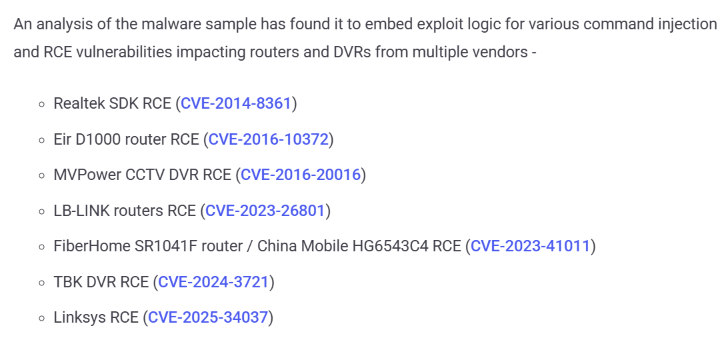
Cling includes exploit logic for multiple additional router/DVR vulnerabilities, including:
- CVE-2014-8361
- CVE-2016-10372
- CVE-2016-20016
- CVE-2023-26801
- CVE-2023-41011
- CVE-2024-3721
- CVE-2025-34037
Persistence and tampering behavior includes:
/root/.cling/usr/local/bin/.cling/etc/inittab/etc/init.d/rcS/etc/rc.d/rc.boot
Cling can also replace legitimate wget with a malicious version so that later wget execution retriggers malware behavior.
C2 behavior:
- Bot contacts a hard-coded list of approximately 13 STUN servers roughly every 5 seconds.
- Malware records externally mapped NAT ports and sends custom registration data.
- Operator command data is encoded in the STUN transaction ID field.
Technical Specifications
| Attribute | Details |
|---|---|
| Primary CVE | CVE-2021-35394 |
| Affected Component | Realtek Jungle SDK diagnostic service (UDPServer) |
| Exploit Trigger Pattern | Crafted UDP packets prefixed with orf; |
| Payload Family | Cling IoT botnet malware |
| Persistence Methods | Hidden files plus init-script/inittab modification and tool replacement |
| C2 Profile | STUN-like beaconing and command transport via transaction-ID encoding |
Affected Products
- Internet-exposed IoT devices that embed vulnerable Realtek Jungle SDK implementations.
- Router, DVR, and embedded edge devices with reachable vulnerable UDP diagnostic services.
- Environments where unsupported or end-of-life embedded devices remain in production.
Attack Scenario
- Attacker scans the internet for vulnerable Realtek-based devices.
- Attacker exploits CVE-2021-35394 over exposed UDP services.
- Remote shell commands are executed.
- BusyBox
wgetdownloads Cling malware. - Cling runs and establishes persistence on the device.
- Compromised host contacts STUN infrastructure.
- Bot registers NAT-mapped ports and state information.
- Operator commands are delivered through STUN-like traffic patterns.
- Cling scans for additional vulnerable routers and DVRs.
- Newly compromised nodes can be used for DDoS, proxying, and TCP tunneling operations.
Impact Assessment
- Unauthorized remote control of vulnerable IoT devices
- Persistent compromise across reboots
- Expansion into large-scale IoT botnet infrastructure
- Worm-like propagation to additional vulnerable endpoints
- Potential DDoS abuse, proxy service abuse, and covert tunneling activity
- Possible use of compromised edge devices as footholds for follow-on intrusion
- STUN-based C2 can resemble legitimate NAT-traversal traffic and reduce visibility in traditional detections
Mitigation Strategies
- Patch devices affected by CVE-2021-35394.
- Upgrade or replace unsupported/end-of-life Realtek-based devices.
- Remove unnecessary internet exposure of routers, DVRs, and embedded appliances.
- Restrict access to vulnerable UDP services with firewall and ACL controls.
- Segment IoT networks from corporate and OT environments.
- Monitor unexpected STUN traffic originating from embedded devices.
- Detect repeated STUN Binding Requests, especially with abnormal or all-zero transaction IDs.
- Investigate non-standard UDP traffic to public STUN infrastructure.
- Hunt for
.clingartifacts, modified init scripts, and suspiciouswgetreplacements includingwget.randwget.partifacts. - Monitor IoT assets for unexpected scanning, proxying, tunneling, and outbound command traffic.
- Add Cling IOCs and behavior-based detections to SIEM, NDR, and IDS workflows.
Resources and References
Public Reporting
Last Updated: October 6, 2026